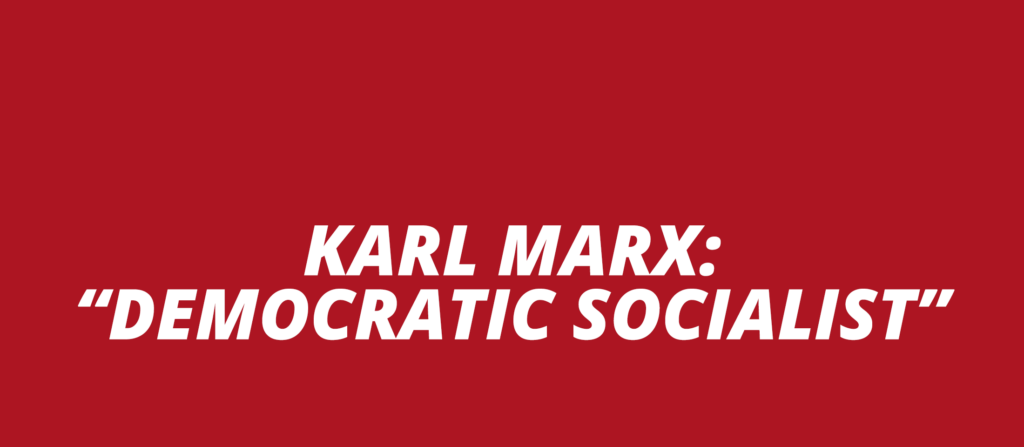


"Champion of human freedom
and democratic socialist,
Karl Marx"
— Michael Harrington, founder of the
Democratic Socialists of America
When democratic socialists say
Karl Marx is one of their own,
they demonstrate that
democratic socialism
is really plain old socialism.
Karl Marx is socialism's most revered figure. He's socialist superstar number one.
Marx's goals and beliefs have defined socialism for the past 150 years. His thinking is tightly linked with authoritarian socialism of the kind found in the Union of Soviet Socialist Republics (USSR).
Here's something else about Karl Marx—something you may not have known:
He's a democratic socialist.
Says who? Says Michael Harrington, the founder of the present-day Democratic Socialists of America (DSA). Harrington knew well what it means to be a democratic socialist and what beliefs would get you booted from the club.
Harrington proclaimed Marx a democratic socialist multiple times. He even dedicated his book The Twilight of Capitalism not to a family member or friend but to
champion of human freedom and democratic socialist, Karl Marx.[1]
Harrington likewise bestowed the democratic socialist seal of approval on Friedrich Engels, Marx's colleague and socialist superstar number two.[2]
There are three important lessons to be learned from Marx and Engel's status as democratic socialists:
First, the fact that these two most important of all socialist thinkers are considered democratic socialists makes it clear that democratic socialism is not a new version of socialism. It shows that democratic socialism is, for all intents and purposes, the same version socialists have sold for generations. It's Marxism.
Second, Marx and Engels being counted as democratic socialists makes it easy to demonstrate that democratic socialism is based on the rejection of the most fundamental rights of liberal society.
Third, these two being considered democratic socialists illustrates that one can be a democratic socialist despite calling for outright authoritarianism. One is welcome to be a democratic socialist even while seeking to create a society intent on eradicating alleged "social parasites," a society that would eliminate our right to individually control our work lives, and a society that would abolish our right to have our own small businesses.
The second and third implications reinforce the first—the reality that "democratic socialism" is not a new version of socialism; it's marketing spin.
Why is democratic socialism based on the rejection of key liberal rights, just like plain old socialism is? Why are democratic socialists permitted to advocate such authoritarian goals as the suppression of alleged "parasites," just like plain old socialists?
Because democratic socialism is plain old socialism.
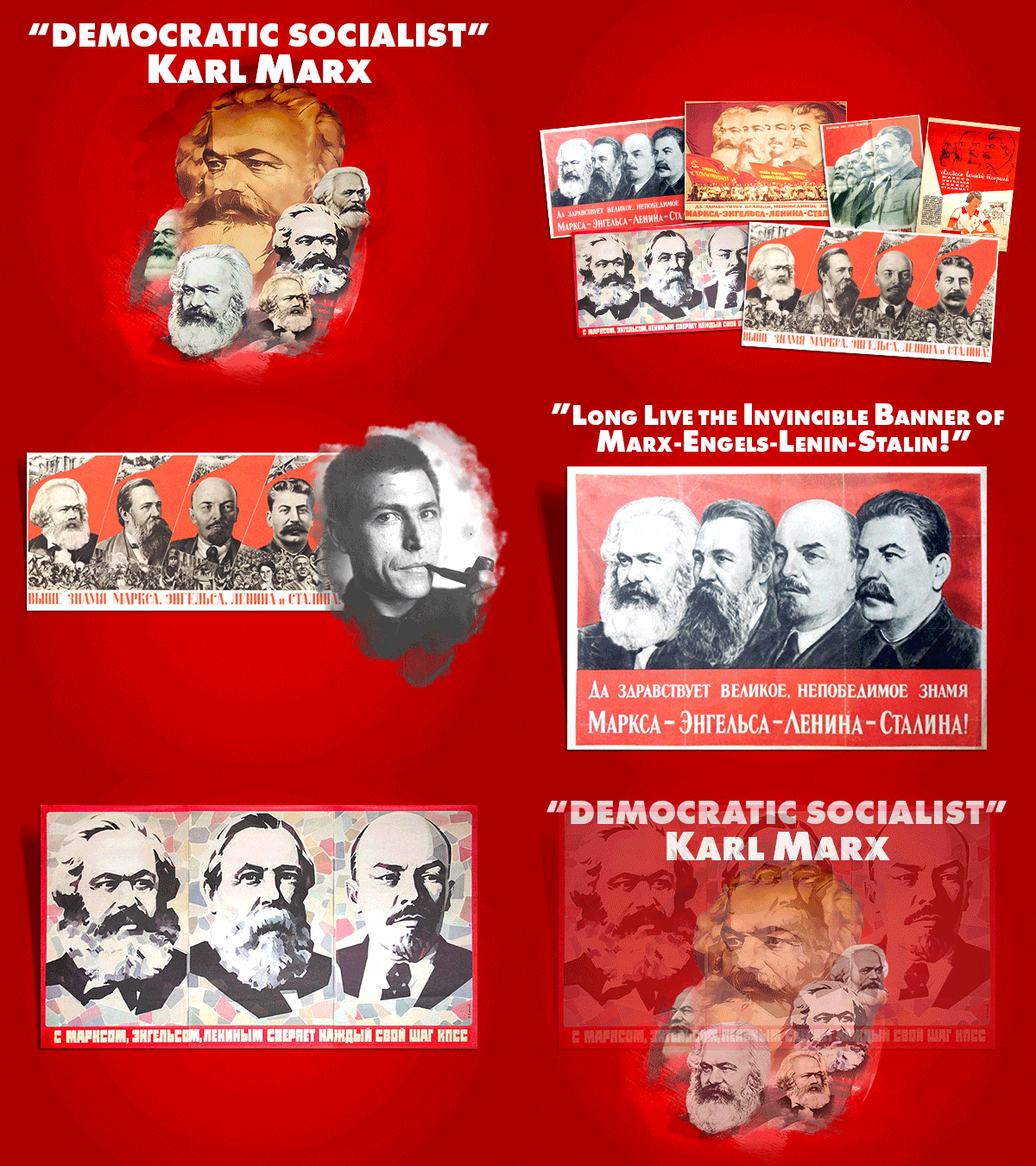
"Marx and Engels Turn to
… Democratic Socialism"
Before exploring the implications of Marx and Engels being considered democratic socialists, let's take a closer look at what DSA founder Harrington has to say.
We've already seen that Harrington dedicated his The Twilight of Capitalism to "democratic socialist, Karl Marx." He names Marx a democratic socialist on at least two other occasions.
In Socialism: Past and Future, Harrington argues that eventually
Marx and Engels turn to what can only be described as democratic socialism.[3]
And in his succinctly titled Socialism, Harrington describes
the emergence of Marx the social democrat.[4]
Was there any requirement for Harrington to call Marx a democratic socialist? Absolutely not. Had he believed Marx's thinking was at odds with democratic socialist ideals, Harrington would never have called Marx a democratic socialist once, much less repeatedly.
Moreover, Harrington had every opportunity to demonstrate nuance. He didn't have to give Marx carte blanche as a democratic socialist.
Had he considered any of Marx's specific goals and beliefs to be inconsistent with those of democratic socialism, Harrington could have said so.
For example, Harrington could have listed a number of exceptions along the lines of: "Except for his desire to eliminate your right to own a small business, Marx was one heck of a democratic socialist."
But Harrington does not write about such an exception. Nor does he list any of Marx and Engels's other anti-liberal goals or beliefs as exclusions when knighting them democratic socialists.
Instead of distancing democratic socialism from Marx and Engels, Harrington hugs them close.
What Makes Marx and Engels Democratic Socialists?
What in particular makes Marx and Engels democratic socialists? We can tell from Harrington's words that he believes something about their thinking changes over time. He describes
the emergence of Marx the social democrat.[5]
Harrington also says
Marx and Engels turn to what can only be described as democratic socialism.[6]
To emerge implies there is something one is emerging from. To turn to something means there's something one is turning away from.
What change in the thinking of Marx and Engels permits them to be democratic socialists? Unfortunately, it's not because they begin to advocate the kind of society that an everyday person would call "democratic."
Do they drop their insistence that socialism be founded on compulsory duty to give our time and talents to society—on the duty of "from each according to their ability"? No, they don't.
Do they discontinue their calls for our liberal right to privately control our work lives to be replaced by "directly social labor"—that is our individual work lives under society's direct control? No, they don't.
Do they punt on their belief that socialism requires eliminating every aspect of capitalism, right down to the suppression of all buying and selling? No, they don't.
We could continue listing one disturbing belief of Marx and Engels after another, and we would discover that none of them change.
The only change to their thinking—the one that leads Harrington to grant them democratic socialist status—relates to their beliefs about how a socialist society could be created.
Marx and Engels originally felt revolution was required to produce socialism. But according to Harrington, they eventually decided that socialism could also result from a democratic process.
Harrington argues that Marx and Engels came to believe that the socialist goal
is to be achieved by democratic, parliamentary means, wherever possible.[7]
This change is the reason Harrington counts Marx and Engels as democratic socialists.
It's a positive change, but is it a meaningful one? Achieving socialism by democratic means "wherever possible" leaves plenty of room for violent exceptions.
Yes, "wherever possible" represents a massive loophole in the requirement that socialism be created by "democratic, parliamentary means." But this is ultimately less important than the fact that all of Marx and Engels's other beliefs end up democratic socialist approved with no changes at all.
Marx and Engels are considered democratic socialists despite their many anti-liberal goals and beliefs. And that means one is free to believe what Marx and Engels believed and still be a democratic socialist today.
With this background on how Marx and Engels came to be democratic socialists, let's turn to the implications of this fact.
Democratic Socialism
Is Plain Old Socialism
The first implication of Marx and Engels being counted as democratic socialists? It demonstrates that democratic socialism is really plain old socialism.
Harrington affirms Marx and Engels as democratic socialists because today's socialism remains Marxism. Democratic socialism is still defined by Marx's goals and beliefs, just as yesterday's socialism was. (And, yesterday's socialism was also said to be democratic socialism in its time.[8])
We've seen a small sample of Marx and Engels' influence over earlier socialist societies illustrated by posters from the USSR, including this one from the 1980s:
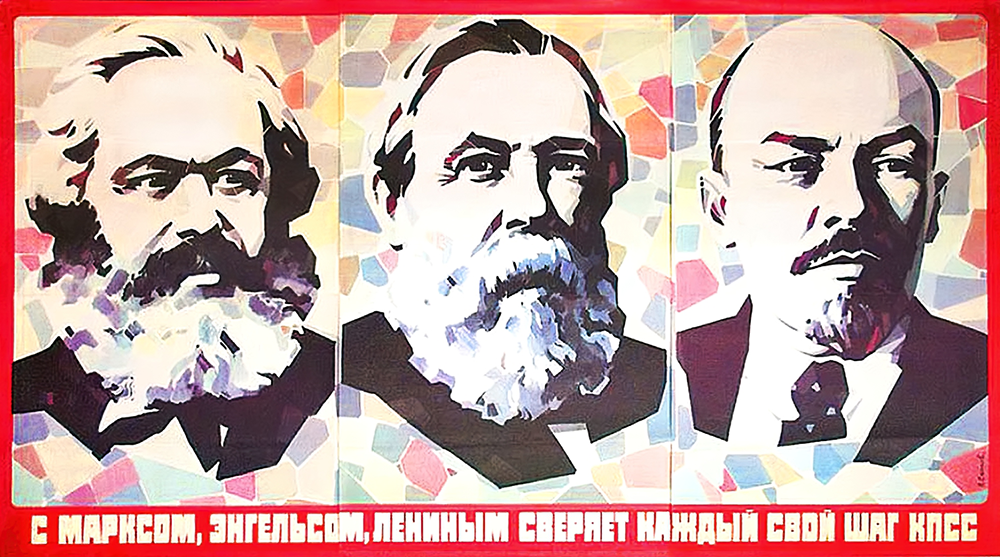
This poster's caption explains how things worked in the Union of Soviet Socialist Republics under the rule of the Communist Party. It reads "The Communist Party is checking its every step with Marx, Engels and Lenin."
What was the government of the USSR doing? Based on what DSA founder Harrington tells us, the Communist Party was striving to be in step with the most important democratic socialists of all time.
If today's democratic socialists had developed a truly new version of socialism, surely Marx and Engels would have been pushed overboard first thing.
Divorcing democratic socialism from these two, whose thinking is so tightly linked with earlier socialist nightmares, would make it clear that today's democratic socialism was actually a new product, not merely a marketing slogan.
But let's say that today's democratic socialists simply couldn't bring themselves to excommunicate Marx and Engels. They still could have explicitly and permanently rejected troubling aspects of the thinking of these two philosophers.
Had their goal been to create a genuinely new and democratic socialism, today's socialists would have formulated a list of anti-liberal aspects of Marx and Engels's philosophy that this improved version of socialism would forever disavow.
Socialists who endorsed this list would have the right to call themselves democratic socialists. Those who didn't could be easily identified as anti-democratic socialists.
But there is no such list.
Why? Because none of Marx's goals or beliefs have been definitively rejected by today's democratic socialism. Many today call themselves democratic socialists (what socialist doesn't?) despite ascribing to every single authoritarian view Marx held.
It's not only what one is permitted to believe while calling oneself a democratic socialist that remains unchanged from yesterday's socialism. The goal of today's socialism remains the same as well.
Today's socialism, just as yesterday's, seeks to create a society based on the principle "from each according to their ability, to each according to their needs."
The specific wording of this socialist saying predates Karl Marx.[9] But what propelled it into first place among socialist axioms is that Marx made it the defining goal of socialism.
He famously (at least among socialists) said the sign that perfected socialism had arrived would be when socialist society could
inscribe on its banners: from each according to his ability, to each according to his needs![10]
This goal Marx established became the goal of yesterday's socialism. For example, Soviet dictator Joseph Stalin tells us:
From each according to his ability, to each according to his needs!—such is the basis upon which the future collectivist system must be created.[11]
And what does DSA founder Michael Harrington say remains clearly the defining goal of today's socialism? He writes:
The goal of socialism, clearly, is to overcome greed and act on the basis of 'to each according to his/her need, from each according to his/her ability.'[12]
Harrington has reversed the clauses, but otherwise, the goal he lists is identical to that of the socialism of the USSR.
Why? Because democratic socialism isn't a different product—it's the same old Marxism.
Democratic Socialists for
Duty Beating Rights
The second implication of Marx and Engels being democratic socialists? One can be a democratic socialist while desiring to do away with liberalism.
Or, more accurately, to be a democratic socialist, one must desire to do away with liberalism.
By definition, a democratic socialist society means the end of critical aspects of liberalism—both liberalism's rejection of compulsory duty to give our abilities to society and its basis on rights protecting minorities, not only from dictators but also from oppression by the majority.
Marx being counted as a democratic socialist demonstrates that democratic socialism is compatible with all of Marx's anti-liberal principles, including these:
Marx considers the concept of human rights "obsolete verbal rubbish."
Democratic socialist Marx outright rejects the idea of human rights. He labels them "so-called rights"[13] and speaks about his "opposition" to the entire concept of rights.[14]
The fact that those who consider individual rights "obsolete verbal rubbish"[15] as Marx does can still be democratic socialists makes it clear the term "democratic" has a very different meaning to socialists than it does to most of us.
Democratic socialism seeks a fundamental change to the basis of society: the switch from a liberal system that rejects compulsory duty to put our time and talents under society's control to a socialist system that requires it. We cannot retain our liberal rights under such a change, because they would interfere with socialism's founding requirement to give our abilities to society.
To learn more about how socialism places duty above rights, see "Our 'So-Called' Rights."
Marx calls for the duty of "from each according to their ability."
Compulsory duty to society means that those running society can make you do things you would otherwise choose not to do. The liberalism that characterizes democracies like the United States rejects compulsory duties of this sort.
Socialists themselves note that a requirement of duty analogous to that socialism demands is "strikingly absent" in both liberal philosophy[16] and the US Constitution.[17]
Some today seem to be under the impression that democratic socialism is a version of socialism that doesn't require compulsory duty to society. This is an entirely mistaken belief.
Democratic socialism seeks to create a society based on the duty of "from each according to their ability."[18] This is the exact standard of duty that socialism has demanded for the past 170 years.
In a democratic socialist society, all citizens would be under this duty—a duty that morphs our individual time and talents into society's property to control.
Marx makes it clear that socialist society would be based on this duty.[19] He's similarly explicit that "ideological nonsense"[20] like rights would not be permitted to interfere with socialist citizens being made to do as society directs.[21]
Marx believes our time should be treated as society's time and that we must "work in order to be able to eat."
Socialism's requirement to give our abilities to society leads socialists to view the time in our lives as the property of society—as society's time. That socialist theory treats the time in our lives as society's time can be demonstrated in many ways, one being the socialist principle that slacking is theft.
As we detail on our sibling website slackingistheft.org, any number of socialist greats have said idleness is a "crime"[22] and that slackers are "thieves."[23] They do so because they see slackers as "stealing" society's time.
Given the socialist duty of "from each according to their ability" and the corollary belief that slacking is theft, another common socialist meme is that "one must work in order to eat." Marx uses this maxim in connection with his call for mandatory child factory labor as part of education in socialist society.
Yes, democratic socialist Marx wanted child labor to be a standard element of socialist education.[24] What does Marx say is one benefit of his plan to make kids work in factories starting at age nine?[25] They would learn the lesson that it's necessary "to work in order to be able to eat."[26]
Learn more about Marx's plan for child factory labor as "education" in our paper "Karl Marx's 'Education of the Future.'"
Michael Harrington tells us Marx should not only be considered a democratic socialist but also a "champion of human freedom."
Marx wanted a society based on compulsory duty, a society that makes factory labor part of every child's schooling, and one in which rights are treated as "rubbish." Yet he should be considered a champion of human freedom?
As an understanding of Karl Marx's principles makes clear, democratic socialism is not left-wing liberalism; it's left-wing anti-liberalism.
Democratic socialism rejects our liberal society's lack of compulsory duty. And it belittles the rights liberalism extends us—rights that protect us from coercion by those claiming to act in the name of society.
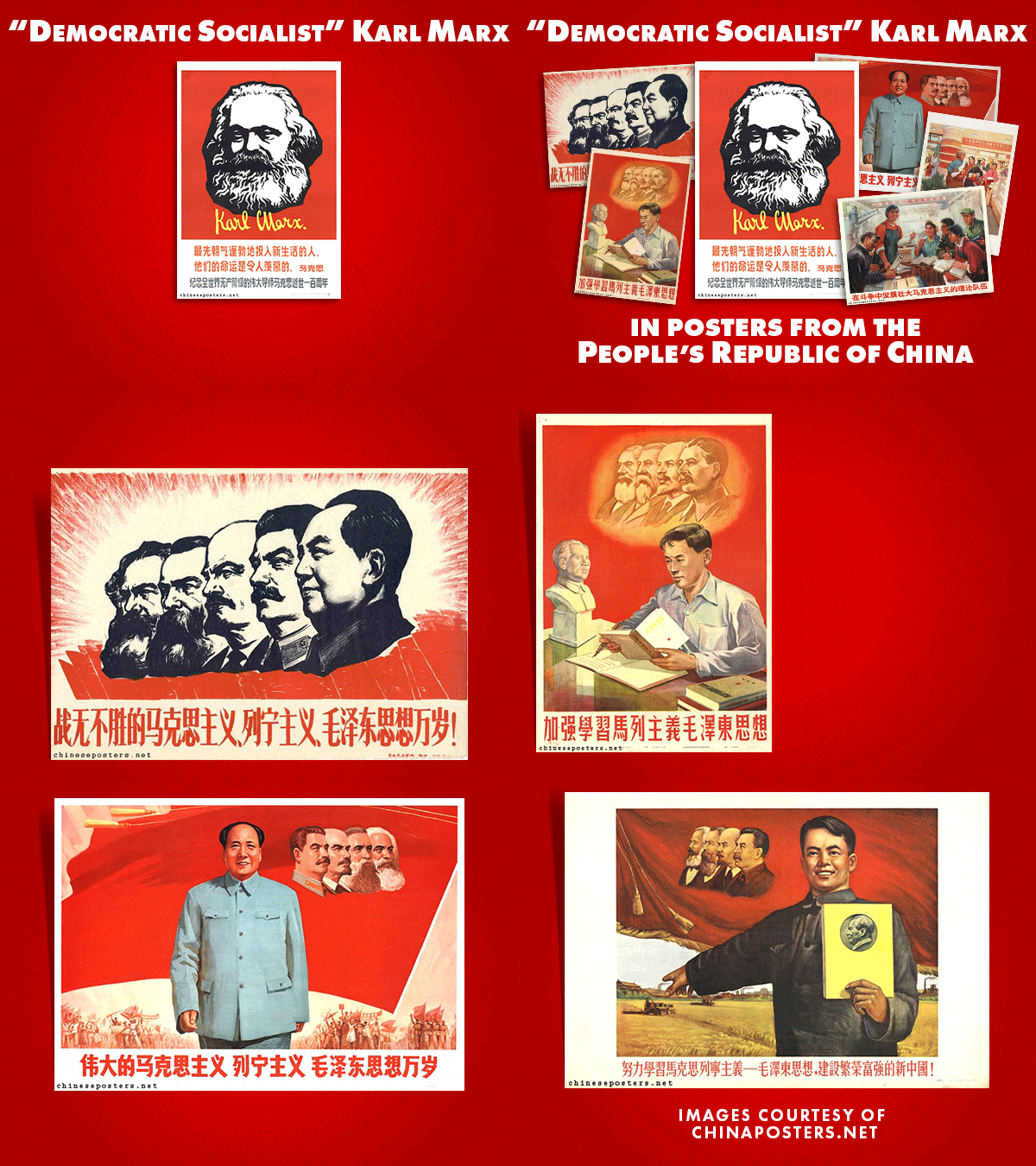
Democratic Socialists
for Authoritarianism
A final important implication of Marx and Engels being democratic socialists? Marx and Engels are held to be democratic socialists despite their calls for a society based on numerous authoritarian policies.
This means that those who today seek the same authoritarian ends are also welcome to call themselves democratic socialists. And unsurprisingly, they do.
Marx calls for the elimination
of our "private labor" rights
In our liberal society, we each have ultimate control over what we do workwise. Marx termed this individual control of our work "private labor"[27]—"private" meaning under our personal management as in "private property."
Marx calls for socialist society to eliminate the private labor of capitalism and replace it with what he says is "its opposite, directly social labour."[28] Directly social labor is Marx's term for your work under society's management instead of under your individual, private control.
The socialist plan to abolish our private labor rights is another byproduct of socialism's foundation on compulsory duty to society. It's another demonstration that socialism treats our time as society's time—as society's property to control.
One is welcome to be a democratic socialist while calling for the suppression of our private labor rights. This reality is further illustrated by the thinking of present-day socialists such as Michael Lebowitz.
Lebowitz considers socialism and democracy synonymous. Yet he says our private labor rights are a "defect" of liberal society, an "infection" socialism must cure.[29]
Learn more in our paper "A 'Defect' of Liberalism."
Marx desires the suppression of "parasites"
Another ripple effect of socialism's foundation on the duty of "from each according to their ability" is its obsession with "parasites." Socialist thinkers have used this word so often that it's become a term of art in socialist philosophy.
A "parasite" is someone whom socialists judge to be failing to properly perform socialism's requirement of duty. Socialist great Beatrice Webb even describes this duty as "a duty not to be a parasite."[30]
Hundreds of socialist thinkers, Marx and Engels included, attack alleged "parasites" and say that forcing parasites to work on tasks socialists approve of is the critical path to creating a socialist society.
One group that socialists call parasites are slackers—individuals who don't give their full abilities to society as socialist duty requires. Socialists also label as parasites the millions of us whose work they consider "socially useless," work they deem, as Engels puts it, "at best superfluous."[31]
Marx, Engels, and innumerable other socialists call for socialist society to make these allegedly "useless" and thus "parasitic" jobs illegal.[32]Those who hold these jobs would be made to work on other tasks—tasks those running socialist society approve as a valid use of what socialists see as society's time.
One can be a democratic socialist despite believing society should have the power to judge people as parasites and to make any number of supposedly "useless" jobs illegal.
Learn more in our paper "The Socialist Obsession: 'Parasites.'"
Marx calls for the suppression of our right to run our own show.
Marx's socialist vision calls for the elimination of the right to own a business.[33] Even sole proprietorships in which one works individually—say as a craftsperson—would be illegal under Marx's socialism.[34] Many people don't think of these individual operations as businesses, but they are to Marx.
One is welcome to be a democratic socialist despite desiring the suppression of businesses, both large and small—especially small, as we'll now see.
Marx desires the elimination of craft workshops, other small enterprises, and small farms.
Marx and Engels are considered democratic socialists despite their disdain for and desire to suppress craftwork and small enterprises generally.
As socialists admit, "Marx completely rejects the craft ideal."[35] His view is that to work as a craftsperson makes one a pinhead.[36]
Engels similarly has no use for small operations of any sort. He says the method by which socialism would achieve its "greatest savings of labor power" is by "fusing" small operations together to make large ones.[37]
Socialist theory says that small-scale production breeds capitalism.[38] So, it isn't surprising that socialists look forward to doing away with small operations.
But Marx and Engels aren't just against small production; they strongly favor the largest-scale production possible. For example, they call for "industrial armies" to be used not only in manufacturing but "especially for agriculture."[39]
These two democratic socialists believe large industry is essential for socialism. They feel this way not just because large industry means increased production, but also because it's Marx view that when one works in a large factory or on a collectivized farm, one "strips off the fetters of one's individuality" and is molded into the type of person who will make a good socialist.[40]
Marx and Engel's advocacy of large-scale agricultural production led to the forced collectivization of farming in the USSR, the People's Republic of China, and elsewhere.
The result? The starvation deaths of millions due to the wonders of socialist planning.[41]
Learn more about socialism's disdain for craft and other small enterprises in our paper "Why Socialism Says Craftwork Is 'Idiocy."
Marx calls for the suppression of every aspect of our capitalist society—even buying and selling.
Marx never wavered in his belief that achieving socialism means eliminating all aspects of capitalism and the capitalist market economy. Neither did Engels.
Their socialism not only requires the suppression of all businesses, but also the complete elimination of buying, selling, and money.[42]
Marx and Engels are democratic socialists despite these plans. And today's democratic socialists are also welcome to ascribe to these authoritarian yet mainline socialist goals—mainline because they are the goals of Karl Marx.
If anyone suggests that the goal of democratic socialism is merely to modify capitalism and not to replace it with a radically different society, they've been misled or are looking to mislead you.
That's also true of anyone who claims that the goal of democratic socialism is only to make the US system of social benefits similar to that found in Scandinavian countries. Knowledgeable socialists are well aware that democratic socialist Karl Marx would roar with laughter at the notion that today's Scandinavian nations represent socialist societies.
If the desire to suppress our private labor rights, suppress alleged parasites, suppress small businesses, and so on sounds like something right out of the playbook of bad old socialism, that's because it is.
These are the very same authoritarian principles on which the socialist experiments of the past were founded. But now we discover that they're democratic-socialist approved.
The bottom line is that you're welcome to call yourself a democratic socialist while pursuing any authoritarian plan whatsoever. You just need to tell yourself that you hope to achieve these goals by "democratic, parliamentary means, wherever possible."[43]
Today's democratic socialists certainly don't wish for the mass murder that repeatedly resulted from earlier socialist experiments. But this wasn't the desire or expectation of Marx and Engels either.
They were somehow oblivious to the same issue that today's socialists incredulously remain blind to: the danger that a system based on compulsory duty and the suppression of rights will end up not simply authoritarian but full-blown totalitarian.
"Democratic Socialism" — A Marketing Slogan
Karl Marx is a democratic socialist. Friedrich Engels is too. These two most important socialist thinkers are said to be democratic socialists despite their many anti-liberal goals and beliefs.
Why are Marx and Engels democratic socialists? Because democratic socialism is plain old socialism, not some new version.
Today's socialism—just like yesterday's socialism—is defined by the thinking of Karl Marx. And yesterday's socialism—just like today's—was sold as democratic. The reality is that, for over a century, socialists have maintained that socialism is, by definition, democratic—that socialism is democracy.[44]
But as the results of earlier socialist experiments that were said to be democratic make clear, hoping socialism will turn out democratic doesn't make it so.
Even having the best of intentions doesn't make those intentions come true. And this is assuredly the case when you support a philosophy based on the dangerous duty of "from each according to their ability."
Here on planet Earth, the duty to give our time and talents to society will forever really mean the duty to give our time and talents to those running society. Socialist duty gives those running society incredible power over our individual lives.
This is the very reason that liberal philosophy rejects such a duty, no matter whether this duty is to a king or queen, to fascists calling themselves "the community," or to socialists calling themselves "society."
Socialism's foundation on the duty of "from each according to their ability" is the irreparable design defect that makes every experiment with democratic socialism an authoritarian accident waiting to happen.
It's an irreparable defect because socialism is not only based on the belief that mandatory duty is morally correct, but also requires this duty in order to function.
If we're left free to do as we wish, as opposed to being under a duty to do what "society" demands, socialism is impossible.[45]
If anyone tells you democratic socialism is something new, please ask them to explain how that's possible when Karl Marx is considered a democratic socialist.
Ask them to explain how democratic socialism can be a new type of socialism when today's democratic socialists are free to ascribe to every bit of Marx's anti-liberal thinking—the same thinking that's defined every prior socialist human rights disaster.
"Democratic" socialism: it's a marketing slogan, not a new version of socialism.
Thank you for reading "Karl Marx, 'Democratic Socialist.'"
Below is a poster from the USSR featuring "democratic" socialists Marx and Engels. This poster was designed by noted artist Gustav Klutsis, who later became a victim of the socialist system he helped create.
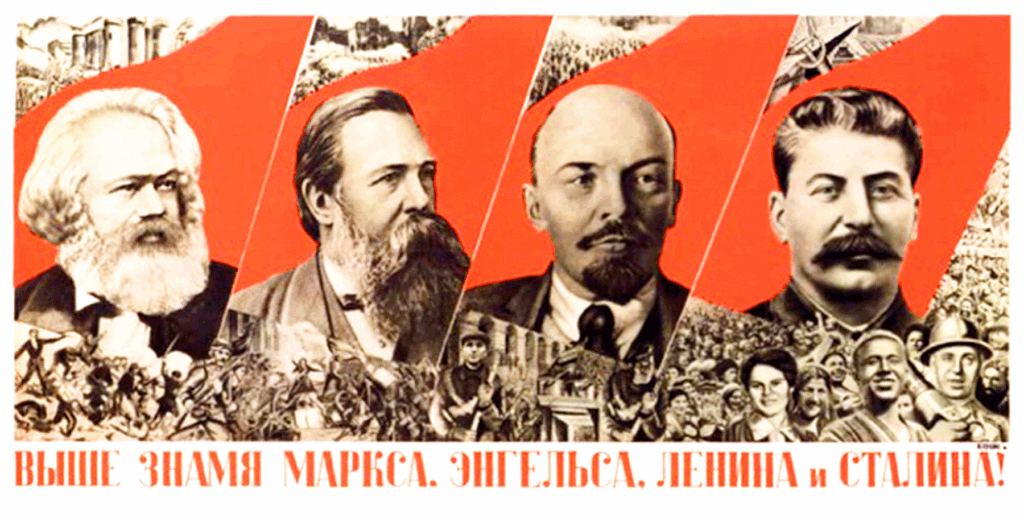
"Raise High the Banner of Marx, Engels, Lenin and Stalin!"
Klutsis was executed at the "Butovo Training Ground," one of the many sites the Soviet government used for executions and mass burials. On the day Klutsis was put to death, over five hundred others were also shot or gassed to death at this single location.[46]
At Butovo and other death camps in the USSR, the Soviets used methods that would later be employed by the Nazis. For example, at Butovo, poison gas was used to kill entire truckloads of supposed "parasites" and "enemies of the people" at one time.[47]
Poster image courtesy of Anita Pisch, The Personality Cult of Stalin in Soviet Posters,1929-1953 (Acton: ANU Press, 2016). Used with permission.