
"We, as Socialists,
have nothing to do with liberty.
Our message … is one of discipline,
of service, of ruthless refusal
to acknowledge any natural right."
—Bernard Shaw
One byproduct of socialism's
foundation on compulsory duty is that
our rights are seen as "rubbish"
and opposed because
they permit us to "resist."
CONTENTS
- INTRODUCTION
- "NOTHING TO DO WITH LIBERTY"
- "NONSENSE ABOUT RIGHT"
- SOCIALISM'S PROBLEM WITH RIGHTS?
- "WITHOUT DUTIES NO RIGHTS"
- "WE, FASCISTS, …."
- MARX AND MUSSOLINI MALIGN OUR "SUPPOSED RIGHTS"
- DEMOCRATIC SOCIALISM SAYS DUTY BEATS RIGHTS
INTRODUCTION
So-called rights.[1]
Ideological nonsense.[2]
Obsolete verbal rubbish.[3]
These are three of the ways Karl Marx described individual rights—a taste of what philosophers have described as Marx's
diatribe against human rights.[4]
Karl Marx is, of course, the most important socialist philosopher of all time. His thinking has defined socialism's goals and beliefs for the past 150 years. It still does today.[5]
Marx outright rejects the idea of human rights.
The goal of this paper is simple. It's to show you what knowledgeable socialists already know: that one of the inevitable byproducts of socialism's foundation on compulsory duty is to make duty the "rock" and rights the "scissors." When they come into conflict, duty always wins.
The liberal philosophy that underpins our capitalist society begins with individual rights. It rejects as incredibly dangerous the compulsory duty to give our time and talents to others.
Socialism flips this script. Socialism is a duty-first philosophy. It's founded on the belief that the obligation to give our abilities to society is morally correct. Moreover, this power over our lives is required to create and operate a socialist society.[6]
For over 170 years, the socialist standard of duty has been defined by the famous axiom "from each according to their ability."[7] This remains the democratic socialist standard of duty today.[8]
Celebrated socialist philosopher R. H. Tawney summarizes the socialist perspective on duties versus rights:
Society should be organized primarily for the performance of duties, not for the maintenance of rights, and … the rights which it protects should be those which are necessary to the discharge of social obligations.[9]
What does this democratic socialist[10] (a thinker praised by Michael Harrington, the founder of the Democratic Socialists of America[11]) teach?
First, a socialist society would be focused on making us perform duties, not on protecting our rights.
Second, our rights would be limited to those needed to perform our new duties.
That socialism ranks duty above rights is but the first of the many ripple effects of socialism's foundation on the duty of "from each according to their ability."

Learn more in our paper
"The Ripple Effects of Socialist Duty."
"We, as Socialists, Have
Nothing to Do with Liberty"
Socialists admit that the type of duty socialism demands is "strikingly absent" from the liberal philosophy that underpins our current society.[12] It's a duty fundamentally different from our liberal obligation to pay taxes.[13].
Given our inexperience with socialist duty, its incompatibility with individual rights may not be immediately apparent. At its most fundamental, a right is a freedom—the power to choose for yourself what you will do and when you will do it. By contrast, a duty is something imposed by the power of another. A duty voids freedom. It compels you to act and tells you how you must act.
The most important right we have in our liberal society is the right to define our own lives by using our brief time here on earth in essentially any way we wish.
What makes this possible is that liberal philosophy starts from the premise that our abilities (our time and talents) are our private property—things we individually own and control and that others can't demand without our consent.
Socialism's duty of "from each according to their ability" is expressly intended to override this most critical of rights. It transforms our time into what socialism treats as society's property, as society's time.[14]
That socialism prioritizes duty over rights isn't news to knowledgeable socialists. But it could easily come as news to you.
So, let's confirm that R. H. Tawney's statement "society should be organized primarily for the performance of duties, not for the maintenance of rights"[15] represents the socialist norm.
In The Left and Rights, Tom Campbell echoes Tawney, explaining that socialist society can provide citizens with "authoritative guidance" regarding the performance of societal goals.[16] Campbell says this would
make duty, not rights, the essential concept of socialist community life.[17]
And from J. Ramsay MacDonald, Laurence Gronlund, E. H. Carr, Henri van Kol, and Ernest Bax, respectively, come a few more of the many examples of socialists backing up Tawney's declaration that socialism requires duty and has little use for rights:
The State does not concern itself primarily with man as a possessor of rights, but with man as the doer of duties. A right is the opportunity of fulfilling a duty, and it should be recognized only in so far as it is necessary to the performance of duty.[18]
This conception of the State as an organism thus consigns the 'rights of man' to obscurity and puts Duty in the foreground.[19]
The new faith [socialism!] reversing the 19th-century trend, will lay more stress on obligations than on rights, on services to be rendered to the community rather than on the benefits to be drawn from it.[20]
The general duty must always be placed above personal liberty…. He who fulfills his duties will enjoy the rights of liberty.[21]
[The socialist citizen] will recognize the call of duty to do and to forbear only in things which directly affect the society; all actions not having a direct social bearing being morally indifferent for him. In this new conception of duty, the individual consciously subordinates himself to the community.[22]
Bernard Shaw, one of the founders of the famed socialist organization the Fabian Society, provides another illustration of socialism's views of duty in contrast to rights:
We, as Socialists, have nothing to do with liberty. Our message, like Mussolini's, is one of discipline, of service, of ruthless refusal to acknowledge any natural right.[23]
Again, we're told that socialism's message is one "of discipline, of service"—that is, of duty. Again, we're told socialism has no use for rights.
The Mussolini whose views are so in synch with those of socialism? It's Benito Mussolini, the world's first fascist dictator.
Shaw points out a reality we'll study further below: socialism and fascism share anti-liberal and anti-rights bonds.
Socialists would no doubt love to disavow the connection Shaw highlights. But his explanation of the socialist view of rights and duties is indistinguishable from the thinking other socialists express above. His only flub is admitting that this means socialism and fascism march in lockstep when it comes to loving duty and spurning rights.
Another socialist who affirms Shaw's "ruthless refusal to acknowledge any natural right"?
Karl Marx.
"Ideological Nonsense
About Right"
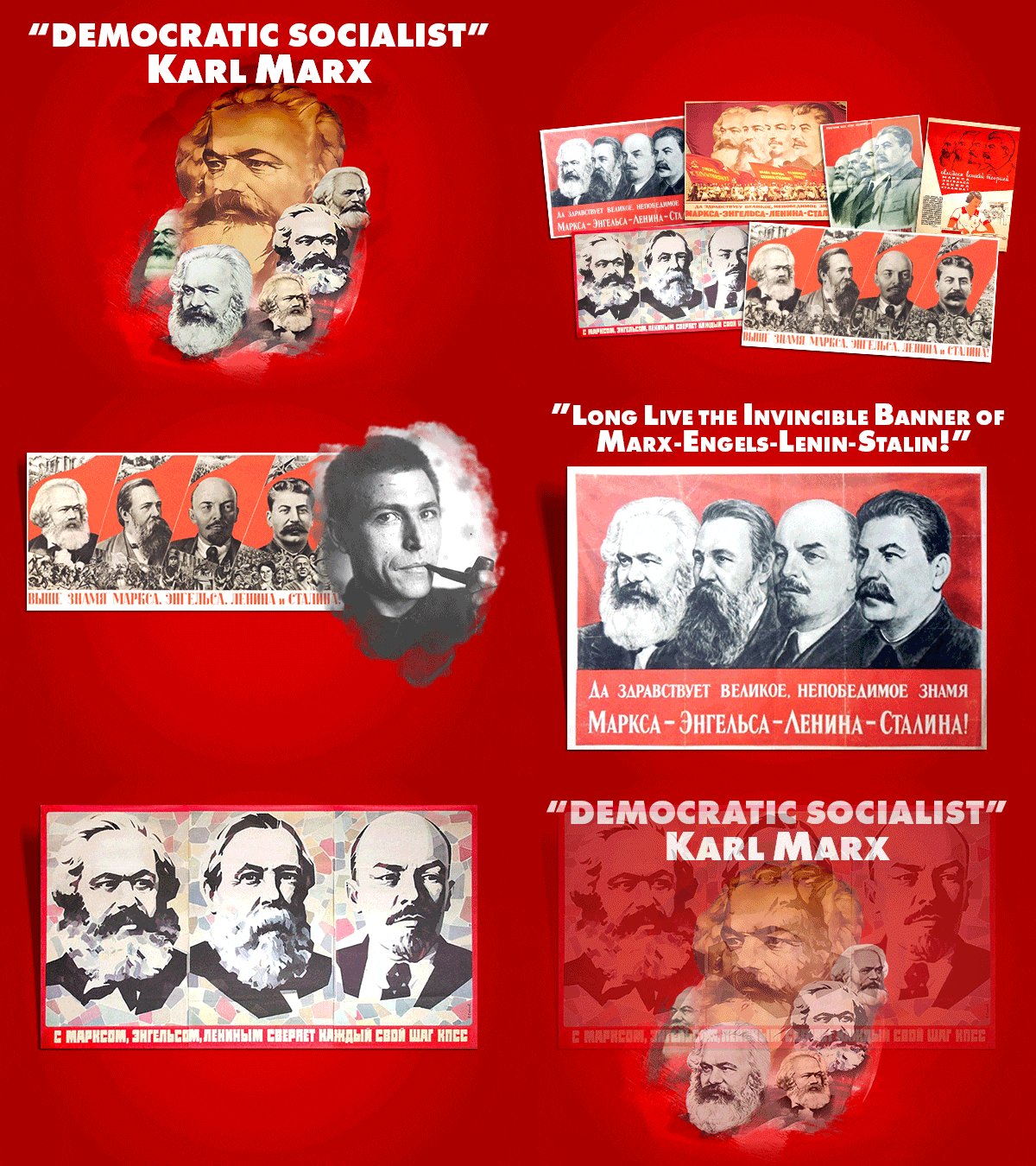
Karl Marx isn't just the most important socialist philosopher of all time. Today's democratic socialists also say Marx is one of their own—a genuine democratic socialist. None other than Democratic Socialists of America (DSA) founder Michael Harrington repeatedly labels Marx a democratic socialist.[24]
This democratic socialist Karl Marx is the same Marx who referred to rights as "so-called rights," as "supposed rights," as "obsolete verbal rubbish," and so on.[25] He's the same Marx who, along with Friedrich Engels, stressed his "opposition" to the entire concept of rights.[26]
Karl Marx's disdain for rights is no quirky pet peeve. It's a pervasive and pernicious aspect of Marx's thinking—the thinking that has defined socialism for well over a century and still does today.
New York University professor Stephen Lukes authored the seminal works Marx and Morality and "Can a Marxist Believe in Human Rights?"
The conclusion Lukes reaches in both is that socialists who are true to the Marxist faith cannot believe in rights.[27] Lukes reports:
Marx and Engels always wrote disparagingly about the language of rights and justice.[28]
They always wrote disparagingly.
Similarly, in their article "Was Karl Marx truly against human rights?," professors Justine Lacroix and Jean-Yves Pranchère tell us:
Everyone is familiar with the young Marx's diatribe against human rights.[29]
And, as Lacroix and Pranchère also explain, it wasn't just the young Marx who belittled rights. They conclude that Marx was a "prisoner of an ideological" view of rights his entire life.[30]
Let's note that this jail was one of his own construction. Marx built an anti-rights philosophical prison. Thousands of socialists have locked themselves in it since.
Marx disdained what he considered "ideological nonsense about right."[31] To his thinking, the entire concept of rights was just so much bourgeois bunk, an artifact of the liberal philosophy that underpins capitalism.[32]
A full review of Marx's attack on rights would consume many pages. For now, let's consider one example of his beliefs: his opinion that
none of the supposed rights of man, therefore, go beyond … an individual separated from the community, withdrawn into himself, wholly preoccupied with his private interests and acting in accordance with his private caprice.[33]
This is deeply flawed thinking. The protections rights afford don't require us to be separated from the community or withdrawn into ourselves.
Likewise, having individual rights in no way suggests we're entirely preoccupied with private interests or acting strictly on private whims (a "caprice" being a whim). Our rights simply mean that others can't force us to work on their goals without our consent.
But it's this very aspect of rights—the protection they provide from compulsion—that socialism is against. Rights must be curtailed so they don't interfere with the compulsory duty on which socialism is founded. As we'll shortly see R. H. Tawney explain, socialism is against rights because they allow us to resist.
Rights that grant us the ability to resist the state are a critical aspect of liberal philosophy. But to Marx and socialism, these rights are proof of an individual separated from the community and concerned only with personal whims.
Marx, again, is someone the very founder of the Democratic Socialists of America says we should consider a "champion of human freedom and a democratic socialist."[34] How can that be when Marx literally argues rights are "rubbish"?[35]
Perhaps the expectation is that we would remain ignorant of Marx's views. Whatever the explanation, one thing is certain: socialism must have very different definitions of what counts as democratic and as freedom.
Socialism's Problem
with Rights?
They Allow Us to "Resist"
We've seen R. H. Tawney argue that society should be organized primarily to make us perform duties, not to protect our rights. He explains the reasoning behind this thinking:
Duties, unlike rights, are relative to some end or purpose, for the sake of which they are imposed. The latter [rights] are a principle of division; they enable men to resist. The former [duties] are a principle of union; they lead men to co-operate.[36]
Why does socialism place duty above rights? Because duty is aligned with the socialist objective of making us work on social goals rather than individual ones.
Duty gives those running society the means to compel us to do things whether we want to or not. The ability to compel is the whole point of duty.
And what, to socialist thinking, is the problem with rights? It's the very fact rights do what they're intended to do: they give us the ability to keep others from interfering with our lives. Rights give us the means to defy the orders socialists look forward to issuing.
When Tawney says "duties, unlike rights, are relative to some end or purpose," he isn't speaking about goals of our own choosing. No, he's talking about ends and purposes selected by those running society. If these ends were of our own choosing, duty wouldn't be required to make us work on them.
Socialism's foundation on duty is how socialists stop us from using our lives for our own purposes and make us work on their goals instead.
Tawney called for our liberal society based on individual rights to be replaced with a socialist society founded on duty. But this isn't to say he was in favor of authoritarianism.
Tawney's objectives were pure, but he failed to appreciate the risks associated with his ideas. He imagined that, with the correct people running the show, one could have a society based on compulsory duty that wouldn't end up a totalitarian nightmare.
This mistaken thinking is hardly unique to Tawney. It's a dubious belief that's always been behind socialist thought and remains so today: the assumption that humans can be angels and, moreover, that they would keep on being angels even when given devilish powers.
A classic example of this mindset appears in Voyage in Icarie, a novel by famed French socialist Étienne Cabet depicting a perfected socialist society.
In Cabet's story, a resident of Icarie relates this key bit of the nation's history to a visitor from another country:
Happily, the dictator elected by the people, the good and courageous Icar, was the best of men.[37]
That certainly was fortunate for the good people of socialist Icarie. No wonder Icarie ended up such a wonderful place.
Too bad things have never worked out that way here in real life. Instead of the best of people, we've ended up with the likes of Stalin, Mao, and Pol Pot. And with millions of dead to show for it.
Socialism's foundation on duty makes it a system that requires a never-ending supply of the best of people. But for every angel among us, how many devils are there—individuals who see a system based on compulsory duty as a means to fulfill their lust for power and their desire to control the lives of others?
And the grave risks posed by socialist duty aren't limited to making it easy for those who are already evil to take control. Socialist experiments have shown time and again that even those who start out as angels can be turned into devils by the power socialist duty bestows on those running socialist society.
"Without Duties No Rights"
Those selling socialism are all too often guilty of the sin of omission. They know facts they should tell us, but they don't because it will hurt the sale.
This problem is particularly acute when it comes to being upfront about the nature and implications of socialist duty. DSA founder Michael Harrington provides us with a prime example of this reality.
In his book Socialism: Past and Future, Harrington praises R. H. Tawney. Harrington speaks of his desire for a society based on Tawney's concept of "fellowship" and writes that this concept would be "critical to the new society" of socialism.[38]
That's nice. But what else do we know Tawney considered critical to the new society? Duty, and limits on individual rights.
Tawney believed that creating a society of fellowship required replacing our liberal society based on rights with one founded on duty and the limitation of rights.[39] No society based on duty instead of rights? No fellowship.
Harrington sells us Tawney's concept of fellowship. But what does he say about the anti-liberal changes to society required to create this fellowship?
Not a peep.
Yes, it can be tough to sell a philosophy that calls for an onerous form of compulsory duty and that disparages rights. Signs reading, "So-Called Human Rights Are Ideological Nonsense!" wouldn't persuade many to become socialists.
The most common tactic socialists employ for dealing with this sales challenge is the one Michael Harrington employs when discussing Tawney's vision of a society of "fellowship": say nothing about socialism's requirement of duty, even when ethics make it clear you should.
But when the issue simply can't be ducked, a common socialist tactic is to link duty and rights in a combo plan, obscuring the intent to impose duty by promising rights as well.
Democratic socialist Eugene Debs provides the pitch that countless socialists have made, all using virtually identical wording:
Without rights there shall be no duties; without duties no rights.[40]
This "visionary axiom,"[41] as socialists have called it, is really a bit of sales trickery designed to deflect attention from socialism's plan to force duty on us. The purpose of the first half of this expression is to keep us from focusing on the implications of the second half.
The first half of the saying is "without rights there shall be no duties." It implies there's little need to worry about socialist duty because we'll only have duties if we have rights too.
But "without rights there shall be no duties" doesn't actually give us anything. In our liberal society, we already have rights. Better yet, we have rights without dangerous duties that override them. "Without rights there shall be no duties"? Thanks for nothing.
What do we discover if we concentrate on the second half of the expression, the "without duties no rights" portion? It confirms socialism's plan to take the ax to the liberal philosophy that underpins our current society.
"Without duties no rights" means we must accept the duties socialism imposes—duties that override the most important of our rights, our right to use our time and talents as we see fit—or have no rights at all.
"We, FascistS, Do Not Speak Only of Rights"
There's one other philosophy that could use socialism's "without rights there shall be no duties; without duties no rights" slogan without changing a word: fascism.
If imitation is the sincerest form of flattery, then fascism sure flatters socialism with its wholesale copying of the socialist playbook. Here are some of the ways in which this other anti-liberal philosophy mimics socialism:
- Like socialism, fascism is founded on the belief that the individual should be subservient to "the community" (as Hitler was fond of expressing it).[42]
- Like socialism, fascism rejects liberalism and its lack of compulsory duty. As the examples below demonstrate, fascism calls for a return to a society based on duty, just as socialism does.
- As with socialism, belief in duty leads fascism to treat the time in our lives as society's time, as the community's property to control.[43]
- Belief in duty leads socialism to belittle rights, to see them as "supposed rights" and as "so-called rights." And, as illustrated below, belief in duty leads fascism to do the same.
- Socialism's foundation on duty has contaminated the whole philosophy. The same is true of fascism. For example, belief in duty has turned both socialism and fascism into philosophies obsessed with eliminating alleged "parasites," those who are seen as failing to perform their socialist or fascist duty.[44]
What accounts for these many similarities? They result from the fact fascism's philosophical roots are found in socialism.
Numerous socialists helped establish this other authoritarian belief system. And those fascists who weren't originally socialists were inspired by socialist attacks on the liberal philosophy that underpins capitalism—particularly by the socialist rejection of both liberalism's lack of compulsory duty and its foundation on the idea of inalienable rights.
Thus, it's not surprising to hear a fascist say, paralleling socialism:
We, Fascists, do not speak only of rights, we speak also of duty.[45]
These are the words of Benito Mussolini, the world's first fascist dictator—the same Mussolini whom Bernard Shaw praises above. Where is it that Mussolini learned to "speak also of duty"?
Why, as a socialist.
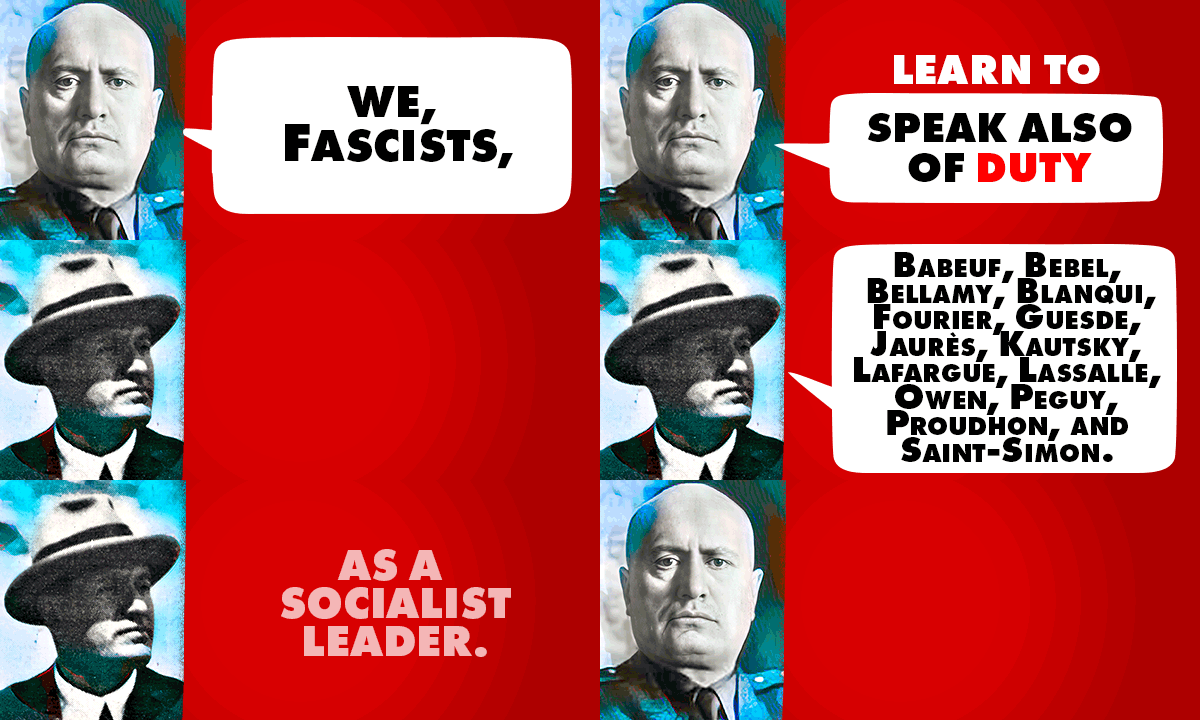
Before becoming "the father of Fascism,"[46] Mussolini was a leader of the Italian Socialist Party and editor-in-chief of Avanti!, the Socialist Party's national daily newspaper.[47] And prior to running Avanti!, he was the managing editor of three smaller socialist newspapers.[48]
Mussolini even founded his own socialist philosophical journal, Utopia: Fortnightly Review of Revolutionary Socialism.[49]
As a socialist leader, Mussolini gave innumerable speeches and wrote countless articles selling socialism. These demonstrate both the depth of his support for socialism and also the breadth of his socialist knowledge.
In them, Mussolini quotes or otherwise references a bevy of important socialist philosophers—not only Marx and Engels dozens of times, but also Gracchus Babeuf, August Bebel, Edward Bellamy, Edward Bernstein, Louis Auguste Blanqui, Charles Fourier, Jean Jaurès, Karl Kautsky, Paul Lafargue, Ferdinand Lassalle, Robert Owen, Charles Peguy, Pierre-Joseph Proudhon, Henri Saint-Simon, Werner Sombart, and others.[50]
Mussolini was a socialist heavyweight and likely would have remained one if not for the split that World War I caused in the Italian Socialist Party, a rift that led to Mussolini's expulsion.[51] But Mussolini, and the other socialists who joined him as fascists, had learned well the socialist lesson of loving duty and disdaining rights. They brought this authoritarian mindset with them to their new fascist home.
Between the direct influence of former socialists like Mussolini and the indirect influence of socialism's repudiation of liberalism, the result is that the fascist views of duty relative to rights are strikingly similar to those of socialism.
Socialism starts from the belief that all should be born owing their time and talents to society. As Louis Blanc put it 140 years ago, and in the words socialists still use today:
From each according to their ability. That is the DUTY.[52]
What does fascism say about duty? These examples come, respectively, from Benito Mussolini, from fascist thinker Mario Palmieri (who praises duty during an attack on individualism and rights), from Adolph Hitler, and from the "National Socialist [Nazi] Program":
The Fascist considers labour a duty and duty a law.[53]
Individualism … is the negation of the principle of Duty which is the foundation of the moral world and the affirmation in its stead of the principle of Rights—those rights which are the perennial spring of all human ills and evils.[54]
It is the duty of the individual to return to the community, zealously and honestly, what the community has given him.[55]
It must be the first duty of each citizen of the State to work with his mind or with his body. The activities of the individual may not clash with the interests of the whole, but must proceed within the frame of the community and be for the general good.[56]
The fascist duty to give our abilities to the community mimics socialist duty, as does the fascist focus on work.[57] And the idea that our individual actions should not be allowed to conflict with "the interests of the whole" also emulates socialist thinking.
Marx and Mussolini
MALIGN Our "Supposed Rights"
When fascists speak about rights in relation to duties, they again make statements that are indistinguishable from those of socialists.
Consider this thinking from Ernest Huber, the Nazi jurist who literally wrote the book on National Socialist (Nazi) law, Constitutional Law of the Greater German Reich:
All rights must be regarded as duty-bound rights. Their exercise is always dependent upon the fulfillment by the individual of those duties to which all rights are subordinate.[58]
Huber says the only rights we should be permitted are those needed to perform duties. This is the same principle expounded by democratic socialists R. H. Tawney and J. Ramsay MacDonald earlier in this paper.
Another quote from Ernest Huber also embodies one socialist belief after another, starting with an overall attack on liberalism:
Not until the nationalistic political philosophy had become dominant could the liberalistic idea of basic rights be really overcome. … There are no personal liberties of the individual which fall outside of the realm of the state and which must be respected by the state. The member of the people, organically connected with the whole community, has replaced the isolated individual. … There can no longer be any question of a private sphere, free of state influence, which is sacred and untouchable before the political unity. The constitution of the nationalistic Reich is therefore not based upon a system of inborn and inalienable rights of the individual.[59]
This Nazi denial of inalienable rights equates to what we have seen Bernard Shaw identify as socialism's "ruthless refusal" to acknowledge such rights, a refusal confirmed by the views of none other than Karl Marx.
Recall also Marx's attack on rights for being, in his view, only a reflection of
an individual separated from the community, withdrawn into himself, wholly preoccupied with his private interests and acting in accordance with his private caprice.[60]
As seen in Huber's thinking, fascism operates from the same flawed view of rights that Marx does: the belief that our liberal rights mean we're focused on private whims and separated from the community that both socialists and fascists believe we are born to serve.
Huber promises fascism would deliver the world Marx desired, a world in which there would no longer be a "private sphere"—that is, no longer any place where the individual is safe from encroachment by those acting in the name of society. For fascism, as for socialism, there is no right to resist the community.
Finally, in The Doctrine of Fascism, Benito Mussolini writes that the fascist state's
functions cannot be limited to those of enforcing order and keeping the peace, as the liberal doctrine had it. It is no mere mechanical device for defining the sphere within which the individual may duly exercise his supposed rights.[61]
Mirroring socialism, Mussolini attacks liberal philosophy. And mirroring Marx, Mussolini disparages our rights as "supposed" ones.
The bottom line is that both socialists and fascists demand duty and denigrate rights. Both of these anti-liberal philosophies look forward to flipping the script on our current liberal society that's based on rights and rejects the form of compulsory duty that fascism and socialism require.
Yes, what we're discussing is philosophy, but it's philosophy that has a critical bearing on our lives in the real world. As experiences with both socialism and fascism have shown, when a society is based on duty and maligns rights, tragedy awaits.
Hitler, Mussolini, Nazis, and other fascists are rightly reviled and hold an especially infamous space in our consciousness for their crimes against humanity. The results of history's socialist experiments have yielded state-sponsored mass murder and even genocide all too similar to those of fascism.[62]
Democratic Socialism Says Duty Beats Rights
As R. H. Tawney explains, the socialist view is that
society should be organized primarily for the performance of duties, not for the maintenance of rights, and … the rights which it protects should be those which are necessary to the discharge of social obligations.[63]
The very starting point of socialism is with the imposition of compulsory duty to society. And the express purpose of this duty is to override our liberal right to use our lives and the time in them as choose. Apart from the goal of controlling what we do with our lives, there would be no reason for socialism's duty of "from each according to their ability."
These underlying principles of socialism show it to be an anti-liberal philosophy. They erode the protections that rights afford us from authoritarianism.
And even democratic socialists hold these anti-liberal views. Democratic socialists don't wish for dictatorial outcomes, but they support a system that makes every experiment with socialism an authoritarian accident waiting to happen.
Today's socialists say Karl Marx and R. H. Tawney are exemplary democratic socialists. This means one can be a democratic socialist despite promoting the idea that human rights are trash and nonsense. It means one can be a democratic socialist despite being against rights because rights allow us to resist.
These troubling views expressed by democratic socialists are the same anti-liberal ones we associate with plain old socialism. They help us see that "democratic socialism" is a misleading marketing slogan, not a new version of socialist philosophy.[64] When you pull off the "democratic" label, it's the same old philosophy inside the package.
That socialism extols duties over rights may have come as news to you.
That democratic socialism is based on the same duty of "from each according to their ability" that has been the socialist standard for 170 years may come as a surprise.
And the fact that socialism and fascism are siblings when it comes to loving duty and disparaging our liberal rights could also be a reality with which you were unfamiliar.
But none of these facts comes as news to any knowledgeable socialist. Knowledgeable socialists are not only aware of all this, but they're also good with it. If they weren't, they would no longer be socialists.
Socialism is founded on belief in the morality of compulsory duty—the compulsory duty to give our time and talents to society. This anti-liberal principle guarantees duty will always beat rights in a socialist society. Duty can only be duty by overriding our rights.
It's common to think of socialism as a left-liberal philosophy, but it's not. Socialism's foundation on the duty of "from each according to their ability" means socialism is, and will forever be, a left anti-liberal philosophy.
Thank you for reading "Our 'So-Called' Rights."