


"In a socialist society,
the labor-power of individuals
is placed under the
management of society."
—Samezō Kuruma
Socialism's anti-liberal nature
is vividly illustrated by the plan
—the democratic socialist plan—
to suppress our private labor rights.
In our liberal society, your abilities—your time and talents—belong to you. And mine belong to me.
We take this as a given. It's fundamental to how we think about ourselves and how we relate to one another.
Socialism has an entirely different perspective. It sees our individual ownership of our time and talents as a mistake—a "defect."
In his recent book The Socialist Imperative, Michael Lebowitz writes that socialism must overcome our current society's
defect of private ownership of labor-power.[1]
"Labor-power" is the term socialists use to describe our abilities applied to work. Lebowitz calls the fact our liberal society treats our time and talents as our private property a "defect."
He then goes even further, describing the liberal principle that says our abilities are our individual property as
more than just a defect: it is also an infection.[2]
Our individual ownership of our time and talents? It's an "infection" that socialism intends to cure.
Lebowitz (like every other individual quoted in this paper) is a socialist philosopher. Moreover, he's a democratic socialist[3]—a democratic socialist calling for the end of our individual control of our lives.
Lebowitz's thinking demonstrates that socialism is founded on the principle that our abilities should be treated not as our individual property, but rather as society's. This is the single most important thing there is to know about socialism.
It's a reality reflected in socialism's compulsory duty of "from each according to their ability," a duty that transfers the ultimate control of our time and talents to those running socialist society.[4]
That socialism sees our time and talents as society's time and talents is also the crucial distinction between socialism and liberalism.
Liberal philosophy considers our abilities our private property to use as we want. It allows us to define our lives as we wish. It says we're free to give our time and talents to anyone we choose, but no one should be permitted to control them without our express consent.[5]
Liberalism rejects compulsory duties to give our abilities to others, be they king, queen, fascists calling themselves "the community,"[6] or socialists calling themselves "society." It rejects such duties as both immoral and incredibly dangerous.
As Michael Lebowitz's thinking illustrates, however, socialism explicitly repudiates the liberal view. To socialism, our private ownership of our time and talents is an "infection" that must be cured—a belief that gives new meaning to the expression the cure is worse than the disease.
Lebowitz's thinking is no outlier. His democratic socialist vision is straight out of the socialist gospel—the gospel according to Marx.
"PRIVATE LABOUR"
AND "ITS OPPOSITE,
DIRECTLY SOCIAL LABOUR"
Karl Marx is the central and unparalleled figure among socialist philosophers.[7] It was Marx who first articulated the concept of "private labor," distinguishing it from what he calls "directly social labor."
Marx says private labor characterizes our present liberal society, whereas socialism requires directly social labor. He tells us:
Private labour cannot be treated as its opposite, directly social labour.[8]
Private labor is what Lebowitz describes as "the private ownership of labor power," labor power being our abilities applied to work.
The "private" in "private labor" has the same meaning it does in "private property": something under our personal, individual control.
Treating our labor as something we own privately is precisely how we're used to thinking of it—as our own. In our liberal society, we're each considered the exclusive owners of our abilities.
One result of this fact is that we're free to pursue any type of work we wish. Another is that we have ultimate control over how many hours a week we're willing to work. If we want to work a limited schedule and live frugally to accommodate this choice, we're free to do so. Our work choices are under our private control.
When you work for an employer, you have duties assigned by them. But unless you've volunteered for the military, you retain your private labor rights and can quit your employment and its duties at any point and for any reason.
Let's say you're working for a large company but decide you want to start your own gig making craft furniture. There's nothing to keep you from quitting your current job and being underway on your new craft venture in a matter of days.
This is the way we're used to the world working. But it's also a prime example of our private labor rights in action—rights socialism intends to eliminate.
Again, socialists since Marx have described our liberal society as being based on private labor—the individual control of our work time. In contrast, socialism is based on what Marx calls "directly social labor," which he explains is the opposite of private labor.
Just as "private labor" is shorthand for our private ownership of our time and talents applied to work, so too "directly social labor" is shorthand for society's ownership of the same. It represents a reality in which our labor time and talents are ultimately controlled by society, not by us individually.
Celebrated modern-day socialist Ernest Mandel explains that, under socialism, decisions about work would be made by society overall and
not by spontaneous decisions of individuals, production units or firms.[9]
The hypothetical scenario in which you quit work at a large company to start your own craft business? It's one example of what Mandel describes as the "spontaneous decisions of individuals" that socialism would not permit.
The plan to do away with our private labor rights is central to the thinking of Karl Marx, who, even among today's democratic socialists, remains socialism's greatest expounder and its defining philosopher. Socialists say Marx considered directly social labor to be a required element of socialism; a truly socialist society cannot exist until private labor is eliminated and replaced by directly social labor.[10]
"THE ABOLITION OF
PRIVATE LABOR"
Socialism plans to fix the supposed defect of our private ownership of the time in our lives. Its cure for this alleged infection is to do away with our private labor rights and replace them with directly social labor.
Karl Marx explains that in socialist society,
the labour of the individual is posited from the outset as social labor.[11]
In a socialist society, your labor would be "posited" (considered) to be "social labor" (society's labor, not your individual labor).
In a socialist society, your work would be treated as society's property "from the outset." You would never own it.
(Note that even though Marx refers to "social labor" in the above quote, today's socialists say that he's speaking about the same concept he calls "directly social labor" elsewhere.[12])
Friedrich Engels was Marx's colleague and is the second most important socialist philosopher of all time. He too reports that, come socialism, our work would be considered society's labor—labor immediately and directly under society's control:
The labour of each individual, however varied its specifically useful character may be, is immediately and directly social labour.[13]
Samezō Kuruma likewise states that socialism would bring the demise of our private labor rights. He affirms that, in socialist society,
labor-power is directly social labor, having a social character from the outset.[14]
The plan to suppress the private control of our time and talents remains a fixture of today's socialism.
Michael Lebowitz's declaration that private ownership of labor power is an infection socialism must cure isn't from the socialist past; it's from 2015.
Similarly, in 2018, Paul Cockshott writes that socialism means
there is no private labor, but only social labor.[15]
And, in Marx's Ecosocialism, published in 2017, Kohei Saito writes that socialism
must be based on the abolition of "private labor."[16]
"The abolition of 'private labor'"—that is, the suppression of our liberal right to privately control our time and talents—is what socialists say is the critical path to achieving socialism. It's a non-optional step that socialists from Marx to the present say is required to realize socialism.
ANOTHER BYPRODUCT OF SOCIALIST COMPULSORY DUTY
This could easily be the first time you've heard of the socialist concepts of "private labor" and "directly social labor." Given the scary and flat-out anti-liberal implications of the plan to eliminate our private labor rights, it's rarely mentioned in the socialist sales pitch.
It's no surprise, however, that liberal society is founded on private labor while socialism intends for society to be based on directly social labor. These facts are simply the inevitable results of the key principles that define and distinguish these conflicting philosophies.
Why is liberal society based on private labor? Because the very starting point of liberalism is with the principle that our time and talents are our private property to use as we wish.
In a society based on liberal philosophy, private labor is simply a given. Private labor is liberalism applied to work.
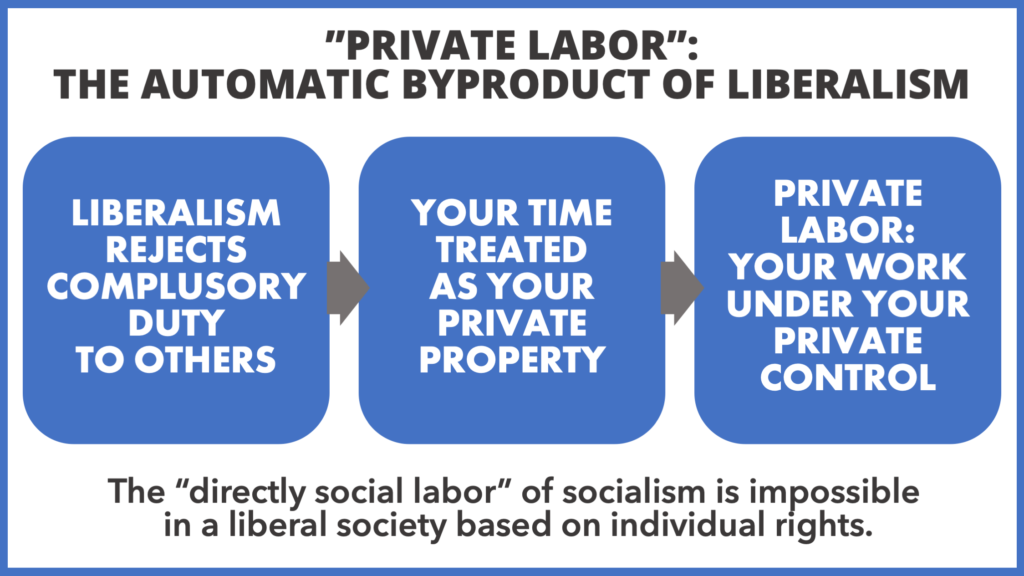
Moreover, in liberal society, it's impossible to implement the directly social labor that socialism seeks.
As liberalism rejects the compulsory duty to give our abilities to society, those running liberal society don't have the means to make us do what they want rather than what we wish. Directly social labor requires a society with the power to control what we do with our lives—perfect for socialism.
Much as private labor is the automatic byproduct of liberalism, so too socialism's basis on directly social labor is the natural result of a philosophy that starts with the rejection of liberalism and a call for all to be made to "return to duty."[17] For over 170 years, socialism has demanded the duty of "from each according to their ability."[18] It still does today.[19]
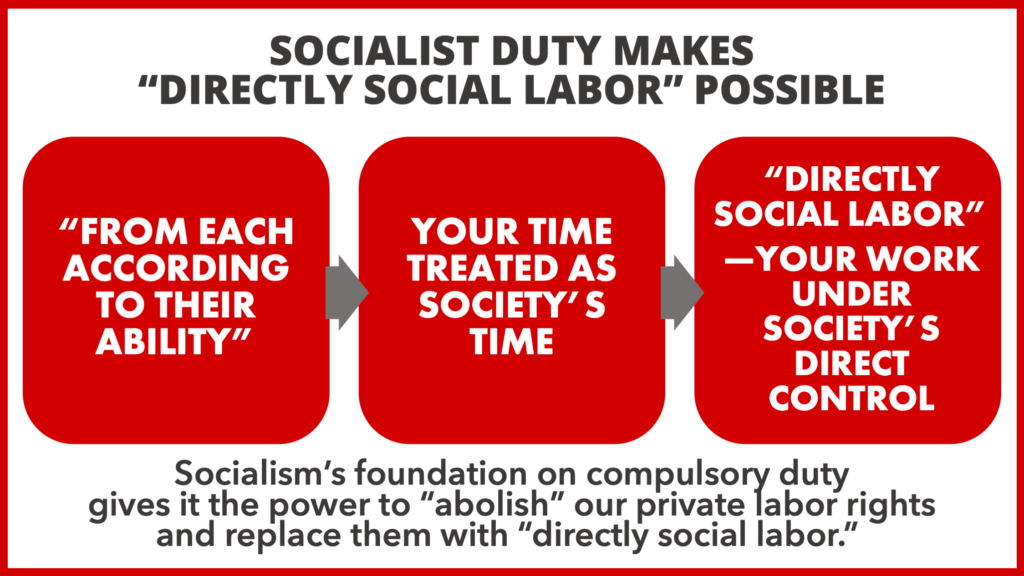
The socialist plan for our work to be treated as directly social labor demonstrates that socialist duty is intended to produce dramatic and dangerous changes in the basis of society. It's also an example of how this duty turns the time in our lives into what socialism treats as society's time.
Socialism's foundation on the compulsory duty of "from each according to their ability" has shaped all of socialist philosophy. The plan to suppress private labor and replace it with directly social labor is but one of the many ripple effects of socialist duty.
"SOCIETY WILL HAVE BECOME …
A SINGLE FACTORY"
What would the socialist world of directly social labor be like?
For starters, any socialist claim that this change would be nothing to worry about can't possibly be true. But for the desire to control what we do with our lives, there's no reason for socialism to seek a society based on the duty of "from each according to their ability" and one in which our private labor rights are replaced by directly social labor.
The very reason socialism demands compulsory duty to society, and the very reason socialists want to eliminate our liberal private labor rights, is so that those running socialist society can keep us from doing what we wish and make us do what they want instead.
Socialists have long desired the power to eradicate millions of what they deem to be "socially useless" jobs held by those they label "parasites."[20] Hundreds of socialist thinkers attack the parasites they believe infest our liberal society.
Socialist theory says that the suppression of alleged parasites is morally correct. Moreover, it says the elimination of parasites is required, as they are the source of the labor to reconstruct society according to the socialist vision.
How, according to socialist thinking, is it that our liberal society ended up filled to the brim with parasites? Socialist theory blames liberalism's lack of compulsory duty and our liberal right to do any work we wish—even work socialists deem to be useless.
Socialism's foundation on duty and directly social labor are the supposed cures to these supposed problems.
Socialist superstar Friedrich Engels provides an example of the socialist remedy at work. He says that socialism's reorganization of society would save large quantities of labor power that our capitalist society allegedly wastes.
How would socialism achieve its greatest savings of labor power? Engels explains:
The greatest saving of labour power lies in the fusing of the individual powers into social collective power and in the kind of organization which is based on this concentration of powers hitherto opposed to one another.[21]
Engels' wording is tricky. But with a bit of decoding, his meaning is clear.
Say you're a craft artisan who makes leather goods by hand. Liberal society, with its private labor rights, lets you get away with working as an "individual power."
Engels says that such individual operations represent a waste—in fact, the greatest waste—of what socialism sees as society's labor power.
Socialism is going to take control of your craft operation. And it's going to do likewise with the other small producers with whom you've been competing (operations "hitherto opposed to one another").
Your operation is going to be "fused" and "concentrated" with those of your former competitors to create a large operation based on "social collective power."
The result of eliminating all these "individual powers"? What socialism says would be its "greatest savings of labor power."
What gives socialism the power to suppress small operations to its heart's content? The control over our lives that compulsory duty and directly social labor vest in the socialist state.
As Samezō Kuruma explains:
In a socialist society, the labor-power of individuals is placed under the management of society.[22]
Come socialism, we would no longer manage our labor-power (our time and talents applied to work) individually. Instead, it would be placed under the management of those running socialist society.
Karl Marx doesn't mince words either. He says that the "first economic law" of socialist society would be
the planned distribution of labour time among the various branches of production.[23]
And he similarly says that socialism means that
society distributes labour power and means of production between the various branches of industry.[24]
Come socialism, what we all do workwise would not be the sum of our individual decisions. Instead, those running socialist society would use the power of socialist duty and directly social labor to distribute the labor power our lives represent.
This is why socialist thinker Agnes Heller, in her noted The Theory of Need in Marx, writes that Marx expected a socialist society would be one in which
the whole of social production will function as a single factory.[25]
Socialist great Vladimir Lenin similarly reports that socialism would mean
the whole of society will have become a single office and a single factory.[26]
DEMOCRATIC SOCIALISTS FOR
ENDING YOUR PRIVATE CONTROL
OF YOUR LIFE
Who are these socialists calling for the suppression of our liberal right to individually control the time in our lives?
They're democratic socialists.
Karl Marx, whose socialism requires eliminating our private labor rights and who envisions a society in which "the whole of social production will function as a single factory"?[27]
He's a democratic socialist.
So says Michael Harrington, the founder of the Democratic Socialists of America (DSA). Even though Harrington is well aware of Marx's plan to do away with our private labor rights, he calls Marx a "champion of human freedom and democratic socialist."[28]
To socialists, one can be a democratic socialist and even a "champion of human freedom" despite calling for the end of our right to control our own lives.
Consider Friedrich Engels. He says socialism would mean "the labor of each individual … is immediately and directly social labor." And he's excited about using the power of compulsory duty and directly social labor to eliminate the small enterprises that our liberal private labor rights make possible.[29]
Despite this utterly anti-liberal thinking, Engels is said to be a democratic socialist. DSA founder Harrington gives Engels the democratic socialist stamp of approval.[30]
Ernest Mandel? He not only promises socialism would be based on directly social labor but also looks forward to socialism doing away with our right to make "spontaneous decisions" about how to lead our own lives. He's a democratic socialist too.[31]
Paul "There Is No Private Labor, Only Social Labor" Cockshott? Yes, a democratic socialist.[32]
And that returns us to Michael Lebowitz, who labels our liberal right to privately control the time in our lives a "defect" and an "infection." He's another democratic socialist.[33]
Many people today are under the impression that "democratic socialism" is a new and improved version. Some are even fooled into thinking democratic socialism is a type of socialism that doesn't demand the duty of "from each according to their ability." These are entirely mistaken beliefs.
As we've seen, socialists see no conflict between considering themselves democratic socialists and supporting socialism's anti-liberal compulsory duty and its plan to abolish our liberal private labor rights.
The punch line to what is no joke: Socialism is not left-wing liberalism. It's left-wing anti-liberalism.
Socialism is a philosophy founded on principles that run directly counter to those of liberal society. The democratic socialist plan for directly social labor to replace our private labor rights is but one example of this reality.
Thank you for reading "A 'Defect' of Liberalism."