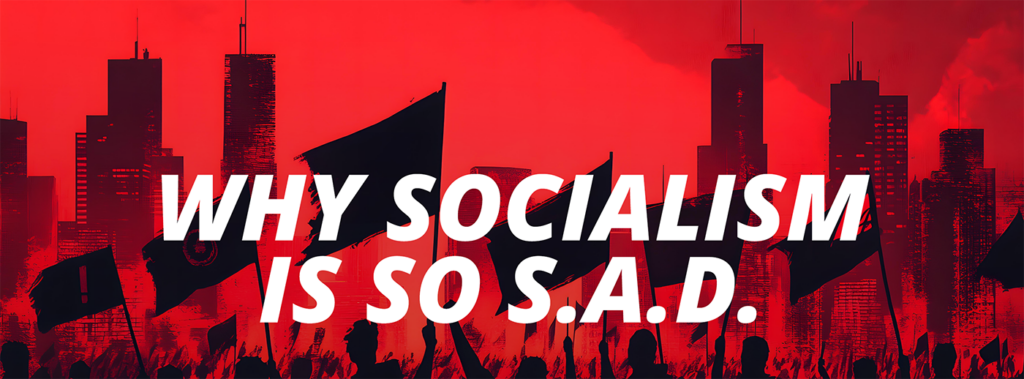
Socialism Says and our 17 free papers use 100s of damning quotes from celebrated socialists to explore the factors that make socialism:
- a Sham—riddled with unethical marketing.
- Absurd—premised on ludicrous assumptions.
- Dangerous—flawed by its foundation on compulsory duty, its requirement for a society of suppression, and more.
We've created a small booklet that provides a synopsis of these three key attributes of socialism:

The S.A.D. booklet is available as a PDF. And we'll also gladly mail you a physical copy for free. Send your address to us at sad@redflagspress.org.
The Sham, Absurd, and Dangerous dimensions are also outlined below.



From socialism's earliest days, its proponents have attacked marketing in capitalist society, arguing that it's based on unscrupulous practices. How ironic to discover that socialists are salespeople themselves, employing every trick in the book.
Using misleading marketing slogans. Making promises that the seller knows will never be delivered. Concealing facts that undercut sales claims. Failing to warn about product risks. Socialists engage in all of these ugly practices and more.
And we're not just talking about socialist politicians but also about those who hold themselves out as theoreticians. So many of these authors and professors are more huckster than philosopher. Their primary focus? How best to pitch their product.
Most chapters of Socialism Says and RFP papers highlight instances of unethical selling by socialists. Two examples:
Concealing Problematic Facts
There are numerous instances of socialists, and even socialist philosophers, hiding facts that would undermine their arguments. A case in point is how today's socialists have disappeared Karl Marx's repeated calls for child labor —child factory labor—to become a central part of the socialist school day.
Even socialist-authored books specifically about applying Marx's thinking to education fail to include a single word about this favorite idea of his. One such book even asserts that "Marx did not write directly on education." This claim would come as quite a surprise to Marx himself. What was Marx's nickname for his concept of child labor as "school"? "The education of the future."
Today's socialists conceal Marx's calls for child labor and other examples of his anti-liberal thinking because these facts put the lie to their efforts to rebrand Marx as a "champion of human freedom" and the like. It's hard to trick people into believing the goal of Marx's philosophy is "the full realization of individualism" if you're honest about his desire for every socialist child to start laboring for society at age nine.
We study the details in "Karl Marx's 'Education of the Future'," also summarized in Socialism Says, Ch. 9.
A Misleading Marketing Slogan
A second, and critical, example of the unethical selling that renders socialism a sham is found in the concept of "democratic" socialism. This term is a misleading marketing slogan—end of story. It isn't the new and improved version of the socialist product that the name implies, and that so many have been led to believe.
One important proof of this reality is that today's socialists say Karl Marx should be considered a "democratic socialist." They count Marx as a democratic socialist despite his saying our liberal rights are "nonsense," despite the central role his thinking has played in authoritarian socialist nations, even though Marx called himself a "communist," etc.
That Marx is said to be a "democratic socialist" makes it clear that democratic socialism is simply a deceptive label applied to the same product socialists have been selling for 150 years: Marxism.
You'll find the particulars on Marx being considered a "democratic socialist" and on six other factors that show democratic socialism is a misleading marketing slogan in "The 'Keto-Friendly' Political Philosophy." This paper is also summarized in Socialism Says, Ch. 7.
Let's also note that it's not just Marx whom today's socialists lionize. For example, they even attempt to portray Soviet dictator Vladimir Lenin as a proto-ecosocialist. This is an additional instance of disingenuous selling—Lenin was anything but sustainability-minded. And it's also an illustration of authoritarianism that today's socialists are willing to condone. Learn the details in "Vladimir Lenin, Ecosocialist? Life Under Lenin's 'Green' Thumb." This paper is also summarized in Socialism Says, Ch. 11.
So Many Other Examples
Hiding Marx's love of child labor and using a marketing slogan that's utterly misleading are but two of the innumerable instances of the unethical selling that plagues socialism, making it a sham.
We'll touch on additional examples as we overview the reasons socialism is absurd and dangerous. You will find many more in Socialism Says and in our papers.



The second critical point to understand about socialism is that it's based on ludicrous assumptions—ones so unlikely to be realized that they turn socialist sales promises into lies.
Utopian and Dystopian
A prime example of this issue is found in socialism's need for a world of overflowing abundance—a world produced by what Karl Marx called "constant over-production."
Innumerable socialists have stated that their philosophy requires a world of "limitless abundance," "superabundance," and the like. As Michael Harrington, founder of the Democratic Socialists of America, explains: "If abundance is not possible, then neither is socialism, and there's no reformulation that can change that fact."
No world of abundance? No socialism. And "there's no reformulation that can change that fact."
This secret sauce is essential to deliver on socialism's most important sales promises. Chief among these is socialism's defining pledge: that it will create a society based on the axiom "to each according to their need." Such a society hinges on the existence of "superabundance." Again, socialists have said so themselves.
The stupendous increase in worldwide production volumes necessary to fulfill this promise pulls off quite a trick: it's both utopian (as in impossible for socialism to create) and dystopian (as in absurdly unsustainable).
Get the full story in "The Secret Sauce of Socialism." This paper is also summarized in Socialism Says, Ch. 10.
Meeting Mania
Another example of the farcical notions central to socialism: socialist theory holds that all citizens would be required to attend endless hours of public meetings and debates. This is how a democratic socialist society would determine which products to produce, which to suppress because they're "socially useless," what jobs to make illegal because they are "parasitic," etc.
Celebrated socialist thinker Ernest Mandel (a key advisor to Che Guevara) has estimated that each of us would need to spend 20 hours a week attending debates and performing administrative tasks for society. That's 20 hours on top of our regular work hours.
The socialist plan is for this meeting mania to continue indefinitely. But, in the real world, the system would soon collapse, returning socialism to its authoritarian norm.
Learn the details about this additional ridiculous premise at the heart of socialist theory in "Four Hours Every Weekday," also summarized in Socialism Says, Ch. 8.
More Sales Mischief
Socialism's absurd assumptions are linked to additional examples of disingenuous sales practices.
For example, knowledgeable socialists recognize that their philosophy is premised on meetings galore. But rather than doing what ethical selling demands and making this reality clear, they compound error by claiming that socialism would reduce working hours.
Such claims are preposterous for multiple reasons. The obvious one in this context is that they require pretending that the hours of societal meetings that socialism demands are a fun hobby, rather than what they really are: another form of work.
Similarly, knowledgeable socialists are well aware that their sales promises require impossible and unsustainable levels of production. Yet they continue to make claims that rest on the hidden assumption of a world of superabundance, without making this premise clear.
Even those who tout themselves as "eco" socialists promise that socialism would yield a world of "to each according to their need." This is a claim that socialists themselves have said can only be delivered by "superabundance" and "constant over-production." Apparently, "constant overproduction" will save the Earth.
Socialism is absurd. And the absurdity leads socialists to double down on the sales sham.



The final critical thing to understand about socialism is that it's exceedingly dangerous. The following defects—responsible for the nightmares of the socialist past—remain in socialism today:
- Its foundation on compulsory duty.
- Its requirement for a society of suppression.
- Its allegiance to the extreme ideas of Karl Marx.
Compulsory Duty That Turns
Our Time Into Society's Time
From socialism's earliest days, it has rejected liberalism's lack of compulsory duty and called for a world in which all are born owing their time and talents to society. Socialist philosopher R. H. Tawney (praised as "the democratic socialist par excellence") explains the socialist view: "Society should be organized primarily for the performance of duties, not for the maintenance of rights."
The saying "from each according to their abilities" has long defined socialist duty. It's French socialist Louis Blanc who is credited with coining this phrase's specific wording. He explains its meaning, using italics and all capitals for emphasis: "The more one can, the more one must. Hence the axiom: 'From each according to his ability.' That is the DUTY."
This duty places our time and talents under the control of those running socialist society. As Fidel Castro puts it, under socialism, our work is "not an individual tool, but a tool for the entire society." He further states that, "For socialism to exist … every citizen must be used in an optimum, rational way."
Come socialism, who will decide what counts as the "optimum, rational" use of your life? One thing is certain: It won't be you.
Its foundation on compulsory duty has warped socialism in multiple ways. One obvious result is that this duty overrides our liberal rights (if it did not, it wouldn't be a duty at all). We examine how socialists—including those touted as "democratic" ones—disparage rights in "Our 'So-Called' Rights," also summarized in Socialism Says, Ch. 3.
Another byproduct of socialist duty is socialism's fascist-like fixation with alleged "parasites" and with "drastic measures to eliminate the parasites," as Che Guevara put it. For details, see "The Socialist Obsession." This paper is also summarized in Socialism Says, Ch. 5.
A Society of Suppression
A second dangerous flaw of socialism is that its creation requires a society of repression, one in which the government possesses extraordinary powers.
The socialist state must have the power to impose compulsory duty. It must have the power to eliminate private enterprise. It must have the power to suppress alleged "parasites," supposedly "useless" jobs and products, and more. These are core aspects of socialist theory, which holds that a socialist society cannot exist unless and until this repression occurs.
Implementing such a program is authoritarian in its own right. But as socialist history has repeatedly shown, the problem is far greater than that. Once a government with such powers exists, there's no way to control how it will be used or how many lives it will consume.
Examples of the suppression that socialism demands and the vast power socialists see their government wielding appear throughout our materials. A case in point: "Vladimir Lenin, Ecosocialist? Life Under Lenin's 'Green' Thumb." This paper is also summarized in Socialism Says, Ch. 11.
See also "Why Socialism Says Craftwork Is 'Idiocy,'" which quotes Fidel Castro bragging about having forced the closure of thousands of artisan workshops and other celebrated socialists blithely discussing how the socialist state will eliminate all craft enterprises. "Why Socialism Says Craftwork Is 'Idiocy'" is also summarized in Socialism Says, Ch. 6.
Unfortunately, "Marx lives!"
As illustrated by self-proclaimed "communist" Marx being promoted as a "democratic socialist," socialism remains Marxism through and through. This reality compounds the threat posed by socialism.
The danger stems not only from Marx's anti-liberal beliefs but also from his pronouncements as to what counts as socialism. What few non-socialists recognize is that Marx defines a socialist society as one in which all private enterprise, and even all buying and selling, are suppressed. Not just every large corporation is to be eliminated, but also every small business, small farm, and craft workshop.
The pursuit of this wholesale societal transformation intensifies the repression required, increasing the likelihood that socialist authoritarianism becomes totalitarianism.
"Marx lives!"—these words conclude socialist Kohei Saito's recent book Marx's Ecosocialism (winner of a socialist book award). Unfortunately, Saito is right: Marx's thinking remains the very definition of socialism. As such, it's critical to understand both the radical transformation of society that Marx insists on and the mass suppression required to create such a world.
More Trickeration
Many socialists argue that private enterprise and trade would be permitted under socialism. How can these claims (claims that mean "evil" profit would exist under socialism) be explained, given that Marx says the opposite? We find the answer in another example of socialist sales trickery.
Even using the most authoritarian of methods, it's not possible to instantly transform a society based on buying and selling and millions of private businesses into one in which the market economy has been eradicated. Thus, socialist theory calls for a first "transitional" phase during which this process is executed.
Some socialists argue that the transition should be rapid. Others say it should be slower. But the endpoint is the same: Marx's vision of a world without a single business, large or small.
The existence of this transitional period permits socialist salespeople to say "Why, of course, socialism will allow private enterprise!" with a semi-straight face. But they're alluding to this first phase, not the final plan. More unethical selling from those who claim to despise sales and marketing.
Socialism is a sham. It's absurd. And it's exceedingly dangerous. Learn the details in Socialism Says and our supporting papers.



Please subscribe to email updates and follow us on social media.