

"All that Socialism
and a Socialist system of distribution
can claim to do is to
destroy social parasites."
— Democratic Socialist
Ramsay MacDonald
Socialism's fixation with "parasites"
and their elimination
—one of the ripple effects of
socialism's foundation on
compulsory duty to society.
CONTENTS
- INTRODUCTION
- BRIEF OUTLINE OF A LONG HISTORY
- PARASITES IDENTIFIED
- THE AUTHORITARIAN SOLUTION
- WHO ELSE PREACHES "NO PARASITES"?
- WHAT IF THE P-WORD DISAPPEARS?
- "PARASITISM, IT'S THE ENEMY"
INTRODUCTION
In 1964, Joseph Brodsky (who would receive the 1987 Nobel Prize in Literature) was sentenced to five years of hard labor.
His crime? Poetry—or, as the law in his case called it, "social parasitism."[1]
Brodsky was a citizen of the Union of Soviet Socialist Republics (the USSR), where tens of thousands were found guilty of violating socialist "anti-parasite" laws.[2]
"Parasite" is a key concept in socialist philosophy—one that can teach us a great deal about socialism.
Hundreds of socialist thinkers have employed this term repeatedly and consistently.[3] Socialists have even written entire books on the subject, such as Parasitism, Organic and Social by democratic socialist Emile Vandervelde.[4]
This word isn't some random put-down. "Parasite" has a specific meaning in socialist philosophy and has appeared in countless socialist theoretical works—for example, those of Constantin Pecqueur, Anton Cu Unjieng, Théodore Dézamy, and Bernard Shaw respectively:
An economy founded on equality and justice cannot accept parasites.[5]
If we got rid of those parasites and redirected all that time …, we could all work less.[6]
All commerce is based on a system of lies. … It's a purely parasitic body.[7]
The idler is a parasite; and the idler's employee, however industrious, is therefore a parasite on a parasite.[8]
Parasites are the sinners of the socialist religion. Whom do socialists see as parasites? What is their sin?
Parasites are the millions of us whom socialists judge to be failing their philosophy's requirement of duty to society. According to socialists, social parasites—like their biological namesake—consume but don't contribute.
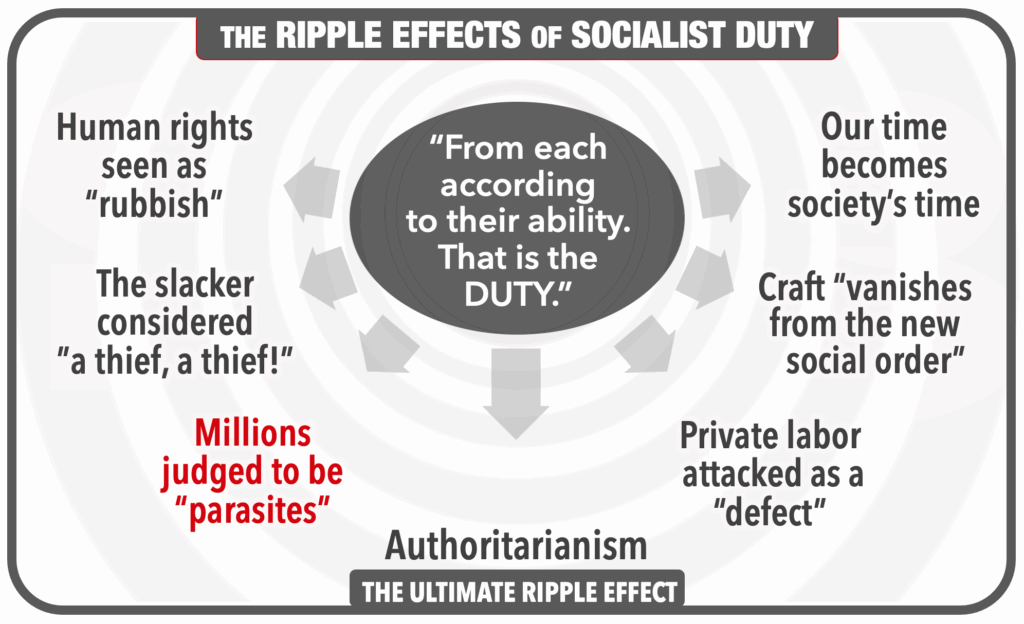
Socialism's parasite fixation is one ripple effect of its foundation on the duty of "from each according to their ability," the obligation to give our time and talents to society. Socialists explicitly link this socialist duty to the parasite concept—for example, describing the duty socialism requires as the "duty not to be a parasite."[9]
The plan is that, come socialism, all of us would be made to "return to duty."[10] Parasites would be treated as "the worst enemy"[11] and "destroyed."[12]
Given its foundation on compulsory duty, socialist philosophy unsurprisingly considers suppressing parasites as morally correct. But it also asserts that parasite elimination is the key to unlocking the socialist future.
To socialist thinking, our present society is teeming with parasites. They are seen as a vast pool of wasted labor that socialism intends to put to work fulfilling its many sales promises.[13]
Thus, the socialist fixation with parasites doesn't end with the arrival of socialism—it intensifies. In one illustration of this reality, Fidel Castro, the longtime leader of socialist Cuba, attacked Cuban citizens he considered parasites in over a hundred speeches.[14]
Should socialism return, socialists won't be limited to judging millions as parasites. They'll have the power to punish as well.
Nobel laureate Brodsky's sentence for supposed parasitism was relatively mild. Tens of thousands have been "liquidated" for this socialist crime[15]—the crime of treating your life as your own.
This paper aims to study the "parasite" concept and its role in socialist philosophy. We'll review the history, causes, and anti-liberal implications of this socialist obsession.
A BRIEF OUTLINE
OF A LONG HISTORY
Nine generations of name-callers
Socialism's fixation with parasites goes back to this philosophy's earliest days. It's been handed down from one generation of socialist thinkers to the next eight times.
In 1822, socialist superstar Charles Fourier was already labeling two-thirds of society (and all Jewish people, as we'll see further below) as parasites:
Null or negative functionaries constitute TWO-THIRDS of the population; namely: Domestic Parasites … Social Parasites … Accessory Parasites.[16]
Two centuries later, today's socialists are still berating parasites.
In his recent work "Imagining Art After Capitalism," Mat Callahan writes that socialism would create a society in which people have no need for anyone
to make art for them, and certainly not for an elite corps of pampered parasites.[17]
Similarly, present-day socialist thinkers George Burns, Paul D'Amato, and Deirdre Griswold respectively write:
Private ownership of capital is parasitism, an injustice whether big or small.[18]
The ruling class today has become entirely parasitic, siphoning wealth but serving no useful social function.[19]
What's more important? The "right" to become a rich parasite? Or the right to a job."[20]
Countless prominent socialists have attacked parasites across nine generations of socialist thought.
Dozens of examples appear in this paper. But to capture the breadth and depth of the socialist preoccupation with parasites, we present over one hundred additional examples of socialists denouncing "parasites," "parasitism," and all things "parasitic" on page 101 Damnations.

The "duty not to be a parasite"
Why do socialists see parasites everywhere they turn? It's a byproduct of socialism's foundation on compulsory duty.
Parasites are those whom socialists judge to be failing their philosophy's requirement of duty.
As socialists note themselves, the socialist belief that we owe our abilities to society is a repudiation of the philosophy underpinning liberal democracies.[21] In liberal philosophy, the time that makes up your life is considered your property—yours to use in essentially any way you wish. Others may disapprove of your choices, but so what? The time is yours.
Socialism rejects this most important of liberal principles. It starts with the requirement to give our time and talents to society—the duty expressed by the famed socialist axiom "from each according to their ability" (which has been the socialist standard of duty for over 170 years[22]).
This duty morphs our time and talents into what socialism treats as society's property. To socialism, our time becomes society's time.
From the socialist perspective, if you're doing things socialists disapprove of, you're not wasting your time; you're wasting society's time while still enjoying the benefits of society. Thus, you're a parasite.
Socialists make explicit links between their philosophy's requirement of duty and the parasite concept. Consider three examples:
Beatrice and Sidney Webb were leaders of the noted British socialist organization, the Fabian Society. In one of their jointly-authored works, they compare the liberal constitutions of France and the United States to the socialist constitution of the USSR.
They applaud the socialist constitution's inclusion of compulsory duties required of each citizen. And they criticize the French and U.S. Constitutions for the fact that compulsory duties are, in their words, "strikingly absent."
In the same passage, the Webbs describe socialist duty as the
duty not to be a parasite.[23]
Another celebrated socialist thinker, Étienne Cabet, also links being judged as a parasite to failing socialism's duty of contributing to society according to one's ability:
The greatest genius on earth, whose work isn't for the general interest, is regarded as a parasite completely inferior to the least intelligent functionary, contributing to the common work according to one's ability.[24]
Again, we see that socialism treats our time as society's time. Those running socialist society are given the power to decide what is "for the general interest" and, thus, the right to control how we use the time in our lives. Failing to perform work approved as a valid use of society's time makes you a parasite.
Sylvia Pankhurst similarly makes an unambiguous connection between failing to serve the community and parasite status:
We aim at the common service; we desire that all should serve the community, that no longer should there be diverse classes of persons; the hewers of wood and the drawers of water [versus] the intellectuals, the leisured classes, who are merely parasites. The Individualist cries: 'Freedom.' We answer: 'Thou shalt not exploit.' 'Thou shalt not be a parasite.'[25]
And Charles Fourier, the socialist superstar who considered two-thirds of society to be parasites, tells us that socialist society
will return to duty and return to productive work those legions of parasites called merchants.[26]
This plan for those "legions of parasites called merchants" is the same plan socialism has for all of us: to make us "return to duty."
Why do attacks on parasites go back to socialism's earliest days? Because socialism's foundation on duty does as well.
Why do socialist attacks on alleged parasites continue today? Because socialism remains—and always will remain—inexorably based on compulsory duty.[27]
Socialism's parasite fixation demonstrates the dangerous and anti-liberal premise at the heart of socialist philosophy: the belief that the time in our lives should be treated as society's property to control.
"These useless ones
are not just idlers"
Socialism is unequivocal in considering those who avoid work to be parasites (as we detail at slackingistheft.org).
But slackers are only the tip of socialism's parasite iceberg. The vast majority of parasites are workers—even workaholics.
Lucien Deslinières explains:
These useless ones are not just idlers as you might think. They are workers and sometimes even work a great deal, but their work produces nothing. … Now these useless workers, socialism will suppress them; it will make them useful. Instead of being parasites they will become producers.[28]
How can you work a great deal, or even too much, and still be a parasite?
By performing work that socialists consider "socially useless"—work that socialists believe wastes what is supposedly society's time. Democratic socialist great Eugene Debs connects the dots:
Social parasitism must cease; every man must be a producer or perform some socially useful function.[29]
(Debs is an icon of democratic socialism. Yet, as we illustrate with over two dozen examples, he attacks alleged parasites in a fashion identical to authoritarian socialists.)
As socialist philosophy has always considered the time in our lives to be society's time, it's also always called for society to decide what work is an approved use of this time and for suppressing "useless" work.
In one of the dozens of available examples of such rhetoric, celebrated socialist William Morris tells us that come socialism,
useless occupations would be got rid of speedily.[30]
You may consider your work incredibly useful—personally useful. But if those running socialist society deems this work useless, it's going to be "got rid of speedily."
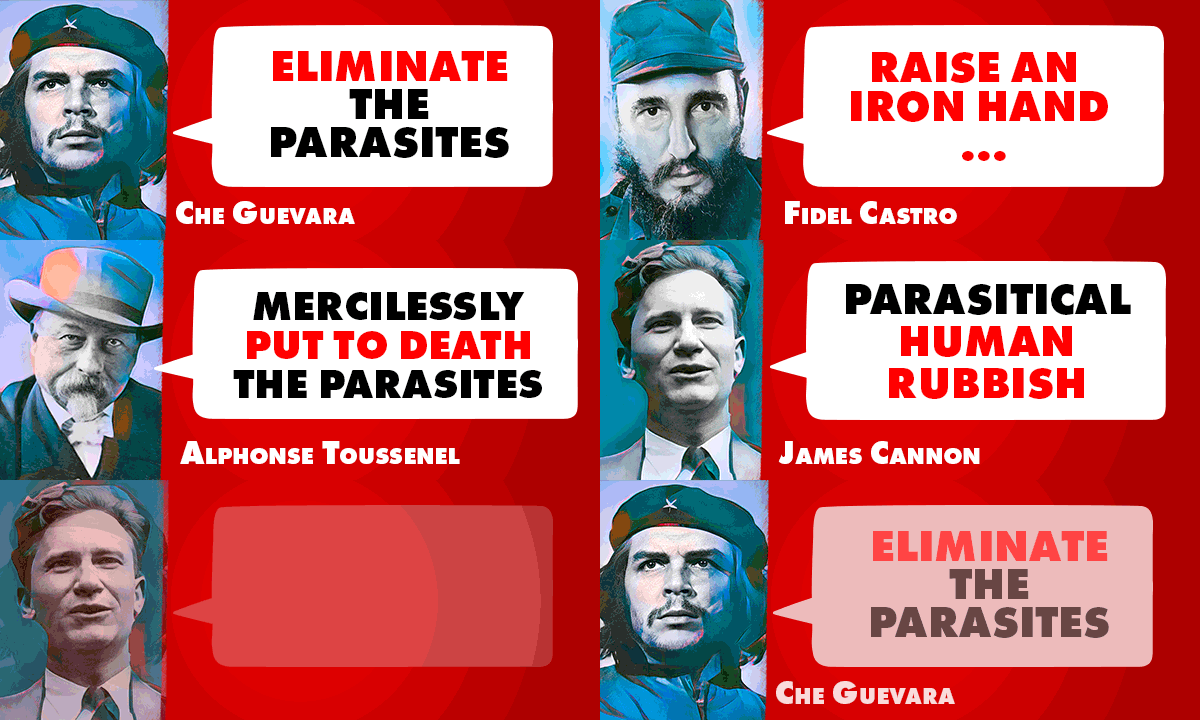
(Sources for some quotes appearing in this GIF are found in our companion resource "101 Damnations.")
PARASITES IDENTIFIED
"Writers … and others who now
escape from legitimate labour"
What are some of the species of parasite that socialists see in our society—professions socialists think of as parasitic, socially useless, a waste of what they consider society's time?
Capitalists are unsurprisingly parasite species number one. Leo Huberman writes:
Ownership, once functional, is now parasitic. The capitalists, as a class, are no longer needed. If they were transported to the moon production need not stop even for a minute.[31]
Karl Kautsky reports that it's not just large businesses that are parasitic to socialism. Small businesses are the same or worse, "producing only evil" and parasites:
The small capitalist class … shows itself as a political factor to be capable of producing only evil and social destruction, just as economically it has today become little more than a parasite on the social body, maintaining its existence only at the expense of society.[32]
John Keracher, in his Producers and Parasites, expands the list:
The legal profession, insurance, advertising, and a host of other parasitic enterprises cling to the body of the real parasite—capitalism.[33]
And Paul Lafargue explains that it's not just the wealthy who are parasites, but all those whose work is connected with the well-to-do:
All consumed by the rich as well as by the domestics and others who serve the rich, and satisfy their tastes and needs, is pure waste … This useless capital must be suppressed to reduce the costs of social production. The social revolution is charged to accomplish this work of economy … it will get rid of these parasites.[34]
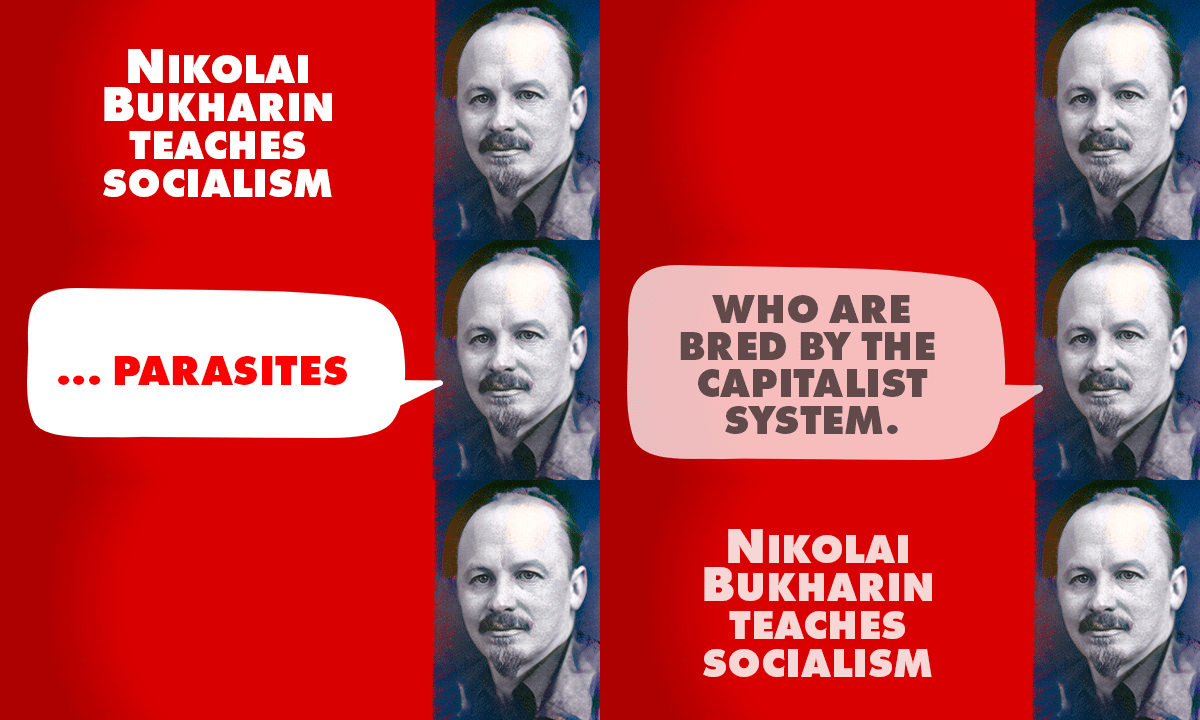
As a final example of the dozens of types of work that socialists have labeled "parasitic," let's return to the artist-parasite.
We've seen Mat Callahan state that socialism would produce a society that does not need "an elite corps of pampered parasites."[35]
Emile Vandervelde and L. G. Money (as well as Nikolai Bukharin in the gif above) express similar thinking and demonstrate again how socialism's foundation on duty leads socialists to pass judgment on what we do with our lives. Perhaps you, too, are a parasite wasting society's time by pretending to be a writer or some other type of artist:
For each Goethe, each Tolstoy, each Puvis, how many slackers are there who try to disguise their parasitism, by taking the look of the intellectual laborer![36]
As for the great army of writers, journalists, ministers of religion of all denominations, dancers, philosophers, lecturers, and others who now escape from legitimate labour, and from their honest share of what needs to be done that we all may live … there will be no room for them as professionals in the Great State.[37]
Artists. Writers. Journalists. Ministers. Dancers. Socialists say these and so many other types of parasites "escape from legitimate labor."
Callahan, Vandervelde, and Money are but three of the socialists who label professions in the arts as parasitic.
Even socialist William Morris, a great artist himself, considered the vast majority of art in our society to be "sham art" that should be eliminated by socialism[38]—sham art created by sham artists, who are no doubt parasites all.
"There must be many farmers,
but not too many writers"
Mat Callahan attacks artists as "pampered parasites." But that doesn't mean this is a universal socialist sentiment. At a minimum, it's a terrible sales tactic.
Most socialists would surely say that careers in the arts are socially useful rather than socially useless and parasitic. But the fact a particular job is considered socially useful doesn't mean a socialist society would simply let anyone who wished to pursue that career take their shot.
No, approving a job as socially useful only means that socialism would permit some quantity of society's time to be used for that profession.
Socialist society would determine the "right" amount of society's time to use for each socially useful task, yielding the "right" number of artists, poets, and so on.
This thinking is direct from the gospel of Karl Marx, who says that in socialist society the
time of production devoted to different articles will be determined by the degree of their social utility.[39]
Richard Lahautière makes the same point as Marx, but in a simplified form:
There must be many farmers, but not too many writers.[40]
Why does socialism say that there must not be "too many" writers?
Because permitting "too many" would waste society's time, costing society farmers and other workers deemed more important.
We see this socialist logic at work in the case of parasite-poet Joseph Brodsky. During his trial for violating the USSR's anti-parasite laws, the judge asked him:
Who recognized you as a poet? Who enrolled you in the ranks of poets?[41]
Brodsky made himself a poet without society's permission. He caused the USSR to have "too many" poets.
He used "society's time" for poetry without being officially "enrolled … in the ranks of poets." Thus, Brodsky was considered a parasite.

(The sources for some quotes in this GIF are in our companion resource, "101 Damnations.")
"The name of the parasite
… is that of the Jew"
There's one other group that a great many socialists have attacked as parasites: Jewish people.
Hostility towards Jews is a terrible stain on many creeds—not just socialism. But there's no denying socialism has had its share, if not more than its share, of anti-Semites.
Socialism's anti-Semitism problems continue today, as evidenced by complaints about the British Labour Party from many of its own members, including Jewish Labour Party members who voted to condemn their own party as "institutionally antisemitic."[42]
(The Labour Party is an alliance of left-leaning politicians, many of whom identify as socialists, including its two most recent leaders: Jeremy Corbyn, 2015–2020, and Keir Starmer, 2020–present.[43])
In 2019, investigative reporting revealed that more than 850 internal complaints of anti-Semitism had been made to Labour Party officials.[44] Over a quarter of these complaints were never examined, and little to no action was taken in the vast majority that were.[45]
The United Kingdom's Equality and Human Rights Commission conducted an investigation that announced its findings in October 2020. It concluded that Jewish members of the Labour Party had suffered "unlawful acts of harassment and discrimination."[46] It also found
a culture within the party which, at best, did not do enough to prevent anti-Semitism and, at worst, could be seen to accept it.[47]
These present-day issues reflect socialism's long history of serious problems with anti-Semitism.
Noted socialist philosophers who attack Jews in their writings include Auguste Blanqui, Auguste Chirac, Lucien Deslinières, Theodor Dézamy, Charles Fourier, J. A. Hobson, Henry Hyndman, Pierre Leroux, Benoit Malon, Pierre-Joseph Proudhon, Gustave Rouanet, Alphonse Toussenel, and Gustave Tridon.[48]
There have been attempts to excuse the many instances when socialist thinkers call Jews "parasites" and other slurs by claiming these attacks were not a reflection of genuine anti-Semitism.
This theory argues that socialists defame Jews not out of true hatred but because they associate Jewishness with capitalism and the liberal political philosophy underpinning capitalism.[49] Thus, attacks on Jews are really attacks on capitalism/liberalism. Apparently, this somehow makes them defensible.
Linking capitalism and liberalism with Jewishness is, in fact, a long-running socialist tradition. It's a connection Karl Marx (himself Jewish) made in his On the Jewish Question[50] and that Werner Sombart makes in his The Jews and Modern Capitalism:
Let me avow it right away: I think that the Jewish religion has the same leading ideas as Capitalism. I see the same spirit in the one as in the other.[51]
But despite attempts to explain away socialist verbal assaults on Jews, it's clear there are socialists who hate Jews as much or more than they hate capitalism. One may wonder if, rather than their disdain for capitalism leading them to disparage Jews, it wasn't hatred for Jews that made some of these socialists attack capitalism.
Alphonse Toussenel is one socialist that even most socialists concede was an anti-Semite. Among his works, Toussenel authored The Jews, Kings of the Epoque,[52] a book that argued Jews controlled France, a claim soon "echoed by an antisemitic chorus."[53]
In one instance, he writes:
The name of the parasite cursed for centuries by all workers, is that of the Jew.[54]
Even in Toussenel's attacks on Jews, we discover a link to the socialist belief that our time is society's property and that, as such, it's society's right to pass judgment on what we do with our lives.
Why are Jews parasites to Toussenel? It's because Jews haven't performed tasks he deems to be "useful":
Not one Jew has done useful work with their hands, since the beginning of the world.[55]
Another example of a socialist thinker who regularly attacks Jews in his writings is Charles Fourier, one of socialism's most important philosophers. In one instance, Fourier writes:
Every government that is committed to good morals should restrain the Jews, compel them to do productive work, and admit them in only in proportion to one-hundredth for vice; a merchant family for a hundred families agricultural and manufacturing; but the philosophy of our century admits inconsiderately legions of Jews, all parasites, merchants, loan sharks, etc.[56]
In addition to calling Jews parasites, Fourier derides the liberal philosophy ("the philosophy of our century") of capitalist society. He blames it for permitting Jews to do as they wish with the time in their lives rather than what Fourier thinks best.
Fourier blamed liberalism for the presence of "legions of Jews, all parasites" in France. Socialist thinker George Lichtheim explains:
Fourier had come to see Jewish emancipation as an aspect of modern society to which he was hostile: the unleashing of individualism.[57]
Liberalism, individualism, capitalism, and Jews: all tightly connected, and all evil to the thinking of Fourier and so many socialists.
What is Fourier's strategy for dealing with what he sees as the Jewish "parasite" problem? Compulsion. Government force.
Fourier calls for the French government to "compel them to do productive work." Jews (or any of us for that matter) should not be permitted to use their lives as they wish. Instead, the state should use force to make Jews perform tasks socialists approve as valid uses of what they consider to be society's time.
THE AUTHORITARIAN SOLUTION
"Drastic measures to
eliminate the parasites"
The plan for parasites come socialism is a super-sized and generalized version of Charles Fourier's anti-Semitic plan to "compel them [the Jews] to do productive work."
Lucien Deslinières and Paul Louis respectively explain:
Now these useless workers, socialism will suppress them; it will make them useful. Instead of being parasites, they will become producers.[58]
It will be precisely one of the first tasks of socialism, when its time comes, to start with a view to the decommissioning and reclassification necessary, between the parasitic tasks and those of collective interest.[59]
Che Guevara similarly calls for taking
drastic measures to eliminate the parasites, be they ones who hide in their attitude a deep hostility towards socialist society or ones who are irredeemably against work.[60]
Socialism's duty of "from each according to their ability" is not only the underlying cause of this philosophy's parasite fixation, but it's also what gives socialist society the authority to take "drastic measures" against parasites. This duty empowers socialist society to both punish alleged parasites and eliminate all work deemed parasitic.
Just how would socialist society determine which jobs are socially useful and which are not? Even in the much-promised but never seen case where a socialist society makes decisions by democratic vote, socialists admit that a majority vote would decide.[61]
Thus, in this best-case scenario, socially useful would really mean "approved by the majority," and socially useless/parasitic would really mean "only approved by a minority."[62]
"A country … without
parasites of any type"
Socialist philosophy argues that eliminating supposed parasites is morally correct. But it also regards parasite suppression as the pathway to the perfected socialist future. As Ramsay MacDonald reports:
All that Socialism and a Socialist system of distribution can claim to do is to destroy social parasites.[63]
MacDonald explains that destroying parasites is the key weapon in the socialist arsenal—it's "all that Socialism … can claim to do."
Destroying parasites is destroying capitalism. And destroying parasites creates what socialist theory assumes will be a vast pool of labor that can be used to pursue socialist goals.
Why does socialist theory predict socialism would outproduce capitalism, thereby creating the possibility of a perfected socialist society based on the axiom "to each according to their need"?
Because it presumes socialism would eliminate the legions of parasites that socialists believe exist in capitalist society, forcing all to perform work approved as socially useful.
Désiré Descamps, Laurence Gronlund, Bernard Shaw, and Fidel Castro, respectively, make it clear the road to socialism is paved with repurposed parasites:
Put these millions of insatiable parasites to work and double your agricultural and industrial production.[64]
By putting all our parasites and superfluous workers where they can work productively … the stock of the good things of this life will thereby be very much enlarged, perhaps doubled.[65]
It is also alleged that existing poverty is due to the world being too small to produce food enough for all the people in it. The real cause is that there are too many people living as parasites on their fellows instead of by production.[66]
We will have such an abundance of everything…. We can have it with our work, with the effort of our working people, with a country of workers without parasites of any type.[67]
The plan to "destroy social parasites" is also behind claims that socialism would result in a reduced workweek. Suppressing slacking and work deemed "useless" would mean more people working on fewer tasks.
One example of this common socialist theme from Georges Renard, who explains:
It [work time] will be reduced to the minimum by the sole fact that everyone will take part in the work and that the parasites and the useless will have returned to the ranks of the laboring army.[68]
One thing is clear: a socialism that did not deliver on Che Guevara's call for taking "drastic measures to eliminate the parasites" is a socialism that could not deliver on its many sales promises.
Anyone claiming that socialism would not result in the suppression of parasites and of jobs deemed "parasitic" (in other words, jobs held by parasites) has been misled or is looking to mislead you.
"Suppressed"? No, "Set Free"
Socialists have long attacked marketing in capitalist society as unethical and as waste.[69] All work that's related to sales and advertising ranks high on socialism's list of parasitic activities to be eliminated.[70]
The irony of this disdain for selling in capitalist society is that socialists are engaged in sales and marketing 24/7. The only difference is that socialists are hawking a political philosophy instead of weight-loss or brighter teeth.
Socialism is a multi-century marketing effort that uses every sales trick in the book.
The examples quoted above speak in clear language about the fate of alleged parasites come socialism. Socialism is going to "destroy social parasites." It's going to "suppress them." It's going to "compel them to do productive work."
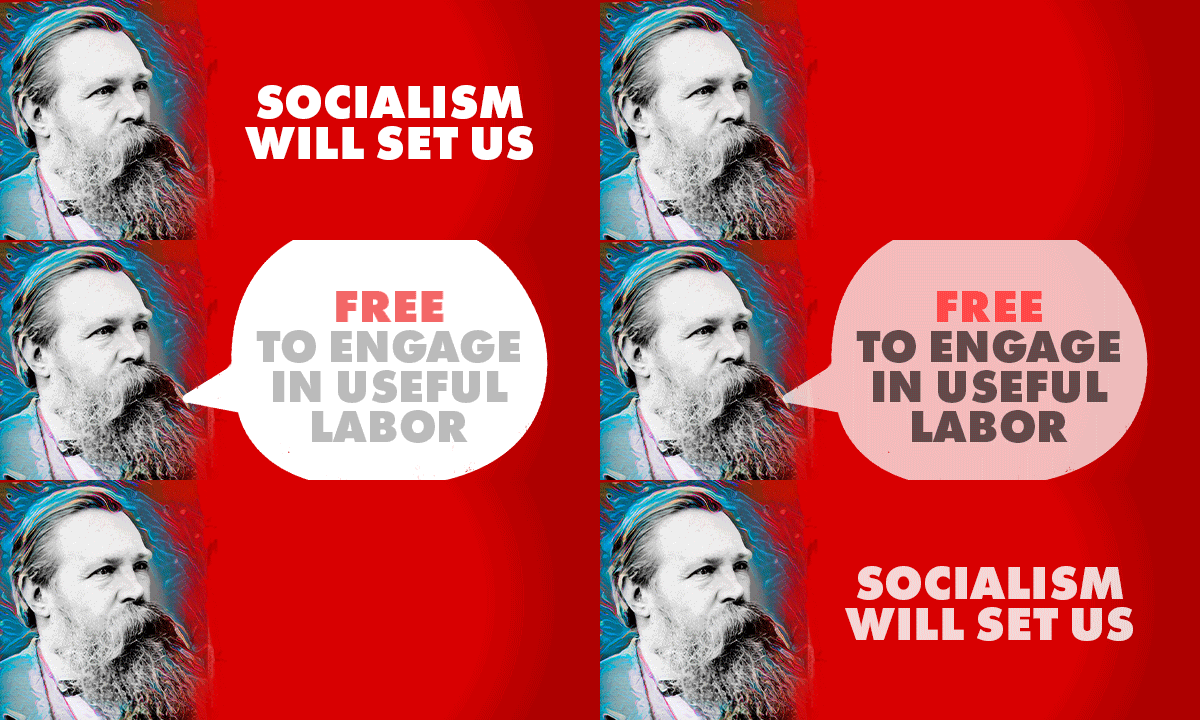
But talk about suppression can scare off potential customers, so Friedrich Engels came up with a bit of marketing spin.
What does Engels say would happen to the vast number of us whose work he considers "at best, superfluous"[71]? Come socialism, we would
become free to engage in useful labour.[72]
We're not going to lose our supposedly "parasitic" jobs. No, we're going to "become free."
Could an advertising agency have distorted reality any better?
Other socialists adopted Engels's chicanery. For example, August Bebel and J. Morrison Davidson, respectively, write that socialism would mean:
A large army of persons of both sexes is thus set free for productive work.[73]
Nine out of every ten persons now engaged as distributors would be set free for useful production.[74]
Socialism is going to set us free. "Free for productive work."
(See craftidiocy.org for an example of Cuban socialist leader Fidel Castro describing the suppression of "artisan-type enterprises" as resulting in the "freeing" of 40,000 Cubans for work in large industry.)
WHO ELSE PREACHES
"ALL PRODUCERS AND
NO PARASITES"?
Who's the author of these words praising the socialist party and attacking parasites?
The resurrection of the most useful and most vilified part of humanity is owed to the Socialist Party. It is the Socialist Party that told the peasantry: the earth is yours and not that of the parasites that exploit you. [75]
It's Benito Mussolini. Socialist Benito Mussolini.
But the same Mussolini who would become the world's first fascist dictator.
Before becoming the "the father of Fascism,"[76] Mussolini was a socialist—and not some run-of-the-mill socialist either.
He was a leader of the Italian Socialist Party[77] and editor-in-chief of Avanti!, the party's daily national newspaper.[78] And prior to that, he was the editor of three smaller socialist newspapers.[79]
Mussolini gave dozens of speeches and wrote hundreds of articles selling socialism.[80] He even founded his own socialist theoretical journal, Utopia.[81]
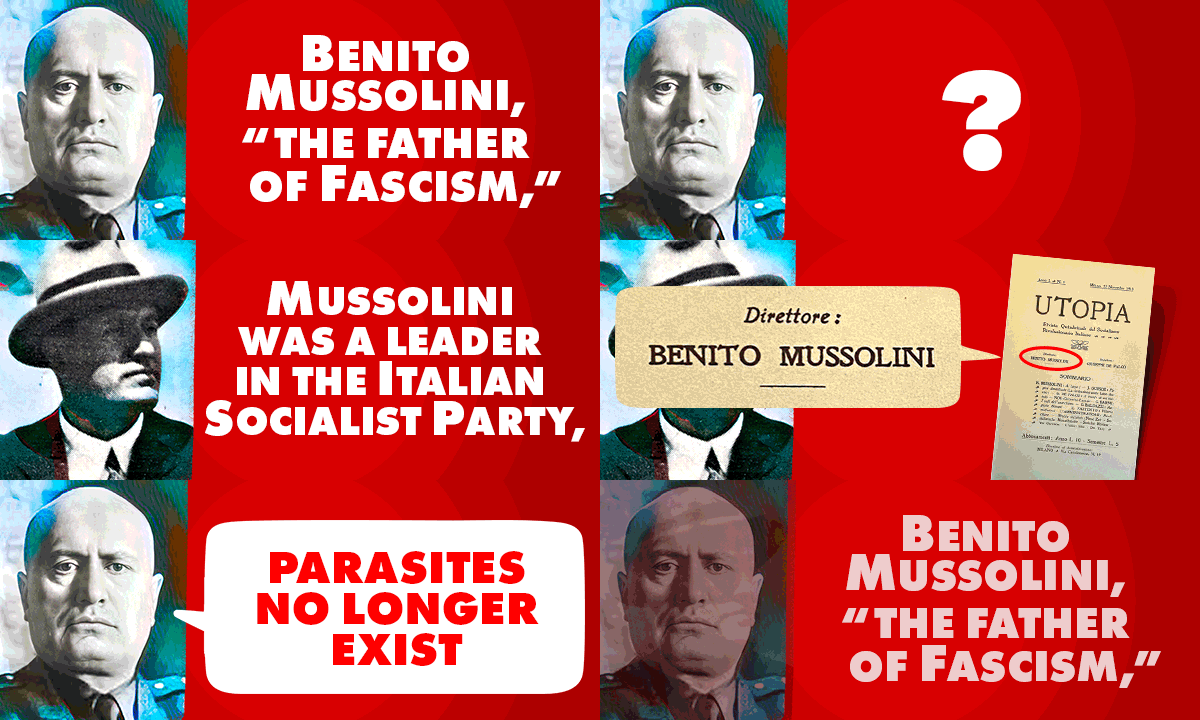
(Sources for some of the facts appearing in this GIF are found in "Our 'So-Called' Rights."
When Mussolini somersaulted from left-wing authoritarian to right-wing one, the socialist love of duty and the resulting loathing of parasites came with him. His socialist anti-parasite rhetoric soon became his fascist anti-parasite rhetoric:
We are the generation of builders … craving for the greatness of the nation of tomorrow, which will be the nation of all producers and no parasites.[82]
The homeland that we dream of is where … parasites no longer exist.[83]
Mussolini's fascist vision of a society without parasites mimics the socialist vision we've seen above.
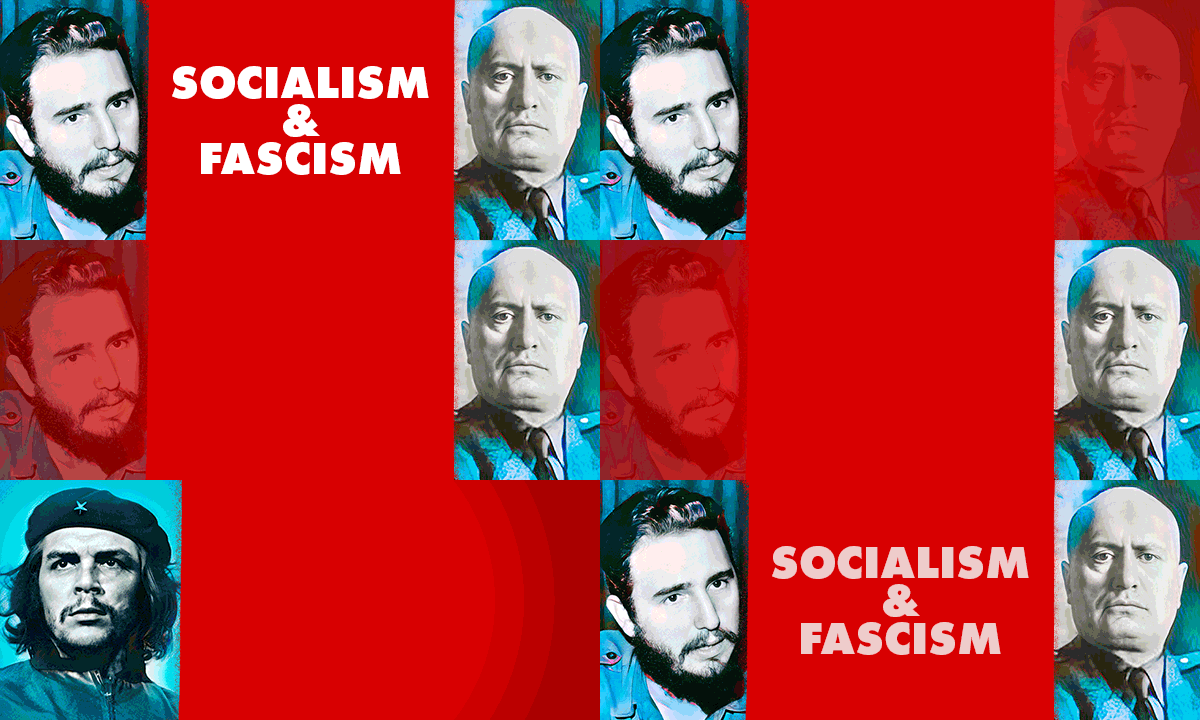
There isn't the slightest difference between Mussolini's promise that fascism means a "nation of all producers and no parasites" and Fidel Castro's promise that socialism means "a country of workers without parasites of any type"[84] and that Cuba "must be more and more a country of workers and less and less a country of parasites."[85]
Fascism is the only other philosophy that uses "parasite" in the bulk fashion socialism does. And socialism itself is in no small part responsible for this fact.
While there are individual philosophers not associated with socialism or fascism who have used "parasite" in their writings, no other philosophy has made this pejorative a term of art like socialism and fascism have.
But which philosophy can say that "parasite" has been employed by hundreds of its thinkers across nine generations?
Only socialism can claim this dubious distinction. Not even fascists can compete.
WHAT IF THE P-WORD DISAPPEARS?
Socialism's war on parasites continues today. This term remains a common one in the socialist lexicon.[86]
But what if "parasite" stopped appearing in new socialist books, articles, and blog posts? What if socialists decide this term is hurting sales and cease using it?
Would this change indicate socialism's parasite obsession had come to an end?
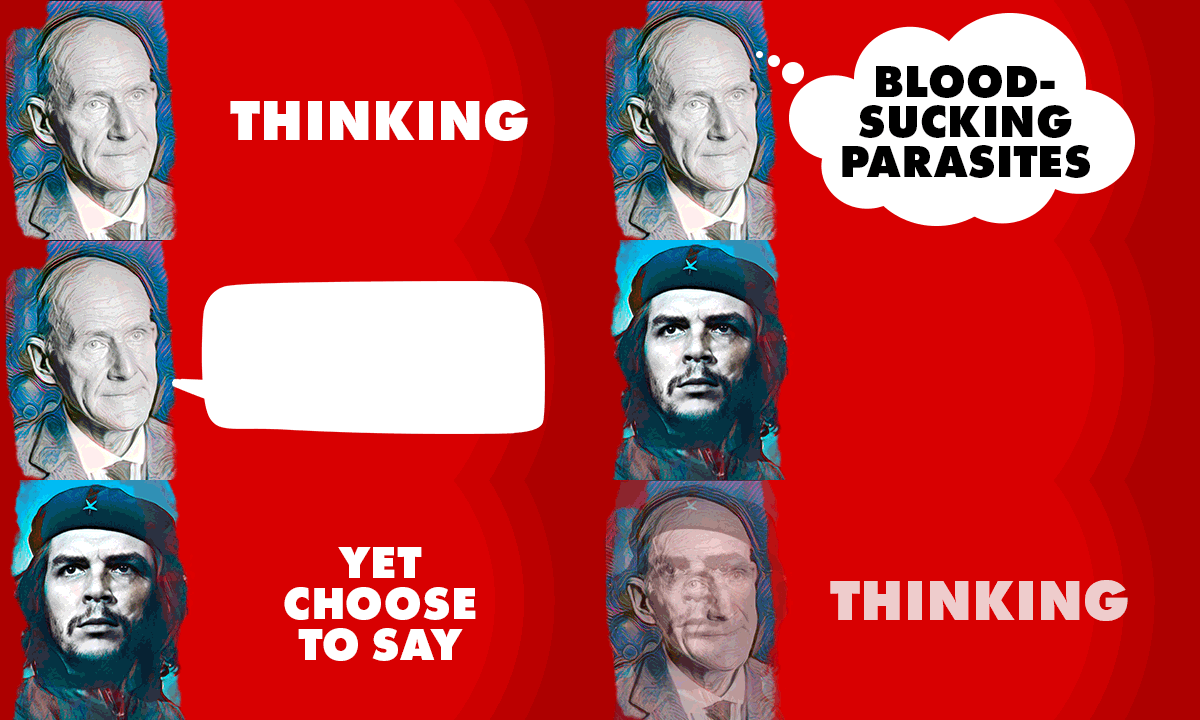
Absolutely not. Choosing not to say "parasite" or write "parasite" doesn't mean someone isn't thinking "parasite."
Whether they say it or not, socialists would continue to think "parasite" each time they interact with one of the millions of us who perform work they consider socially useless/parasitic, a waste of society's time.
Seeing parasites is simply an automatic byproduct of socialism's foundation on the duty of "from each according to their ability." As this duty is a fixed aspect of socialism, socialists will forever see parasites at every turn.
"PARASITISM, IT'S THE ENEMY!"
What type of philosophy is based on labeling millions with a slur?
What type of philosophy has a term like "parasite" appearing as a standard element in its theoretical writings?
What type of philosophy shares both its foundation on compulsory duty and the resulting belief that parasites are "the enemy" and "the worst enemy"[87] with fascism?
An anti-liberal philosophy. An authoritarian philosophy.
It's common to think of socialism as a kind of left-wing liberalism. But it's not.
Each of the thousands of times socialists have used the term "parasite" is a reminder that socialism is based on the repudiation of liberalism and seeks instead to, as Mao Zedong put it, "combat liberalism."[88]
Every socialist use of "parasite" is a reminder that socialism rejects the core principle of liberalism: that we each own the time in our lives and have the right to use that time as we wish.
We each have an incredibly brief time to live. This time should be ours to use as we choose, not something we're born owing to society—that is, to those running society.
Thanks for reading "The Socialist Obsession: The Central Role of 'Parasites' In Socialist Thought."