

"Every large factory which arises on
the ruin of the shops of the small artisans
we consider an advance in civilization."
— American Socialist Philosopher
Laurence Gronlund
Socialism's anti-craft bias is revealed
by core aspects of socialist philosophy
that you may not know about,
but knowledgeable socialists do.
CONTENTS
- INTRODUCTION
- MARX ON CRAFT
- WHOSE TIME IS IT?
- FOUR MORE CONFLICTS
- A SOCIALIST SALES TRICK
- "DON'T WORRY"
INTRODUCTION
The automatic workshop wipes out specialists and craft-idiocy.[1]
This bit of bah humbug may sound like the words of some villainous capitalist Scrooge, but these are the words of Karl Marx, the central figure of socialism.
As one of today's socialist thinkers admits:
Marx completely rejects the craft ideal.[2]
And Marx isn't alone when it comes to socialists rejecting craftwork. Every quote on this website comes from a socialist thinker, and their words demonstrate that socialism and craftwork are at complete odds.
Here's a small additional sample of this reality from Nikolai Bukharin, Paul Argpriadès, and Lucien Deslinières, respectively:
It is not enough that the capitalists should go. It is necessary to establish production on the largest possible scale. All small and futile enterprises must die out. All work must be concentrated in the largest possible factories, works, farms.[3]
By the centralization of services, we will suppress the small workshops where three or four workers labor strenuously without producing a hundredth of what they could produce in a large social factory.[4]
The State will suppress all small workshops, all work by hand …. instead of little workshops, we will have immense factories.[5]
Socialism simply can't be squared with the wonderful goods we find at craft fairs and on Etsy, nor with the people who make them. On the contrary, craftwork violates multiple tenets of socialist philosophy.
That's why noted American socialist Laurence Gronlund (touted by today's socialists as a proto-ecosocialist[5a]) says:
Every large factory which arises on the ruin of the shops of the small artisans we consider an advance in civilization.[6]
There are four significant conflicts between socialism and craft:
First, socialism says small-scale production like craft literally creates capitalism "continuously, daily, hourly, spontaneously, and on a mass scale."[7]
Second, socialism considers efficiency a moral necessity. By socialist standards, inefficient craft production is an immoral waste.
Third, socialism argues that the crux of the problem with capitalist production is that there are millions of independent producers, making production fragmented and "anarchical." Craftwork is the poster child for this "anarchical" production that socialism despises.
And fourth, socialism is based on "social control" that requires limiting the number of producers and making them uniform. Craft is completely incompatible with social control.
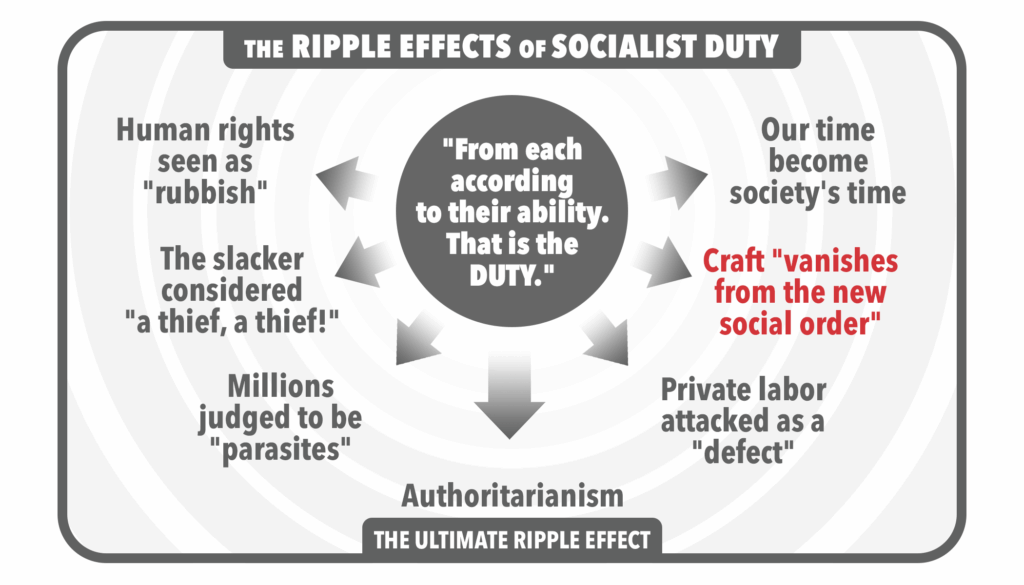
Each of these four clashes between socialist philosophy and craft is itself a byproduct of an underlying fifth conflict resulting from socialism's foundation on the duty of "from each according to their ability."
This duty turns our abilities—our time and talents—into what socialism treats as society's property to control. As we'll explore, it spawns the socialist thinking that conflicts with craft.
As illustrated in the graphic below, desiring that craft "vanish from the new social order" is but one of many negative byproducts of socialism's foundation on compulsory duty.
Socialism's anti-craft biases are also a window into this philosophy's desire for a government of unlimited power. We'll see some of socialism's most celebrated philosophers nonchalantly call for the socialist state to destroy craft businesses by the hundreds of thousands.

That core aspects of socialist philosophy are strongly anti-craft doesn't come as news to knowledgeable socialists. So why is this likely news to you?
Because today's socialists recognize that attacking craftwork would be sales suicide.
But no matter how much time socialist politicians spend glad-handing at craft fairs and downing pints at local breweries, it doesn't tell us the first thing about socialist philosophy.
Such stunts don't represent socialism any more than a Catholic politician marching in a pride parade represents the Pope. A philosophy must be evaluated on its core beliefs, not on the Instagram posts of its salespeople.
The founding principles of socialism make it a philosophy that's fundamentally anti-craft. It's a philosophy whose intellectual leader describes craftspeople as pinheads and whose thinking "requires the demise of craft labor."[8]
MARX ON CRAFT
"Marx completely rejects the craft ideal"
Karl Marx is the most important socialist philosopher of all time. His thinking has defined socialism for the past one hundred and fifty years. And it still does today (the founder of the Democratic Socialists of America even states that Marx should be considered a democratic socialist).[9]
Present-day socialist thinkers Sean Sayers and Paul Adler describe his views:
Marx completely rejects the craft ideal. … It's a limited, individual activity.[10]
Marx saw the destruction of craft skills as having an emancipatory significance.[11]
The destruction of craft skills is "emancipatory"—that is, freeing. Craftwork is completely rejected because it's an "individual activity."
Marx is against craft not only because of its inefficiency but also because he's against professions in which one works individually.
He strongly favors "social work," particularly group work in large industry, believing it molds workers into the type of people socialism requires, whereas the individual nature of craftwork does not.[12]
Marx not only rejects craftwork for being an "individual activity," he even attacks the specific nature of craftwork: the fact that the craft artisan performs all steps in the production of an item. He makes the snarky assertion that this style of labor creates workers who have
the knowledge and the consciousness of the pin.[13]
Working as the craftsperson does results in having the smarts of a pin. It makes you a pinhead—an idiot.

"It was necessary to destroy the village in order to save it"
Socialist G. A. Cohen is a celebrated modern-day Marxist philosopher. He's been described as "arguably the leading political philosopher of the left" and the "most important interpreter of Marx in the analytical tradition."[14]
In one of his treatises, Cohen examines the implications of Marx's thinking regarding craftwork.[15] Cohen concludes that under Marx's socialism, craftwork would not be permitted as a profession in the first phase of a socialist society.
Craft would only return to socialist society if this first phase of socialism succeeded in creating an ultra-automated second phase—a society so unbelievably mechanized that everything needed by the world's population could be produced without a single human actually working.[16]
Cohen explains that what people would do in this perfected socialist society that permitted the return of craft would only
resemble activity which once was labor.[17]
There would be no actual work, but only activities that resemble what was work. In other words, there would only be hobbies.
Should such a fantasyland ever exist, it's untold centuries in the future. And Cohen admits that those who hope to pursue craftwork as a career in socialist society are not going to be pleased by his conclusions.[18]
During the Vietnam War, a U.S. Army officer infamously stated: "It was necessary to destroy the village in order to save it."[19] The only method Cohen can find to permit craft in Marx's socialism follows this logic.
This noted Marxist thinker even writes that creating a society that solves Marx's objections to craftwork first
requires the demise of craft labor.[20]
It's necessary to destroy craft in order to save it.
"Wiping out" small operations " one of the strong points" of socialism
Marx's animus towards small-scale production wasn't limited to craftwork. He and Friedrich Engels (Marx's collaborator and socialist superstar number two) were against small enterprises of all types.
And their anti-small biases applied not only to industry but also to agriculture. Marx and Engels called for "industrial armies" to replace small farms.[21]

Sources for quotes in this GIF (as some don't appear elsewhere in this paper).
Marx and Engels's expected and desired a socialist society that eliminated small production of all types and replaced it with the largest-scale industry and agriculture possible.
Numerous demonstrations of this fact are found in their writings.[22] Engels, for example, argues that the "rational order" of socialism would achieve its "greatest savings of labour power" by suppressing small operations and "fusing" them into large ones.[23]
Socialism's biases against small enterprises both predate Marx and are not unique to Marxism.[24] But there's no question the anti-small thinking of socialism's most important philosopher poured plenty of gas on the fire.
Karl Kautsky was nicknamed "the Pope of Marxism"[25] for being the leading interpreter of Marx's thought after Marx and Engels died.
Here, the "Pope" channels the socialist messiah Marx, stating that "one of the strong points" of socialism is that it creates the possibility of
wiping out in the quickest possible manner [by using government force] the ruins of the outgrown means and methods of production.[26]

WHOSE TIME IS IT?
"Labor is not an individual tool … but a tool for an entire society"
Marx's disdain for craftwork wasn't a pet peeve. And socialism's disdain for it isn't about loyalty to Marx. Socialism is anti-craft because its underlying principles are anti-craft.
The ultimate cause of the rift between socialism and craftwork is found in socialism's rejection of the liberal philosophy underpinning capitalist society. Socialism's anti-craft biases are but one of the many ripple effects of the anti-liberal beliefs on which socialism is based.
The founding principle of liberalism is that we own our lives outright; we're not born owing our lives or the all-too-brief time that makes them up to others.
In liberal society, we spend the time in our lives on our own behalf. Others are likely to benefit from what we choose to do with our time, but they benefit indirectly, not because it's our duty to work for them.
Because we live in a society based on liberal philosophy, we're used to thinking of the time in our lives this way—as our property to use in essentially any way we wish. But socialism explicitly rejects this liberal view.
Socialism operates from the polar opposite principle: from the conviction that we should be born owing our time and talents to society.
This foundational socialist belief is encapsulated in its famous axiom "from each according to their ability," which has been the socialist standard of duty for 170 years[27] and remains so today.[28]
"From each according to the ability" isn't just the moral basis of socialism. It's a compulsory duty in socialist society. It turns our time into what socialism treats as a societal resource—as society's time.[29]
Socialist greats Fidel Castro and Richard Lahautière, respectively, explain the socialist view of work that flows from the "from each according to their ability" principle:
Labor is not an individual tool for earning a living but a tool for an entire society; not the resource of an individual.[30]
Every individual in his sphere, works not for himself, but to accomplish the tasks of humanity …. Every man is born to work; every worker is a public servant.[31]
To socialism, you do not work on your own behalf; you work for society. Your work is "not an individual tool," but rather, it's society's tool. And, as such, socialist society gets to decide how its tool is used.
In socialism, the question is not what you think of a particular job—whether you would consider it a good use of your time. Instead, the question is whether those running socialist society deem this work a good use of society's time.
Craftwork fails this test.
G. A. Cohen said that craft would not be permitted as a profession in the first, and likely only, phase of socialist society. Other socialist thinkers agree with his analysis.[32]
What gives socialist society the power to make craft (and any other job imaginable) illegal as a profession?[33] It's one of the many byproducts of socialism's foundation on the duty of "from each according to their ability," a duty that morphs our time into society's property to control.
In our liberal society, the idea of making craft illegal as a career is as incomprehensible as it is obscene. That's because liberalism is based on the premise that it's our fundamental right to use our lives and the time in them as we wish. No matter how many alleged philosophical geniuses think craftwork is idiocy, we're still free to open a craft workshop if we so choose.

Whose time is "senselessly squandered and wasted"?
That socialism treats our time as society's time isn't some minor thing, and it's certainly no joke. It's thinking that permeates all of socialist philosophy and that's a hidden premise behind many of the statements that socialists make.
Consider what August Bebel, one of socialism's most noted thinkers, labels capitalist waste:
The workshop of the small master mechanic … an arrangement by which time, power and material are senselessly squandered and wasted.[34]
If you own your life and the time in it, would your time be "senselessly squandered and wasted" by choosing to run your own workshop? Of course not. You would be using the time in your life exactly as you wished.
Small workshops appear to be "waste" to socialists because socialist philosophy operates from the premise that our time is society's time, not our own. And from that anti-liberal perspective, all small enterprises are a waste of society's time relative to the efficiency of large-scale operations.
Here's a second craft-specific example of socialism's society's time principle at work:
American socialist leader Daniel DeLeon argues that using inefficient production methods (as the craftsperson surely does) is "socially unnecessary" and a waste:
The excess of labor-power, expended upon the yard of cloth turned out by the old appliances, is labor-power wasted. It is labor-power wasted because it was socially unnecessary. It was socially unnecessary because society had evolved the superior appliances and methods.[35]
If you own the time in your life, is it "labor-power wasted" if you choose to use this time making fabric via old-school methods? No, it sure isn't.
But DeLeon calls this labor time "wasted" and "socially unnecessary" because socialism operates from the premise that the time in our lives is society's property to control.
Treating our time as society's property isn't an aspect of socialism specific to craftwork. It's a foundational dimension of socialist philosophy that impacts the whole of socialist thought. It's a fundamental and incurable defect in the design of socialism. One that's played a critical role in prior socialist societies becoming humanitarian nightmares. One that guarantees any future socialist experiment is another authoritarian disaster waiting to happen.

FOUR MORE CONFLICTS
Let's explore four more reasons that socialism and craft are like oil and water:
- Socialism says small-scale production like craft creates capitalism.
- Socialism considers inefficient craft production is immoral.
- Socialism is dead-set against fragmented production like craft.
- Socialism requires "social control"—a concept at complete odds with craft.
We'll see that each of these conflicts between socialism and craft results from socialism's foundation on the duty of "from each according to their ability."
The ultimate problem socialism has with craft is that craft is based on treating your time and talents as your individual property, not as the property of society.
Craft is the archetype of work as "an individual tool," the very thing socialism rejects and that socialism's duty of "from each according to their ability" is designed to snuff out.
Socialism loathes capitalism;
craft creates it
Vladimir Lenin led the world's first socialist revolution. And he's an extremely important socialist thinker in his own right. Lenin laments:
Unfortunately, small production is still very, very widespread in the world, and small production engenders capitalism and the bourgeoisie continuously, daily, hourly, spontaneously, and on a mass scale.[36]
Small-scale production, Lenin reports, creates the very thing he and socialism hate: capitalism. Small production creates capitalism non-stop and in bulk.
Lenin also hated Karl Kautsky, the "Pope of Marxism" quoted above.[37] The feeling was mutual.
But despite the fact these two giants of socialism loathed each other, Kautsky's views regarding small production mirror those of Lenin. Kautsky tells us:
Small production always creates the Will to uphold or to obtain private property in the means of production.[38]
"Private property in the means of production" is a stock phrase socialists use to describe privately-owned businesses—the basis of capitalism.
What does small production always do? It "always creates the Will to uphold or obtain" capitalist businesses.
Craft and other small enterprises are neon signs for capitalism and the liberal philosophy that underpins capitalism. They light up every neighborhood with examples of the benefits of treating our time as liberal philosophy says it should be: as our individual property that we're free to use as we wish.
And when we're free to use our time as we want, the private enterprises that define capitalism are the automatic result.
Why is there a conflict between socialism and craft? Because, as celebrated socialists Lenin and Kautsky tell us, saying "socialism and craft" is like saying "socialism and capitalism."
(An aside on Lenin: today's socialists tout him as a proto-ecosocialist. Not only is it disingenuous to promote this brutal dictator as eco-minded, but it also reveals the authoritarianism that today's socialists condone. Details in "Vladimir Lenin, Ecosocialist?")

Socialism loves efficiency;
craft is anything but
The issue of efficiency creates a second major rift between socialism and craft.
Craftwork is inefficient production. Socialism considers inefficiency (in particular, consciously chosen inefficiency) immoral.
As Michael Harrington—founder of the Democratic Socialists of America—explains, in socialist society, efficient production is
a moral as well as an economic necessity.[39]
This is another consequence of socialism's foundation on compulsory duty to society.
In our liberal society, your time is your private property to use as you wish. As such, it can't be immoral for you to use your time producing goods via craft methods even though they're inefficient.
But the very starting point of socialism is the rejection of the idea that we own the time in our lives. Because socialism sees our work as society's tool, using inefficient methods is seen as wasting this societal resource.
Any number of other socialist thinkers confirm Harrington's contention that efficiency is a central economic and moral issue to socialism. David Gordon, Leon Trotsky, Charles Rothenberg, and David McNally respectively, write:
A socialist society will prefer one production process over another if the former is quantitatively more efficient.[40]
To organize society for the purpose of efficient production and distribution … is the object and aim of socialism.[41]
The utilization of labor-power must be to the last degree economical.[42]
Socialist economy does possess an inbuilt drive to increase the efficiency of production.[43]
Che Guevara even says that in socialist society, the meaning of "individualism" should be redefined to be an issue of efficiency:
Individualism ought to be the efficient use of the whole individual for the absolute benefit of a collectivity.[44]
Letting socialist citizens perform inefficient craftwork can't possibly represent "the efficient use of the entire individual for the absolute benefit of a collectivity."
We think of capitalism as a system focused on efficiency, but Karl Marx states that efficiency is of greater importance to socialism than to capitalism.[45] He maintains socialism would make ever-increasing efficiency an invariable "economic law," something he said capitalism could not achieve, thereby demonstrating capitalism is "becoming senile."[46]
Why is socialist society able to make ever-increasing efficiency an invariable law? Because it would have the power ("thanks" to socialist compulsory duty) to dictate what we do with our lives, including determining what production methods are valid uses of society's time.
And why is Marx right when he says that capitalism is unable to guarantee ever-increasing efficiency as socialism, in theory, can?
Because in capitalist society, we're free to make our own choices about how we use our time. And the millions of us who've started our own craft businesses are deliberately choosing inefficient methods relative to those of mass production.
Craftwork is consciously-chosen inefficient production. Craftspeople make a virtue out of what socialism says is a vice.
Socialist theory says efficiency is a moral necessity. By socialist standards, craft is an immoral extravagance.

Socialism demands order;
craft is "anarchy"
Socialism and craft are further divided by the socialist attack on capitalism for being "fragmented" and "anarchical."
This critical aspect of socialist philosophy could easily come as news to you, but it is no surprise to knowledgeable socialists. They know that "fragmented" and "anarchical" are curse words in the socialist lexicon. These terms are labels socialists use for their core gripe about production and distribution in capitalist society.
Hundreds of socialist thinkers use such phrases as "the anarchy of production" and "the anarchy of the market"[47] when condemning the fact that capitalist economies aren't centrally controlled but instead are the result of millions of businesses making independent decisions.
In the foundational socialist work The Doctrine of Saint-Simon, Prosper Enfantin and his socialist coauthors attack the fragmented nature of decision-making in capitalist society and summarize their view with the words
The cause of evil lies nowhere else.[48]
Given that socialism is against fragmented and thus "anarchical" production, how can craft be anything but "evil" as far as socialism is concerned? Craft is the most extreme form of fragmented and anarchical industry.
Celebrated socialist Charles Fourier devotes the title of his final book to this crucial dimension of socialist thought. He labels capitalism "False Industry" and describes it as
Fragmented, Disgusting, Deceptive.[49]
Fourier also attacks the "Vices of Individual Action in Industry."[50] Craft is the epitome of this individual action, guilty of all its supposed vices.
Here, Laurence Gronlund and Karl Marx respectively speak of "anarchy" when making their complaints about capitalism:
There is [in capitalist society] absolute Social Anarchy. It is this anarchy against which socialism is, chiefly, a protest.[51]
The capitalist mode of production … begets, by its anarchical system of competition, the most outrageous squandering of labour-power.[52]
And today's socialists continue to attack what socialists label the "anarchy" of capitalism, as these examples from Chris Williams and Rob Sewell attest:
The market system of production … is a sprawling, anarchic, and out-of-control monster.[53]
The laws of the system operate in and through the anarchy of the market, as Marx explained.[54]
Socialists universally say argue that the problem with capitalist production is that it's fragmented and thus anarchical. As such, it's not hard to guess socialism's proposed cure.
What does Charles Fourier call the "antidote" to the "fragmented" order of capitalism? It's the "combined" order[55] of socialism. Friedrich Engels explains socialism's plan:
Anarchy in social production is replaced by systematic, definite organization.[56]
Ending capitalist anarchy calls for "fusing"[57] and "concentrating"[58] small operations into large ones. "Competition will be suppressed" and "production will be centralized as much as possible."[59] Socialist philosopher Agnes Heller even writes that
one reads in [Marx's] Capital … that the whole of social production [under socialism] will function as a single factory.[60]

Let's apply this socialist logic to the U.S. beer industry.
Today, there are over eight thousand craft breweries in the US.[61] The beer industry is over ninety times more fragmented—or in socialist parlance, "anarchical"—than in 1978, when there were only eighty-nine U.S. breweries.[62]
This dramatic increase in the number of independent breweries is the exact opposite of what socialism desires and requires.
Do you think beer drinkers would be pleased if the eight thousand breweries in the U.S. were "fused" and "concentrated" back into eighty-nine? How many would be pleased if all eight thousand breweries remained but uniformly pumped out Miller Light?
Today's socialists can fill social media with images in which they're drinking craft beer and fist-bumping craft brewers, but none of this sales mischief alters the fact that socialism is utterly opposed to the fragmented production that craft represents.
In liberal society, millions of us use our time to pursue personal dreams by starting a small business, craft or otherwise. Voila! Fragmented and anarchical production.
A key reason socialism demands the duty of "from each according to their ability" is to take control of our time and implement its plan to end this supposed evil—the "anarchy" that results from our using our lives as we choose.

Socialism requires
"social control";
control is death to craft
The final critical conflict between socialism and craft also vividly illustrates the unlimited power socialism gives government.
Socialism requires "social control"—control by society. Yet the essence of craft is found in craft artisans' ability to make individual decisions about every aspect of their work. There is no way to "socially control" craft and have it remain craft.
The Socialist Party of Great Britain says that if socialism could be "summed up in a single phrase," its choice would be the
conscious social control of all aspects of life.[63]
It's socialism's foundation on compulsory duty that gives socialist society the power to implement this "conscious social control" and make us follow the orders of our social controllers. But even armed with the power of socialist duty, achieving conscious control by society remains a formidable task.
What's easier to socially control? Eight thousand independently-owned hamburger grills or eight thousand McDonald's? What's easier to socially control? Eight thousand small breweries or eight enormous ones?
The reality is that social control of even eight breweries would be impossible if they remained truly independent. The very point of social control is to override independent decision-making.
Yet what makes craft beer "craft" is that each independent brewer makes its own choices and does as it wishes. But this is individual control, and it's capitalism. It's what socialism says is "anarchy" and must be stamped out.
The challenge of implementing social control inevitably results in the desire to slash the number of producers and force uniformity on those that remain. It also leads to socialist plans to drastically reduce the number of product models that are available for any given product category.
How many different designs should be permitted for each kind of product? Che Guevara explains the socialist view:
If there is a need for 1 million glasses, then 1 million glasses are produced. The glasses are all the same, and there is no competition. In the capitalist nations the finish of the product is of great importance and creates competition in the market.[64]
From the socialist perspective, a single product design is the best answer.[65] This not only represents the most efficient use of society's time and what's easiest to socially control, but it also eliminates what socialism sees as the evil of competition—an evil inherent in the existence of multiple product designs.
Yet every craft workshop means additional designs for existing products. To socialist thinking, these are superfluous designs. And craft goods compete based on "the finish of the product," which Che attacks as a feature of capitalism, not socialism.
If only a handful of designs for each kind of product are permitted in socialist society, then craft is by definition ruled out.
But implementing social control of production involves much more than suppressing the number of product versions. Here Karl Kautsky defines the obstacles to social control and overviews the socialist solution:
The larger the number of producers, and the more independent of each other they are, the more difficult it is to organize them socially. This difficulty disappears in the measure in which the number of producers decreases, and the relations between them become more close and uniform.[66]
An industry with many independent producers is a roadblock to implementing the social control socialism requires.
The fix? The unlimited power of the socialist state is used to suppress the number of producers and eliminate the independence of those that remain.
Kautsky continues by illustrating how socialism uses government power to implement social control. He makes an example of the textile industry:
Of the 200,000 textile plants, there are only 3,000 which employ more than 50 workingmen. It is clear that the concentration of industry in these latter plants would very much simplify the task of the social regulation of production. It will be still simpler when we consider that the new regime, will have closed up all plants employing less than 200 laborers. Of the 200,000 there would then only remain 800. To control and supervise this number of industries is certainly no longer an impossibility.[67]
Social control is achieved by forcing 199,200 firms to close—the smallest first. As Kautsky is happy to report, once these tens of thousands of small businesses have been wiped out, controlling the remaining 800 "is certainly no longer an impossibility."
Kautsky's plan for the craft industry is hardly unique. For example, August Bebel promises that
backward, old-fashioned forms of production, as represented by the small handicrafts … vanishes from the new social order.[68]
And such discussions aren't simply theoretical; they're exactly what socialism has done in practice. Here Fidel Castro details the suppression of "artisan-type enterprises" in socialist Cuba (which results in the "freeing" of workers so they can be made to labor in large industry):
Artisan-type enterprises are disappearing as a result of the rationalization —as a matter of fact, when those firms were rationalized, 40,000 workers were made available for other industries … 40,000 workers freed[69] for those industries! Forty thousand workers! The work they did in a little ? [word in speech unclear] is done by one machine, a more modern factory.[70]
Castro, Bebel, and Kautsky demonstrate that socialists expect their government to be one of unlimited power. How are 200,000 textile firms turned into 800?
The socialist state waves its wand and "vanishes" 199,200 of them.
Implementing the social control that defines socialism requires reducing the number of producers, decreasing the number of product versions, and eliminating independent decision-making. This amounts to the death of craft three times over.
Socialism's requirement for social control is another reason that craft and socialism are like oil and water.

A SOCIALIST SALES TRICK
William Morris: a bogus proof that socialism is cool with craft
Given the many conflicts between socialism and craft outlined above, how do socialists navigate the immense popularity of craft goods today?
What are knowledgable socialists likely to say when confronted with the fact that socialism anti-craft? The odds are high they'll respond, "You must be ignorant of William Morris."
Why cite William Morris in an attempt to show socialism can be cool with craft?
For starters, because there are virtually no other options. Few socialists want to pick a fight with Karl Marx and his stridently anti-craft views.
Moreover, few can perform the contortions needed to make craft appear congruent with a philosophy that (1) says small operations create capitalism, (2) considers inefficiency immoral, (3) sees fragmented production as evil, and (4) requires social control.
But William Morris seems like an ace in the hole. In addition to being a socialist, Morris was a remarkable craftsperson. And he wrote News from Nowhere, a novel depicting a craft-filled socialist society.
At first blush, Morris and his novel appear to be important exceptions to the rifts between socialism and craft we've explored above. But presented honestly, this isn't the case at all.
The detail that's critical to understand (the detail most socialists fail to mention when citing Morris) is that the crafty society Morris depicts in News from Nowhere does not represent his expectations for the first phase of socialist society that would follow capitalism.
Instead, News from Nowhere presents Morris's vision of a perfected second phase of socialism.
The utopian society Morris portrays is one in which every single good and service is produced in such massive quantities that everything is free for the taking. Nowhere is a world without money, a world without buying or selling. It's a world where everyone works without being paid.
News from Nowhere assumes these utopian premises just like the Harry Potter series assumes the existence of magic.
The premise of a world of overflowing abundance and free everything for all makes efficiency a non-issue. It permits Nowhere to feature inefficient craft production without violating socialist theory.[71]
But what role did Morris expect craft would play in an actual first phase of socialism—a phase that would not feature production at superabundant levels and thus would retain socialism's strictures against inefficiency?
None whatsoever.
E. P. Thompson is the most celebrated of Morris's many biographers and also a noted socialist.[72] Thompson authored the seminal work William Morris: From Romantic to Revolutionary.
He explains that Morris expected craft would play no role—zero role—in the first phase of socialist society, the transitional stage between capitalism and perfected socialism. The possibility of permitting craftwork in socialist society would only be
a choice to be made after the transitional stage.[73]
Paul Meier is another Morris biographer and socialist. In his noted work William Morris, Marxist Dreamer, Meier writes:
Not for one moment could William Morris be regarded as a crusader for handicraft [in socialist society]…. For him, handicraft was … a distant utopian expectation.[74]
Contrary to our natural assumption, it turns out Morris is another socialist who believed socialist society would be barren of craft for generations, and potentially forever.
Moreover, even if the "distant, utopian" second phase of socialist society did ever arrive, Morris did not believe the return of craft should be a given. E. P. Thompson explains that Morris felt that at that point, socialist society "might decide" that craft should be permitted to return in "certain fields."[75]
Even in this fantasyland future of free everything for all, opening your own craft workshop could easily remain completely illegal or, in the best case, would only become legal in select fields.
Finally, don't let the fact Morris was a craftsperson lead you to assume he considered it your right be one also. He didn't believe anything of the sort. He believed what socialists believe: that the time in our lives should be society's property to control and to determine approved uses of.[76]
The bottom line on William Morris? Rather than showing that socialism favors craft, Morris's beliefs demonstrate just how anti-craft and downright anti-liberal socialism is.
Socialists who use Morris to suggest socialism is cool with craft are likely aware of these facts and have a responsibility to make sure we are too. But any true telling of the Morris story sends his usefulness up in flames.
(See our paper "Artist, Visionary, Authoritarian" to learn more about Morris, including his calls for socialism to suppress "sham art" and numerous art careers.)
"DON'T WORRY"
Craftwork violates multiple principles of socialist philosophy, and it's scorned by Karl Marx.
There's no meaningful explanation of how craft can be made congruent with socialism. Celebrated socialist philosopher G. A. Cohen tried, but concluded that Marx's socialism "requires the demise of craft labor" until a fantasy future in which work has ceased to exist. Similarly, using William Morris to demonstrate socialism favors craft is disingenuous at best.
What's left for socialists to argue?
"Don't worry."
Don't worry. We'll permit craft despite the fact Marx disdained it.
Don't worry. We won't suppress craft, even though it creates capitalism "continuously, daily, hourly, spontaneously, and on a mass scale."[77]
Don't worry. We won't act on what our philosophy says is "a moral as well as economic necessity"[78] and eliminate inefficient production.
Don't worry. We'll permit the fragmented and "anarchical" production that hundreds of socialist thinkers attack as the "cause of evil."[79]
Don't worry. We won't implement the "social control" and enforce the uniformity that socialism requires.
Don't worry. We won't treat the time in your life as society's property to control, even though this is the fundamental premise of socialism and the means by which a socialist society is created.
There is no basis in socialist philosophy for any one of these exceptions, much less all of them.
Promises that socialism won't do what socialist philosophy says must be done are worthless. And they sure don't change this disturbing reality:
Socialism's foundation on the duty of "from each according to their ability" makes it both anti-craft and anti-liberal.
Thanks for reading "Why Socialism Says Craftwork Is Idiocy.'"