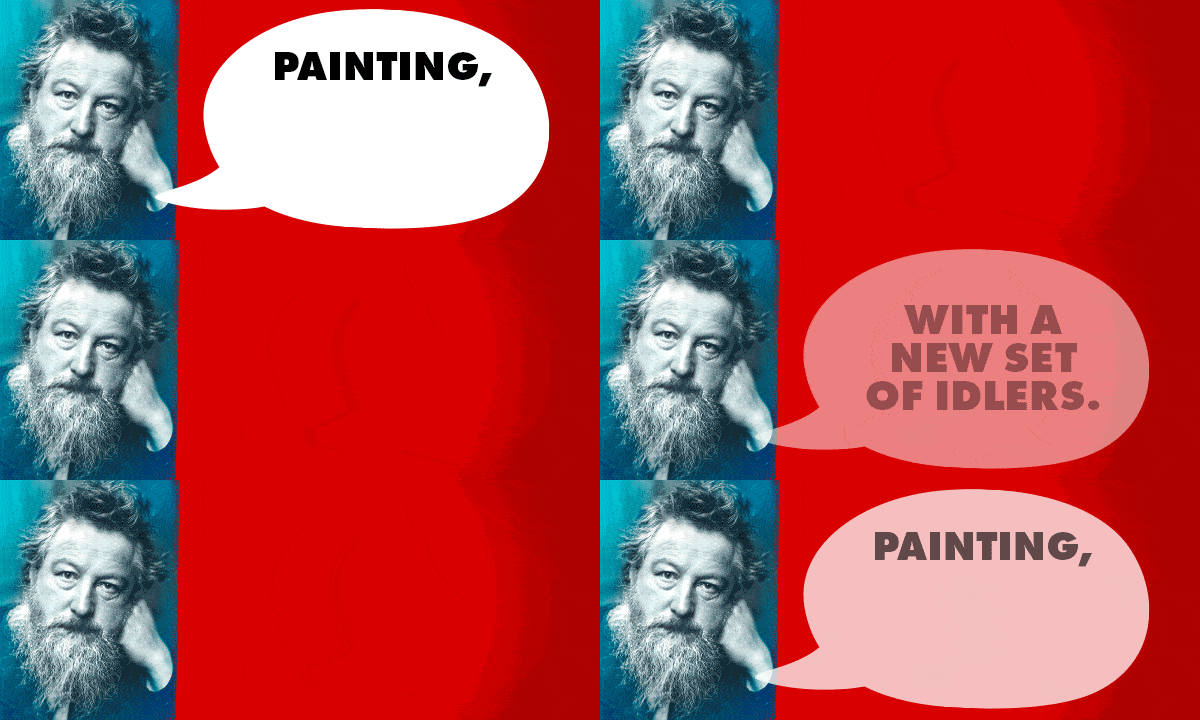
"If a man does not work usefully,
neither should he eat."
"Sweep the sham art away."
—William Morris
There's a wide gap between socialism's promises and its methods.
William Morris was a renowned British author and artisan. He is also regarded as one of socialism's most important prophets.
In works about socialism published today, only socialist superstars Karl Marx and Friedrich Engels are referenced more frequently than Morris.[1] Such well-known figures as Che Guevara receive only a fraction of the attention Morris does.[2]
As a socialist, Morris is best known for his novel News from Nowhere and its captivating vision of a future socialist world. Nowhere, as the imagined society is called, is a place in which everyone's needs are met and all are free to do as they please.
A prime example of the social freedom Morris depicts is found in the characters he calls "the Obstinate Refusers."[3] This group of artists and builders get their name from the fact that they refuse to participate in essential community work so they can pursue a pet project of building a beautiful house.
The Obstinate Refusers ignore socialism's duty to give our abilities—our time and talents—to society. Instead, they treat their abilities in a liberal fashion: as their private property to use as they wish. Despite this, they're still welcome to take everything they need for free from the community stores. And while their neighbors think them silly, the Refusers are left alone to pursue their chosen task.
It's the freedom portrayed in News from Nowhere that's caused Morris's star to rise dramatically in socialist circles. Today's socialists make the most of this vision and its creator as they sell their product.
But there's a very different side to Morris—one that most socialists fail to mention. The same Morris who described a community that welcomed Obstinate Refusers also wrote that in socialist society,
if a man does not work usefully, neither should he eat.[4]
And despite being an artist himself, Morris called for socialism to suppress numerous careers in the arts because he believed they result in
anti-social habits that would burden the community with a new set of idlers.[5]
Further, as biographer Paul Meier (himself a socialist) explains, Morris expected a socialist government that was "centralized" and "authoritarian."[6] It was Morris's plan that this government would outlaw not just big business but all private business. Even being self-employed would be illegal. Morris wrote that the socialist state would be
the sole employer of labour.[7]
How is it that this famed author and artist who created the liberal vision of New from Nowhere also calls for an authoritarian society that even suppresses the arts? What is it that turns Morris from Dr. Jekyll into Mr. Hyde?
A Tale of Two Phases
One of socialism's most important thinkers appears to have a split personality. However, this contradiction is characteristic not only of Morris but of socialism overall—democratic socialism included.
Socialism promises human freedom and happiness while simultaneously advocating, and indeed practicing, some of the most repressive policies imaginable. William Morris is a figure worth considering because he illustrates this paradox at the heart of socialist philosophy.
What explains the conflicting Morrises? The answer is found in a key tenet of socialist theory, which says that there are to be two phases of socialism: a first following capitalism and then a second, perfected stage.
The captivating society of Nowhere with its Obstinate Refusers is Morris's vision of socialism's second phase. It's a world in which all needed goods are produced so efficiently and bountifully that they are free for the taking. Conversely, Morris's numerous authoritarian dictates are his prescriptions for how socialism would operate during the first phase as it sets out to create a society of overflowing abundance like Nowhere.
The concept of two phases of socialist society—each with very different characteristics—is not unique to Morris. Actually, it's Karl Marx who not only gets the credit for originating this idea but also for making it an essential element of the socialist gospel.[8] Marx famously stated that the sign that a perfected second phase of socialism had arrived would be when socialist society could be based on the philosophy's most famous axiom:
From each according to their ability, to each according to their need.[9]
What does it mean to have a world that operates on the principle "to each according to their need"? Socialist theory is explicit that such a world is one in which all needed goods and services are available for free. They would be free for the taking worldwide and forever.[10] Socialists describe this predicted world as being one of "abundance," "superabundance," "limitless abundance," and the like.[11]
"Abundance Resolves
Such Difficulties"
As socialist A. L. Morton explains,
News from Nowhere is Morris's picture, not of the immediate future, but of life in this second stage—two centuries at least after the defeat of capitalism.[12]
Consistent with Marx's vision of a second phase of socialism based on the axiom "to each according to their need," Nowhere is a society of such abundance that every needed thing is free for the taking. Everything has been free for so long that money no longer exists. No one knows what money is. No one is familiar with the concepts of buying and selling.[13]
Virtually every other noteworthy feature of the society Morris portrays is a byproduct, a corollary, of the fact that Nowhere is assumed to be a world of perpetual abundance. Most importantly, it's this premise that permits News from Nowhere to feature characters like the Obstinate Refusers without violating socialist principles.
Given the supposition of never-ending free everything, what citizens do for work is of no consequence. Some may obstinately refuse to work on societal tasks and instead do as they choose. Big deal. No harm, no foul. The cornucopia of free goods will persist. Thus, enforcing socialism's duty to give our time and talents to society is not necessary.
As Morris biographer Paul Meier points out, when it comes to aspects of Morris's imagined future that would be impossible or illegal during socialism's first phase,
abundance resolves such difficulties.[14]
Yes, abundance is powerful magic. It makes many features of Morris's hypothetical socialist society possible, not just the Obstinate Refusers.
For example, one feature of Nowhere is its organization as a society of "small, self-sustaining and self-governing communes."[15] In the real world, where we depend on large-scale production and trade, this is a recipe for subsistence living. Only the premise of an abundance that "resolves such difficulties" makes it possible for Nowhere to be portrayed as a society based exclusively on small communes.
And why is craftwork common in Nowhere despite the fact its extreme inefficiency conflicts with socialist principles (causing even celebrated artisan Morris to expect the first phase of socialism to be devoid of craft)?[16] Here's why: the assumed world of abundance overrides socialism's requirement for efficient production just as it does the need to enforce socialism's duty of "from each according to their ability."
Morris's assumption of a world of free everything stands behind his novel's patina of socialist freedom and so much more. But what does News from Nowhere say about how this overflowing abundance was achieved? And what does it say about how it's sustained, not just in normal times but in times of natural disasters or epidemics?
It says nothing. Zip.
New from Nowhere simply assumes the existence of a world of abundance with the same confidence that Harry Potter assumes a world of magic. As socialists admit, Morris makes no meaningful effort to explain how the society he portrays created or maintains an economy that constantly produces not only enough to meet demand but also the surplus needed to handle inevitable disruptions in production.[17]
Morris's book is a novel. He obviously has a right to make any fantastical assumptions he desires. And he certainly doesn't disguise the fact that what he's depicting is his vision of a perfected socialist society premised on the assumption of superabundance.
But there are significant problems with the way in which today's socialists sell Morris and the happy vision of socialism depicted in News from Nowhere. They fail to explain that it's the assumption of a world of freely abundant goods and services that makes so many of Nowhere's other features possible.[18] Worse yet, they obscure—often completely—Morris's exceedingly authoritarian plans for socialism's first phase.[19]
"State Socialism and
Pretty Stiff at That"
Morris depicts socialism's second phase as one of abundance-fueled freedom. What does he say about the nature of socialism's first phase? He writes that
some transition period was of course inevitable, I mean a transition involving State Socialism and pretty stiff at that.[20]
(Morris refers to socialism's first phase as "transitional" reflecting his belief that socialism would succeed in boosting worldwide production to the astonishing levels required to reach a second stage. To learn why this "transition" would likely last forever, see our paper "The Secret Sauce of Socialism."
The state socialism Morris calls for, far from being a free and voluntary society or one based on "small, self-sustaining and self-governing communes," means the top-down control of labor and production by a centralized government. State socialism is what we've seen in earlier socialist nations, where "pretty stiff" understates what occurred.
While he portrays socialism's second stage as one in which all are free to do whatever they choose, Morris calls for the first phase to be one of duty. He says the very "first step" in creating a socialist society is to "abolish" those who "shirk their duties":
The first step to be taken is to abolish a class of men privileged to shirk their duties as men, thus forcing others to do the work which they refuse to do. All must work according to their ability.[21]
"All must work according to their ability" means that work is treated as an obligation, giving those running socialist society the right to judge us, to compel us, and to control how our time and talents are used.
Morris's friend and fellow socialist Bernard Shaw explains Morris's view of those who shirk work:
He believed that people who didn't do their fair share of social work were damned thieves.[22]
It's not just slackers and the lazy whom Morris sees as "damned thieves." It's also those who perform what Morris and other socialists consider the wrong kind of work, work that socialism deems "socially useless."
Morris called for
all useless work abolished.[23]
It was his plan that when the first stage of socialism began,
useless occupations would be got rid of speedily.[24]
The socialist state would determine which types of work are "useless" to society. Professions so judged would become illegal. Individuals performing these supposedly pointless jobs would be "freed" (as socialists like to put it[25]) to perform work approved by society.
Many of the jobs to be eliminated would be a byproduct of a third type of suppression that Morris desired: banning countless products that socialists also think are "useless." One group of workers that Morris said should lose their jobs in this fashion were
the mass of people employed in making all those articles of folly and luxury … things which people leading a manly and uncorrupted life would not ask for or dream of.[26]
Suppress idlers. Suppress work producing products not required by "a manly and uncorrupted life." And suppress other supposedly useless jobs. There were three steps in Morris's plan for eliminating the countless "parasites"[27] he believed infest capitalist society.
That he was serious about this goal is demonstrated by the rule he said should apply in socialist society, already quoted in the introduction:
If a man does not work usefully, neither should he eat.[28]
Morris sets "usefully" in italics to emphasize his belief that work isn't sufficient to meet one's mandatory duty to socialist society simply because it's work. Rather, come socialism, if you feel like eating, you must not only work, but your work must be what those running society have approved as useful.
In Morris's vision, true to the socialist norm, it would be easy for the state to eliminate alleged "parasites." He promises the socialist government will not be impeded by our present liberal system of laws and rights:
The present society will be gone, with all its paraphernalia of checks and safeguards; that we know for certain. [29]
And, as we've seen, he also calls for the government to be
the sole employer of labour. [30]
In his noted work William Morris: The Marxist Dreamer, socialist Paul Meier summarizes Morris's expectations regarding socialism's first and likely only phase:
During the first stage of the new society, the needs of compulsion and organization have given rise to a centralized power.[31]
Meier further defines the government Morris anticipated by saying it
would be authoritarian and would need to possess means of coercion.[32]
A Society "Wholly without
Art or Literature"
We can cement our understanding of the real Morris by considering what he had to say about the arts. Contrary to what you would expect of a famous author and artist, Morris demands that the arts be suppressed. It was his view that the bulk of art is
sham art and half sham art.[33]
Who produces "sham art"? Sham artists.
Morris calls for socialism to cleanse society of this art he disapproved of:
[If socialism] will sweep the sham art away and give us good hope of a new art arising from a society founded on the equality of labour, there will be no loss, but immeasurable gain.[34]
What powers must the socialist state have to fulfill Morris's demand to "sweep the sham art away"? It must be empowered to decide who counts as a real artist and who does not. And it must have the authority to stop "sham" artists from creating more of their now-forbidden art and to force them to work on approved tasks instead.
This noted artist also called for numerous careers in the arts to be abolished come socialism:
Picture painting, sculpture … imaginative literature …. I feel sure that it would not do for men to be absorbed entirely in such arts. It would tend to disease, to anti-social habits that would burden the community with a new set of idlers.[35]
Despite having done a great deal of "imaginative" writing himself—News from Nowhere an extraordinary example—Morris says the profession of fiction writing should be eliminated come socialism. Sculptors and painters would also get the ax.
Why must these and other vocations in the arts be done away with? Having used the power of the socialist state to suppress slackers and other supposed "parasites," the last thing socialist society will permit is "a new set of idlers."
Morris was a remarkable craftsperson. Yet his socialist biographers admit that he expected the first phase of socialist society to be barren of craftwork.[36] He even endorses the possibility of a socialist society "wholly without art or literature":
The experiment of a civilized community living wholly without art or literature has not yet been tried. The past degradation and corruption of civilization may force this denial of pleasure upon the [socialist] society which will arise from its ashes. If that must be, we will accept the passing phase of utilitarianism as a foundation for the art which is to be.[37]
And he argues that suppressing "sham art" is so important that it's a goal worth pursuing even if the result is a socialist society permanently deprived of art:
Surely it must be said that if the coming change in the basis of society [to socialism] were to make an end of all this sham and half-sham art without any hope of new art arising from it the loss would not be great.[38]
Both Morris's general proposals for the first phase of socialist society and his ideas specific to the arts are the polar opposite of what's found in News from Nowhere. The real William Morris is not an advocate of societal freedom and personal satisfaction. He is a flat-out authoritarian.
In line with socialist philosophy overall, Morris treats our time and talents as society's property to control rather than our own. His thinking invests the socialist state with incredible power over our individual lives—precisely the type of power that has caused one socialist society after another to become an authoritarian dictatorship.
Morris is but one of the countless historical and present-day socialists who call for bulk suppression: suppression of our liberal rights, of alleged "parasites," of "useless" work, and of "useless" products.[39] And he's but one of the innumerable socialists who look forward to doing away with our liberal society and its "paraphernalia of checks and safeguards."[40]
These are standard elements of socialist philosophy, and they are the necessary byproducts of socialism's foundation on compulsory duty to society.[41] They're not unique to Morris.
Obstinate Refusers
Would Not Eat
It's the Obstinate Refusers and similar aspects of News from Nowhere that make Morris and socialism appear like lovers of freedom. But these features only appear in Morris's novel because it's premised on the assumption that a world in which everything is eternally free already exists.
How would Refusers be viewed during socialism's first phase—the only phase any of us would ever know? Morris has told us:
The first step to be taken is to abolish a class of men privileged to shirk their duties as men, thus forcing others to do the work which they refuse to do.[42]
Obstinate Refusers would be seen as "forcing others to do the work which they refuse to do."
And what would happen to someone so foolish as to try "shirking their duties" by obstinately refusing during this period? Again, Morris has told us:
If a man does not work usefully, neither should he eat.
In socialism's first and likely only phase, Obstinate Refusers wouldn't eat.
In socialism's first and likely only phase, neither William Morris nor socialist philosophy has anything to do with personal freedom. Morris and other socialists call for a society of suppression in the here and now, making them authoritarians—end of story.
That someone who condones suppression today believes it would eventually produce a future of freedom doesn't change their status as an authoritarian one bit. If it did, even socialism's bevy of mass-murdering dictators could be sold as lovers of freedom.
Lenin? Stalin? Mao? Just like Morris, they claimed socialism would create a world of abundantly available goods and services resulting in "perfect freedom." They promised a society like Nowhere in which even government would "wither away."[43] And they vowed that their socialist states, which were based on the authoritarian principles Morris advocated, would create this fantasy future.
The actual result? Tens of millions dead.[44]
PRODUCING "PERFECT FREEDOM"
It's not only William Morris who portrays a socialist future of freedom. This is a standard socialist promise. But it's critical to understand that all such claims are, like the freedom of Morris's Nowhere, byproducts of the assumption that socialism would create a world of overflowing abundance resulting from an "unlimited expansion of production."
For example, in his Principles of Communism, Friedrich Engels famously claimed socialism (which he and Marx interchangeably called "communism") would yield a world of "perfect freedom." What does he say about how this world would be created?
Engels writes, "Large-scale industry and the unlimited expansion of production which it makes possible can bring into being a social order in which so much of all the necessities of life will be produced that every member of society will thereby be enabled to develop and exercise all his powers and abilities in perfect freedom."
Learn more about the absurd assumptions that underpin socialism in "The Secret Sauce of Socialism," which is both a chapter in Socialism Says and a detailed paper.