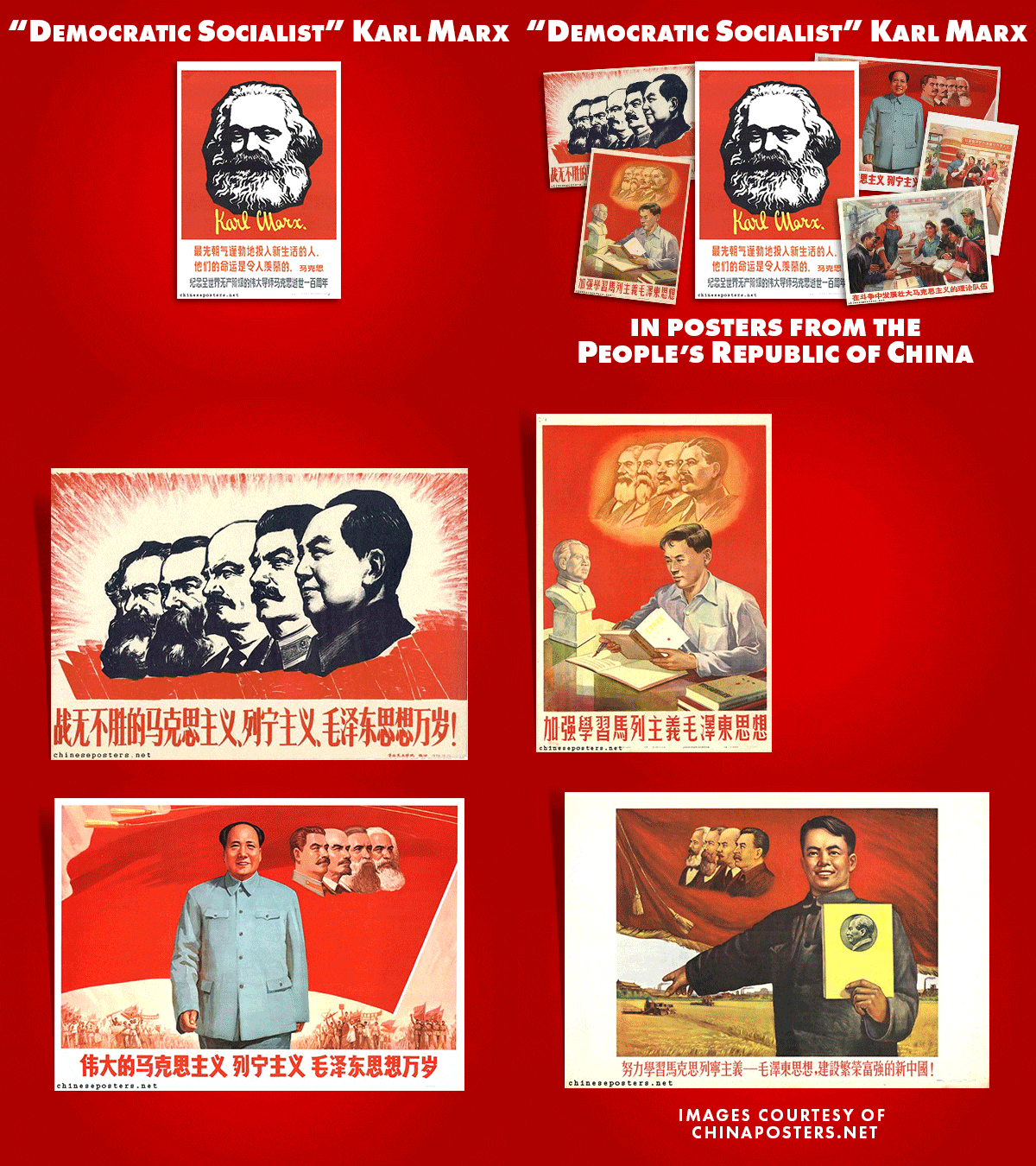
"KARL MARX, 'DEMOCRATIC SOCIALIST'" ENDNOTES
1. Michael Harrington, The Twilight of Capitalism (New York: Simon and Schuster, 1976), v.
2. Harrington, Twilight of Capitalism, v.
3. Michael Harrington, Socialism, Past and Future (New York: Mentor, 1992), 47.
4. Michael Harrington, Socialism (New York: Saturday Review Press, 1970), 57.
5. Harrington, Socialism, 57. Emphasis mine. Please also note Harrington's use of the term "social democrat" here. He's used it as a synonym of "democratic socialist." Some of today's democratic socialists attempt to differentiate between democratic socialists and social democrats, but Harrington uses these terms interchangeably in the cited book.
6. Harrington, Socialism, Past and Future, 47. Emphasis mine.
7. Harrington, Socialism, Past and Future, 47.
8. For example, Eugene Debs and Beatrice Webb and other celebrated socialists claimed that the USSR was democratic socialism in action. To see quotes and details, read the Red Flags Press paper "Democratic Socialism? Déjà Vu All Over Again."
9. "From each according to his ability, to each according to his need" is the most famous saying of socialism because Karl Marx made it socialism's defining goal. The concept behind the saying and even its exact phrasing was already in use by socialists prior to Marx. Louis Blanc is generally credited with developing the specific wording in the 1840s. In 1848, he wrote: "Chacun produise selon son aptitude et ses forces, que chacun consomme selon ses besoins" (Louis Blanc, Nouveau discours de M. Louis Blanc sur l'organisation du travail devant l'assemblée générale des délègues des travailleurs [Paris: Commission du Gouvernement Pour Travailleurs, 1848], 10). However, Étienne Cabet was using the phrase in that period as well.
10. Karl Marx, Critique of the Gotha Programme, in Marx & Engels Selected Works, vol. 2 (London: Lawrence and Wishart, 1950), 23.
11. Joseph Stalin, "Anarchism or Socialism?," in Collected Works, vol. 1 (Moscow: Foreign Languages Publishing House, 1954), 338.
12. Michael Harrington, "What Socialists Would Do in America—If They Could," Dissent, Fall 1978, 445.
13. Karl Marx, "On the Jewish Question," in Robert Tucker, ed., The Marx-Engels Reader (New York: W. W. Norton & Company, 1978), 40. See the Red Flags Press paper "Our 'So-Called' Rights."
14. Karl Marx and Friedrich Engels, The German Ideology, 3rd rev. ed. (Moscow: Progress Publishers, 1976), 225. See also the Red Flags Press paper "Our 'So-Called' Rights."
15. Marx, Critique of the Gotha Programme, 23.
16. Joseph Carens, "Rights and Duties in an Egalitarian Society," Political Theory 14, no.1 (February 1986): 31.
17. Sidney Webb and Beatrice Webb, Soviet Communism: A New Civilisation, 3rd ed. (London: Longmans, Green and Co., 1944), 437.
18. Michael Harrington writes: "The goal of socialism, clearly, is to overcome greed and act on the basis of 'to each according to his/her need, from each according to his/her ability.'" Harrington, "What Socialists Would Do in America," 445.
19. Marx endorsed the concept of "from each according to their ability," which has been the socialist standard of duty for over 170 years and remains so today (Marx, Critique of the Gotha Programme, 23). In The Communist Manifesto, Marx and co-author Friedrich Engels list "equal liability of all to labour" as one key requirement of socialist society (Karl Marx and Friedrich Engels, Manifesto of the Communist Party, in Robert Tucker, ed., The Marx-Engels Reader [New York: W. W. Norton & Company, 1978], 352). And, as discussed elsewhere in this paper and detailed in the Red Flags Press paper "The 'Education of the Future'," Marx called for school children to perform factory labor as part of their education, with the goal of teaching them the necessity "to work in order to eat." Socialist citizens were to be drilled in the importance of performing labor as society directs, starting at age nine.
20. Marx, Critique of the Gotha Programme, 23. See the Red Flags Press paper "Our 'So-Called' Rights."
21. Any number of Marx's ideas demonstrate his belief that individual rights (what he considered "nonsense" and "rubbish") should not interfere with our duty to do as society directs. For example, Marx called for a socialist society in which the "society distributes labour power and means of production between the various branches of industry" (Karl Marx, Capital, trans. Ben Fowkes and David Fernbach, 3 vols. [London: Penguin Classics, 1978–1981], 2:434). To distribute our labor power (that is, our time and talents applied to work) is to distribute us. How does socialist society get the authority to distribute us as it desires? Socialism requires duty to society, overriding our right to use our lives as we wish.
22. E.g., "No one can without committing a crime shirk labor" ("Nul n'a pu sans crime soustraire au travail"). Gracchus Babeuf, Analyse de la doctrine de Babeuf, tribun du peuple: proscrit par le Directoire exécutif pour avoir dit la vérité́ (Paris: 1796), 1. See the Red Flags Press paper "Why Socialism Says Slacking Is Theft."
23. "They are slackers, that is to say thieves" ("Il y a des fainéants, c'est-à-dire des voleurs"). Henri de Saint Simon, "L'Industrie," Œuvres de Saint-Simon & d'Enfantin, vol. 18 (Paris: E. Dentu, 1868), 130.
24. As one example of the multiple times Marx promoted the idea of mandatory factory labor as part of education, Marx writes "every child whatever, from the age of nine years, ought to become a productive labourer in the same way that no able-bodied adult person ought to be exempted from the general law of nature, viz.: to work in order to be able to eat." Saul K. Padover, ed., Karl Marx on the First International (New York: McGraw-Hill Book Company, 1973), 26.
25. Padover, Karl Marx on the First International, 26.
26. Padover, Karl Marx on the First International, 26.
27. Marx, Capital, 1:165.
28. Marx, Capital, 1:188n.
29. Michael Lebowitz, The Socialist Imperative: From Gotha to Now (New York: Monthly Review, 2015), 67.
30. Webb and Webb, Soviet Communism, 437.
31. Friedrich Engels, "Speeches in Elberfeld," in Marx Engels Collected Works, vol 4., Marx and Engels 1844–1845 (Chadwell Heath: Lawrence & Wishart, 2010), 248.
32. See the Red Flags Press paper "The Socialist Obsession."
33. "The proletariat will use its political supremacy to wrest, by degrees, all capital from the bourgeoisie, to centralize all instruments of production in the hands of the State. … Of course, in the beginning, this cannot be effected except by the means of despotic inroads on the rights of property." Marx and Engels, Manifesto of the Communist Party, 352.
34. As seen in the note directly above, Marx and Engels call for the entire elimination of private enterprise and for the State to have complete control of the "means of production." This by definition means that their vision—what we are told is a democratic socialist vision—is of a society in which you have no right to start your own small workshop of any sort.
35. Sean Sayers, "The Concept of Labor: Marx and His Critics," Science & Society 71, no. 4 (October 2007), 449. See the Red Flags Press paper "Why Socialism Says Craftwork Is 'Idiocy.'"
36. Karl Marx, The Poverty of Philosophy (Moscow: Foreign Languages Publishing House, 1956; orig. 1847), 144.
37. Engels, "Speeches in Elberfeld," 252.
38. For example, socialist great Vladimir Lenin reports: "Unfortunately, small production is still very, very widespread in the world, and small production engenders capitalism and the bourgeoisie continuously, daily, hourly, spontaneously, and on a mass scale." Vladimir Lenin, "Left-Wing" Communism, An Infantile Disorder (New York: International Publishers, 1940), 10. See the Red Flags Press paper "Why Socialism Says Craftwork Is 'Idiocy.'"
39. Marx and Engels call for the "establishment of industrial armies, especially for agriculture," in their most famous work, The Communist Manifesto. Marx and Engels, "Manifesto of the Communist Party," 352.
40. "When the worker co-operates in a planned way with others [as the worker does in a factory, but not when working individually as a craftsperson], he strips off the fetters of his individuality, and develops the capabilities of his species." Karl Marx, Capital, 1:447.
A good discussion of Marx's view that the social nature of work in large industry develops people ready for socialism is found in G. A. Cohen, "Marx's Dialectic of Labor," Philosophy & Public Affairs 3, no. 3 (Spring 1974), 243–46.
And Bertell Ollman explains that Marx's desire for "industrial armies" is not only about boosting production but also motivated by "changing the personalities of those involved." One would assume that this personality change was not intended to make them desire their own small businesses but rather to make them into good socialist citizens. Bertell Ollman, "Marx's Vision of Communism," Dialectic Marxism, accessed August 21, 2019, ttps://www.nyu.edu/projects/ollman/docs/vision_of_communism.php
Finally, Marx's belief that work in large industry would mold people into good socialists is further demonstrated by his desire to incorporate factory labor into child education in socialist society. See the Red Flags Press paper, "The 'Education of the Future.'"
41. It's Marx and Engel's advocacy of large-scale agricultural production, of "industrial armies, especially for agriculture," that led to the forced collectivization of farming in the USSR, the People's Republic of China, and elsewhere. The result? The starvation death of millions. Estimates of the number of deaths caused by these human-made famines exceed 50 million. Two excellent works on the subject, respectively on the catastrophes in the USSR and in the People's Republic of China, are Anne Applebaum, Red Famine: Stalin's War on the Ukraine (New York: Doubleday, 2017); and Frank Dikötter, Mao's Great Famine: The History of China's Most Devastating Catastrophe, 1958–1962 (New York: Walker Publishing, 2010).
42. Marx, Engels, and an untold number of socialists since them say that a socialist society is to be one in which there is no buying or selling of goods and services, and not even money. By Marx's definition, a society with buying, selling, and money cannot be a socialist one. A key reason for Marx's desire to abolish buying, selling, and money is that he considers this the only method of eliminate what he called "alienation."
What's alienation? Noted socialist Eric Fromm defines Marx's complex concept as what happens when "man does not experience himself as the acting agent … but … the world (nature, others, and he himself) remain alien to him." Erich Fromm, Marx's Concept of Man (New York, Frederick Unger Publishing, 1971), 44.
That explanation of "alienation" probably doesn't clarify much, but this is no fault of Mr. Fromm's. It's a dense concept that only a far longer explanation might begin to untangle. But a deeper exploration of its meaning is actually an unnecessary distraction, since the key point is that Marx's goal was to end alienation, and this in turn was only possible, to his thinking, by eliminating the market economy based on buying, selling, and money. Why? Because these are what cause alienation in the first place.
Marx says that alienation is the automatic result of the production of commodities (goods made to be sold to others rather than for direct consumption) that characterizes capitalist society. Commodity production is itself the automatic result of the fact that production in capitalist society is fragmented across many independent producers—what hundreds of socialists' label "the anarchy of production." The production of goods by fragmented producers requires exchanging those goods as commodities, which leads to buying, selling, and money.
Thus, to eliminate alienation, socialist society would eliminate all private producers, all buying, selling, and money. One of the many obvious implications of such a world is that it would be one without any independent small or craft producers. It would also be a world in which it would be literally illegal to sell things you no longer needed. What type of authoritarian state would be required in such a world?
Marx called for two stages of socialist society: a transitional stage following capitalism and a "higher phase" of perfected socialism. In the higher phase, socialist society would have (in theory) boosted production volumes so massively that every good and service humans need would be available in quantifies greater than demand, permitting them to be distributed for free (see the Red Flags Press paper "The Secret Sauce of Socialism"). If everything were free, there would obviously be no need for buying, selling, and money.
But Marx even called for the end of buying, selling, and money as part of the first phase of socialist society and before the fantasyland of free everything for all had arrived courtesy of what Marx called "constant over-production." In this first phase of socialism, when goods would still be in scarce supply, Marx proposed that buying and selling still be ended by the socialist state taking ownership of all businesses large and small and producing all goods by a prearranged plan. He proposed that money be replaced by a voucher system in which workers would receive chits reflecting the quantity of their work and could then surrender these for goods at a government store (as they would be the only stores). It would be illegal to trade vouchers with others. They would not circulate as money does but would rather be analogous to a movie ticket—only good for exchange in one place.
It remains exceedingly common for today's socialists to attack capitalism as the cause of alienation (a concept almost no one understands but that we all know sounds bad) and to suggest that socialism would mean the end of alienation. But when they do, they almost always fail to explain that any society that has buying, selling, and money is a society that will suffer from what Marx called alienation. They fail to explain that the only means of curing alienation is to create a world with zero private businesses, no buying or selling, and no money. But surely such a world is a cure far worse than the disease.
The Khmer Rouge in "Democratic Kampuchea"—Cambodia—performed a real-world experiment with Marx's idea of eliminating markets and money. Untold thousands died as a direct result. For an overview of the Cambodian disaster, including the decision to eliminate money, buying, and selling, see David P. Chandler, Brother Number One: A Political Biography of Pol Pot, rev. ed. (Boulder, Westview Press, 1999).
Despite the Cambodian experience, the desire among socialists to fulfill Marx's dream still burns bright. Any number of socialists remain loyal to these dangerous ideas. For example, see Anitra Nelson and Frans Timmerman, Life Without Money: Building Fair and Sustainable Economies (London: Pluto Press, 2011).
Thus, one can desire a world in which all businesses large and small have been taken over by the government, a world in which it is illegal to buy or sell anything, a world in which money is done away with as part of the plan to make buying and selling impossible—one can be committed to all these things and still be a democratic socialist.
43. Michael Harrington, Socialism, Past and Future, 47
44. See the Red Flags Press paper "Democratic Socialism? Déjà Vu All Over Again."
45. Socialism starts from the belief the individual should be subservient to society and do society's bidding. Thus socialists say, for example, that individualism should be redefined to mean "the efficient use of the whole individual" for society's benefit (Ernesto "Che" Guevara, ""On Economic Planning in Cuba [April 30, 1961]," in Venceremos! The Speeches and Writings of Che Guevara, ed. John Gerassi [New York: Simon and Schuster, 1968], 115).
From the socialist standpoint, being born owing our time and talents to society is morally correct. Thus, it's hardly surprising that socialists would develop a philosophy that operates from the assumption that all individuals would be under mandatory duty to society and that required this duty to function.
Socialism is based on the idea of "social control"—control by society. Without the ability to override our individual rights through duty to society, there would be no way for socialism to implement the required social control.
There are multiple reasons socialism requires mandatory duty to function and implement "social control." For example, unless we are under the requirement to give our time and talents to society, there would be no way for socialist society to channel our work into activities socialist society approves as "socially useful"—in contrast to those activities that "waste" our time, such as are permitted today in our liberal society. In our liberal society without mandatory duty, we are left free to pursue essentially any career we consider personally useful regardless of how "socially useful" others may judge it to be. Socialist theory says that creating a socialist society requires the elimination of "socially useless" work so that all are working on priorities set by society. This requirement in turn necessitates our being under mandatory duty to give our abilities to society.
46. Klutsis was executed on February 26, 1938, at the Butovo Training Ground, along with 562 others. See Iveta Derkusova, "The Creativity of Gustav Klutsis," Marc Chagall Museum in Vibetsk, accessed November 19, 2020, http://chagal-vitebsk.com/node/238; "Butovo training ground lists of those shot," GeekApple, accessed November 19, 2020, https://geekapple.ru/en/sociologiya/butovskii-poligon-spiski-rasstrelyannyh-publikacii/.