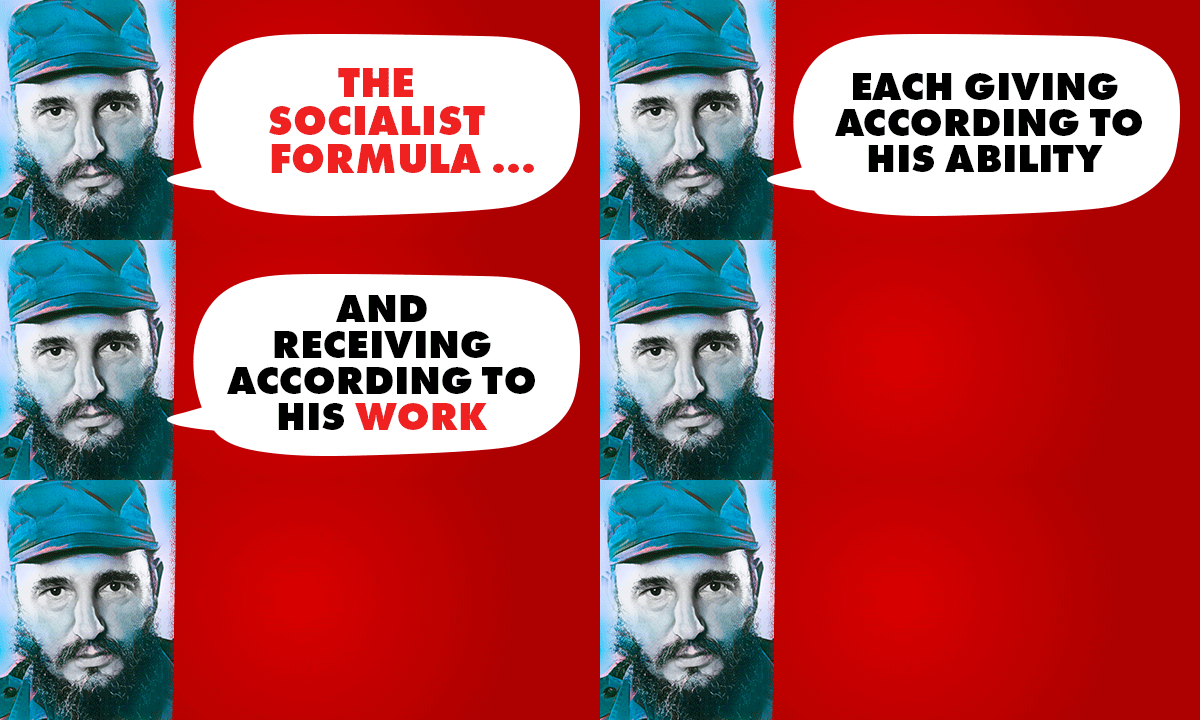


"That everyone contribute
according to his ability,
that each one receive
according to his work [not need]
is a principle, an inexorable law
in the construction of socialism."
— Fidel Castro
The central role compulsory duty
plays in socialist philosophy
is made clear by the fact socialism
has not one, but two versions
of its most important axiom.
This is far and away the most famous of socialist sayings:
From each according to their ability, to each according to their need.[1]
Perform socialism's duty to give your abilities—your time and talents—to society. In exchange, you will freely receive whatever you need.
For over 150 years, thousands of socialists have repeated this phrase and claimed their philosophy will make it a reality.[2] They still do today.
For example, in Imagine: Living in a Socialist USA, Michael Steven Smith writes that under socialism,
the rule will become "from each according to their ability, to each according to their need."[3]
Not might become or could become. The rule will become. Socialism will deliver on what such noted socialists as Michael Harrington, the founder of the Democratic Socialists of America, say is their philosophy's defining promise.[4]
In "On Justice Under Socialism," Edward and Onara Nell describe this axiom as
a capsule summary of the socialist approach to distributing the burdens and benefits of life.[5]
The benefit is receiving all goods and services you need, and receiving them for free."[6]
The burden is the duty to labor for society to the extent of your ability and independent of what you need.
It's likely you've already heard the expression "from each according to their ability, to each according to their need" and probably multiple times at that. This motto plays a central role in the marketing of socialism.
But did you know there's an alternate version of this saying?
A SECOND VERSION
The second version of socialism's most famous axiom is not nearly as well known. As Bernard Bykhovsky explains, it's
the socialist motto 'from each according to his ability, to each according to his work.'[7]
This alternate version is obviously identical to the first with a single exception: "need" has been replaced by "work."
Swapping one word results in a radical change to socialism's promise. Receiving based on our needs means receiving goods and services independent of our work. The alternate version of socialism's most famous axiom cancels this pledge.
This second saying doesn't represent some different version of socialism. It's another aspect of the same philosophy and appears frequently in the writings of socialist thinkers.
Take, respectively, the words of Fidel Castro, John Roemer, Bertell Ollman, Leo Huberman, and David Pena:
We are in the socialist phase of the revolution in which … the type of distribution needed is the one set forth by Marx in his program "from each according to his abilities, to each according to his work."[8]
The historical task of the socialist revolution is to bring about a regime where each labors according to his ability and is paid according to his work.[9]
[Eventually] socialism can be organized according to the principle "From each according to his ability, to each according to his work."[10]
From each according to his ability, to each according to his deeds.[11]
"From each according to their abilities, to each according to their work" is what we are fighting for, and "From each according to their abilities, to each according to their needs" is our inspiration and ultimate destination.[12]
The "work" version even appears in the constitutions of socialist nations. Here it is in the 1977 Constitution of the Union of Soviet Socialist Republics (USSR):
The state exercises control over the measure of labour and of consumption in accordance with the principle of socialism: "From each according to his ability, to each according to his work." Socially useful work and its results determine a person's status in Society.[13]
The benefits portion of this second creed is at complete odds with the promise of each receiving "according to their need." But there's another aspect of these two sayings that's entirely in synch.
Duty: The Common
Denominator
Both versions of socialism's central axiom begin with the identical: "from each according to their ability."
The first half of both is the compulsory duty of socialism. Louis Blanc, who developed this saying over 170 years ago, employs italics and all caps for emphasis, explaining:
The more one can, the more one must…. Thus, the axiom: From each according to their ability. That is the DUTY.[14]
Duty is what a person must do. It's a requirement. In its prescription of duties, socialism rejects the political philosophy that underpins liberal democracies—countries like Canada, France, Japan, and the United States
Liberal philosophy values each person by protecting the rights of the individual. It makes individuals the owners of their own lives and the time in them.
Liberalism rejects mandatory duty to others—be they king, queen, fascists calling themselves "the community,"[15] or socialists calling themselves "society."
Why? Because such duty gives others the dangerous power to control our lives without our express consent.
Socialism flips the script. It says the purpose of our lives is to perform our "humble function in the great social machine."[16] It says we'll find happiness being "conscious cogs."[17] Socialism's requirement that we give our abilities to society both results from and reinforces these core socialist principles.
Thus, we find that both versions of socialism's defining axiom start with the duty of "from each according to their ability." This is also the starting point of socialism itself, but the aspect that's often overlooked when socialists focus our attention on the appealing promise of "to each according to their need."
Why a Second Version?
Edward and Onara Nell describe the well-known version of the socialist motto as "a capsule summary of the socialist approach to distributing the burdens and benefits of life."[18]
As the Nells alert us, there's a link between the burden and benefit halves of the saying. One would fairly assume that the two halves have a contingent relationship with each other. That is to say, it's reasonable to assume that
(1) If you fail to give society your full abilities, then you have no right to expect society to give to you according to your needs, and,
(2) If society doesn't give to you according to your needs, then society would have no right to demand your abilities.
It's certainly clear that socialism plans for the first of these conditional relationships to be true. Socialist theory dictates that, if you don't give your full abilities to society, the only thing you should expect in return is to be treated like a thief.
As we explore on our sibling website slackingistheft.org, socialism considers failing to give your full time and talents to society to be tantamount to stealing from it. That's why so many prominent socialist philosophers attack slackers as "thieves," "parasites," and "exploiters."[19]
As one example of the dozens available, Henri Saint-Simon writes:
They are slackers, that is to say thieves.[20]
So, the first contingent relationship holds true. But what about the second?
If socialism fails to deliver on the promised benefit of "to each according to their need," does that cancel the requirement to give society control of our time and talents?
No, it doesn't. The failure of socialism to deliver its part of the bargain doesn't change the socialist demand for duty in any way.
The socialist plan is for us to be under the thumb of duty no matter what. This is the reason socialism has an alternate version of its most important axiom.
In fact, socialists know that the "to each according to their need" version they sell will never be the basis of a first phase of socialist society.
And they know that the promise of a world based on "to each according to their need" is likely to remain unfulfilled for centuries, if not for eternity.
But socialism requires the duty of "from each according to their ability" to function independent of what, if anything, we are given in return.
Voila! The alternate version is born.
As we'll detail below, knowledgeable socialists recognize there are two reasons socialism could never start based on the famous saying that promises "to each according to their need."
First, they know that an initial phase of socialism based on compulsory duty without distribution based on need is an explicit element of socialist philosophy.
Second, they know that—merely based on production volumes—a world of "to each according to their need" is currently impossible and may well always be.
These are the reasons that, after more than two decades of socialism in Cuba, Cuban leader Fidel Castro gave an interview in which he explained:
We in Cuba are still laying the first bricks of socialism. We live according to the formula which stipulates: From each according to his ability, to each according to his work. We cannot escape from this principle, regardless of how much we may dream about that other one.[21]
"That other" principle that's only a dream is, of course, the one that promises a world of "to each according to their need."
Castro died in 2016, thirty-five years after this speech. After three additional decades of laying the bricks of socialism, Cuba had not realized the "to each according to their need" dream and was, if anything, further away from doing so.[22]
Non-Optional
The primary reason for the second version of the socialist motto is a simple one. Even though most non-socialists are unfamiliar with this alternate version, socialist theory requires it.
Socialists say socialism is to have two phases—a first phase after capitalism, followed by a second, perfected phase. It was Karl Marx who made this plan socialist gospel.
Marx said that the "to each according to their need" standard would apply in what he called a "higher phase "of socialism.[23] This second stage would only come to pass if the first phase (that does not use the "to each according to their need" standard) was successful in both reconstructing society along socialist lines and dramatically boosting worldwide production of every needed good and service.
And how would the first phase operate? How would it accomplish this radical restructuring of society (for example, making an untold number of "parasitic" jobs illegal and transferring those who perform them to alternate tasks)? How would it achieve a dramatic increase in the production of needed goods?
By using the power of compulsory duty, that's how.
The expectation of a society based on duty is what's behind the socialist belief they could overhaul society in such a way as to open the wormhole to socialism's much-promised, never-seen higher phase.
That the first phase of socialism would be based on the use of compulsory duty is hardly surprising. Socialism starts from the premise that such a duty is morally correct, no matter what socialism delivers in return.[24] Moreover, socialism has been designed so that compulsory duty is required for socialism to operate (which is itself unsurprising given the socialist belief in the morality of duty).[25]
Thus, the first phase of socialist society without question requires an alternate version of socialism's most famous saying, one that demands duty but does not deliver on the basis of need.
Knowledgeable socialists are fully aware of this sleight of hand, even as they pitch the "to each according to their need" formula that would be used if this initial stage of socialism were able to create Marx's "higher phase."
Beam Me Up, Scotty Karl
There's a second reason that socialism has an alternate version of its most famous saying. It requires this alternate version because there's good cause to doubt that worldwide production volumes could ever be boosted to the levels required to deliver on socialism's promise of "to each according to their need."
"To each according to their need" is no modest proposal. Socialist philosophy says that in such a world, every good and service humans need would be so massively available that it could be taken for free, with some even leftover for a rainy day.[26] The world's population would be able to take everything they need for free forever and "according to self-defined needs."[27] (See our paper "The Secret Sauce of Socialism" for further details and quotes.)
Every needed thing. Free. For all. Worldwide. Forever.
This is how socialists have long defined the meaning of "to each according to their need."[28] The quantity of goods and services produced worldwide today doesn't come anywhere close to permitting a world based on this standard.
What's produced today isn't anywhere near sufficient to permit a world of "to each according to their need," even if:
- we made the absurd assumption that the transition to socialism would not result in massive disruption to the world economy.
- we made the counterfactual assumption that this new socialist society would avoid the dramatic loss of productivity relative to capitalism that has characterized all prior socialist experiments (causing them to collapse or to return to capitalist economics while preserving the socialist dictatorship).[29]
Socialist theory explains that a world of "to each according to their need," requires an oversupply of needed goods and services.[30] And creating this oversupply by definition requires overproduction.
Thus, a world of "to each according to their need" necessitates non-stop, worldwide overproduction.
And it isn't just a matter of a small oversupply. No, as Karl Marx explains, to create a world based on "to each according to their need," there must be not only a supply that exceeds demand but also a significant additional oversupply that acts as an insurance policy.
This over-oversupply (created by over-overproduction) would permit socialist citizens to continue taking as they need despite natural disasters, pandemics, and other unexpected events that disrupt production.[31]
The odds of achieving this world of what Marx called "constant over-production" and "perpetual relative over-production"[32] would be incredibly long even without the ecological emergency we're facing. The climate crisis makes the never-ending overproduction required to create a world of "to each according to their need" less likely than ever—and even immoral.[33]
Maybe in some Star Trek-style future, the limitless resources needed for a world of "to each according to their need" will somehow become a reality. But there's not even a glimmer of a hope this world could come to pass in your lifetime.
Even if a socialist society was founded tomorrow, you would live forever under the whip of duty, but not receive according to need. You would live the rest of your life in a society based on the alternate version of socialism's most important axiom, the version the vast majority of socialists forget to mention when they sell.
Bait and Switch?
Before reading this paper, did you know socialism had a second version of its most famous saying—a version that puts us under compulsory duty to socialist society but jettisons the promise to distribute according to need? It would be no surprise if you did not.
Some socialists do what ethical selling requires: when they speak about "to each according to their need," they make it clear that this is a distant dream and potential impossibility.
They explain the little-known alternate version of socialism's key axiom and its requirement of compulsory duty despite not providing goods based on need. They make it clear that this is the version that would apply unless and until a first phase of socialist society dramatically boosted worldwide production despite the climate crisis.
But honest explanations of this sort are the exceptions, not the rule. They're exceptions that prove the rule—the rule being that the explanations most socialists provide fall far short of what full and honest disclosure demands.
Far too many socialists sell their philosophy as a system that will be based on "to each according to their need" and give the impression socialism would deliver on this promise in our lifetime.
They make this promise to convince us that the dangers posed by socialism's foundation on compulsory duty to society are worth the risk. But when they do, they're fully aware that what socialism would actually mean is a world based on "from each according to their ability" but not on "to each according to their need."
Every socialist who sells "to each according to their need" without making the full story clear engages in unethical selling of the worst sort. They promise one thing while fully intending to deliver another—a bait and switch.
"An Inexorable Law in the
Construction of Socialism"
The central role compulsory duty plays in socialist philosophy is made clear by the fact socialism has not one, but two versions of its most important axiom.
Socialism has two versions in order to guarantee that all would be born owing their abilities to society no matter what it gives them in return.
Fidel Castro explains:
That everyone contribute according to his ability, that each one receive according to his work is a principle, an inexorable law in the construction of socialism.[34]
Is the inexorable law of socialism that it will deliver on its famous promise of "to each according to their need"?
No, it isn't. It's anything but.
For our lifetime, if not for eternity, anyone living in a socialist society will be ruled by the alternate version Castro explains: owing duty but not receiving based on need.
There's only one thing that's inexorable—inevitable, unavoidable, inescapable—about socialism: all will be made to perform its dangerous and anti-liberal duty of "from each according to their ability."
Thank you for reading "Doubling Down on Duty."