

"They have laid the foundation
of the first real democracy
that ever drew the
breath of life in this world."
— Eugene Debs,
celebrated democratic socialist
Yesterday's socialists sold the USSR
and other socialist experiments
as representing democratic socialism
in action.
Many people think that democratic socialism is a new type of socialism. But socialists tell us the world has already seen a democratic socialist society. More than one, in fact.
American democratic socialist great Eugene Debs says of one of these societies:
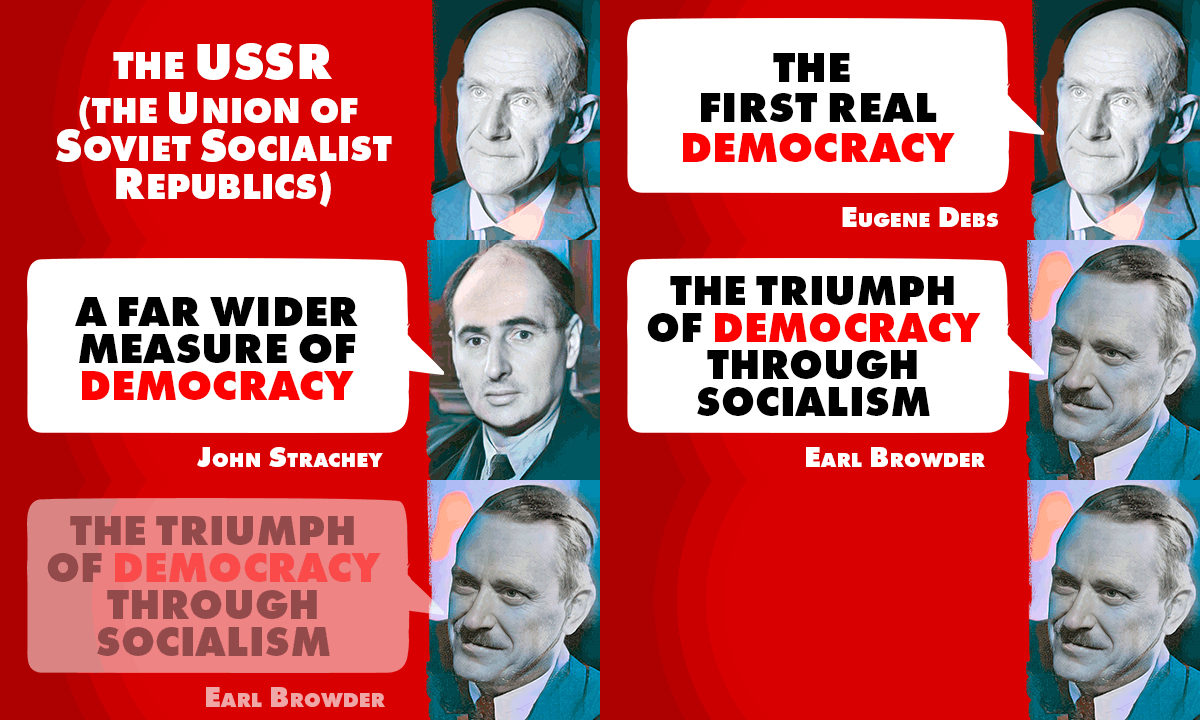
They have laid the foundation of the first real democracy that ever drew the breath of life in this world.[1]
According to Debs, this country wasn't merely the first socialist one to be democratic. It was the world's first democracy of any sort.
Which socialist society "laid the foundation of the first real democracy"?
It's the Union of Soviet Socialist Republics (USSR), the country today considered the definitive example of totalitarian socialism.
And it's not just the USSR that socialists claimed to be democratic socialism in action. Essentially every socialist experiment has been sold as such.
It turns out that today's democratic socialism is not a different version of socialism. It's the same old product, which we've mistakenly assumed to be a new one.
This mistake is the understandable consequence of comparing the promises made by today's socialists to the results of earlier socialism.
Today's socialists promise that a future socialist society would be democratic. We take this to mean that what's being sold now is different from earlier socialism, which surely was authoritarian.
But comparing the promises that today's socialists make to the outcomes of prior socialist experiments is comparing apples and oranges. Promises are not outcomes.
To make it apples to apples, we must compare what today's socialists promise to what yesterday's socialists promised when prior socialist experiments began. When we do, we discover that earlier socialists promised precisely what today's do: democratic socialism.
And when a socialist state becomes too authoritarian, embarrassingly authoritarian? What then?
Then, as we'll see, we're told that what socialists had long claimed to be democratic socialism was never socialism at all. No, it was really capitalism—what socialist spinners call "state capitalism"—right from the start.
Were you under the impression that "democratic socialism" is a new form of socialism? Or did you already know what knowledgeable socialists know: that socialism has been sold as the ultimate expression of democracy for over a century?
The reality is that socialists have long considered socialism to be inherently democratic. Socialists have even rationalized dictatorships as being "more democratic than any other state in history"—more democratic than countries with elected representative governments.[2]
Socialists think of socialism and democracy as synonymous (and do so despite socialism's requirement of compulsory duty to society). They've convinced themselves that socialism is democracy. And they likewise believe that whatever is not socialism is not democracy.
To socialist ears, "democratic socialism" is the equivalent of "socialist socialism." It's a redundancy, a tautology.
THE USSR: THE WORLD'S FIRST DEMOCRATIC SOCIALIST SOCIETY
Socialists in the past marketed the Union of Soviet Socialist Republics—what is now the very definition of bad old socialism—as a democratic socialist society.
And it was by no means only Eugene Debs who did so. But Debs is worth our focus since today's socialists say he epitomizes democratic socialism.[3]
Debs's thinking illustrates the socialist belief both that socialism is inherently democratic and, conversely, that any government that isn't socialist isn't democratic.
It's clear that Debs believed only socialism can be democratic. For example, prior to the founding of the USSR, Debs stated:
There has never been any democracy in the world.[4]
That Debs rejected the idea that democracy can exist outside of socialism was also implicit when Debs praised Vladimir Lenin and his Bolshevik party, saying that "the Bolshevik administration" was
the first real attempt at actual democratic administration in the history of the world.[5]
And on a separate occasion, he wrote:
They [the Bolsheviks] have laid the foundation of the first real democracy that ever drew the breath of life in this world.[6]
If the USSR is "the first real democracy," it clearly means Debs didn't count the US, Canada, the UK, France, or the other countries with democratically elected governments as "real" democracies when he made this statement.
Moreover, it's worth noting that by the time Debs calls the USSR the first democracy, he had been the socialist candidate for president of the United States four times. Despite running for president in multiple democratic elections, Debs did not consider the US a democracy.
Why? Because the US isn't socialist and, to socialists, not socialist is not democratic.
Debs's beliefs also demonstrate that socialists see any government they consider to be socialist as democratic, no matter how little like a democracy it may be.
When Debs praised Vladimir Lenin and his Bolshevik party for having "laid the foundation of the first real democracy,"[7] Debs knew they had taken power by overthrowing the results of Russia's first democratic election.
Voting for the newly formed Russian Constituent Assembly was held in November of 1917. Lenin's Bolshevik Party received less than 25 percent of the vote.[8]
Did the Bolsheviks work to improve their standing with the people, hoping to win a majority in future elections? No, they staged a coup.
In January 1918, five months before Debs called the USSR a democracy, the Bolsheviks declared that the democratically-elected assembly was "counterrevolutionary." They shut it down and took dictatorial control of the country.[9]
To democratic socialist Debs, the USSR represented the birth of democratic socialism despite these facts.
The USSR—in which the results of an election were overthrown to form a dictatorship—was a democracy. And the United States—which had democratic elections—was not a democracy.
To socialists, socialism is democracy, and not socialism is not democracy.
Some say Debs eventually became concerned about the direction of the USSR. But if he had a change of heart, it wasn't much of one.
Five years after praising the USSR as a manifestation of democratic socialism and shortly before his death, Debs still believed the USSR was
a beacon light of hope and promise to all mankind![10]
"THE USSR IS THE MOST INCLUSIVE AND EQUALISED DEMOCRACY"
It wasn't just in the years immediately following the USSR's founding that socialists sold it as democratic socialism. It was for decades thereafter.
Two decades after the formation of the USSR, American socialist leader Earl Browder gave a speech entitled
Twenty Years of Soviet Power, the Triumph of Democracy Through Socialism[11]
And consider the thinking of Beatrice Webb. Webb, like Eugene Debs, was among the twentieth century's most important socialists. She and her husband, Sidney, were leaders of the Fabian Society, an influential British socialist group.[12]
It's claimed that the Webbs and other Fabians were "gradualists"[13] whose thinking was based on an evolutionary change from capitalism to socialism and the "rejection of violent upheaval."[14] But after the Russian Revolution created the USSR, the Webbs embraced this first socialist experiment as the express route to the perfected future.
The Webbs traveled to the USSR in 1932 and toured the new socialist wonderland. Three years later, they published Soviet Communism: A New Civilisation?, a work of over a thousand pages reporting their exceedingly positive findings.[15]
In 1942, Beatrice Webb wrote a new introduction for the book's third edition. It provides her views of the USSR twenty-five years after its founding, and after she knew creating this "new civilisation" had taken a significant human toll.[16]
Subsequent events did not change Webb's earlier rosy opinions. A quarter-century into the USSR's authoritarian history, she argued it was democratic socialism in action:
The USSR is the most inclusive and equalised democracy in the world.[17]
The USSR is not only a fully fledged political democracy, but also an industrial democracy.[18]
Joseph Stalin was the USSR's leader when Webb wrote her updated introduction. Stalin is now seen as a brutal dictator, and today's socialists work overtime trying to lay the problems of the USSR at his feet. But Webb claimed:
Stalin is not a dictator.[19]
No, he was working hard to advance democratic socialism:
Stalin successfully advocated the policy of building up a multiform democracy.[20]
Beatrice Webb wasn't trying to deceive anyone. These were her honest beliefs—opinions shared by tens of thousands of other socialist true believers.
Beatrice Webb, Earl Browder, and Eugene Debs were by no means outliers. According to innumerable socialists, the USSR was the world's first democratic socialist society. What were its results?
"EXECUTION BY HUNGER" IN
"THE FIRST REAL DEMOCRACY"
The USSR was a disaster for its citizens—a human tragedy of mind-boggling proportions. Take just three of the many examples that demonstrate this fact:
The USSR was the setting for the Holodomor—a term that combines the Ukrainian words for hunger (holod) and extermination (mor).
The Holodomor was the genocide of 1932–1933 during which Ukrainians were intentionally starved by their socialist government. At the peak of the deliberately caused famine, well over ten thousand adults and children perished each day.[21]
Execution by Hunger is both the perfect description of this state-sponsored mass murder and the title of a book by Miron Dilot providing an eyewitness account of the tragedy.[22] Anne Applebaum's recently published Red Famine is another excellent history of this atrocity that took over four million lives.[23]
During what is known as the Great Terror, over 650,000 Soviet citizens were "liquidated" for being enemies of the socialist state.[24]
The government in each region of the USSR was assigned a specific number of citizens who should be summarily executed and a separate number of citizens who should be sent to concentration camps. It was left to the local government to find enough individuals who were "guilty" of anti-socialist activities to meet or exceed these preassigned quotas.[25]
Hundreds of thousands of the victims of the Great Terror and of the many other similar purges before and after it were socialist faithful consumed by the system they created. One example is noted avant-garde artist Gustav Klutsis, whose poster art was used as socialist propaganda. Klutsis was a loyal supporter of socialism and of the socialist government.[26] Or at least he was right up to the day he was arrested for being "an enemy of the people."
Klutsis was put to death at the Butovo Training Ground, one of the sites the socialist government used for executions and mass burials. On the day Klutsis was executed, over five hundred others were also shot or gassed at this single location.[27]
At Butovo and other death camps in the USSR, the Soviets developed methods of mass murder that would later be employed by the Nazis. For example, at Butovo, poison gas was used to kill entire truckloads of "the guilty" at a time.[28]
The USSR operated over 450 slave-labor camps in which citizens were imprisoned for such offenses as being a "parasite."[29]
Some eighteen million served time in these concentration camps.[30] A detailed account of this system is found in Anne Applebaum's Pulitzer Prize-winning Gulag. (The term "gulag," the nickname for the Soviet system of slave labor, is derived from the Russian words for Main Camp Administration: Glavnoe Upravlenie Lagerei.[31])
This is only a small taste of the evil that occurred in Beatrice Webb's "most inclusive and equalised democracy" and Earl Browder's "triumph of democracy." By the time these socialists wrote their words praising the USSR's socialist government as democratic, it had already murdered millions of socialist citizens.
Webb, Browder, and the innumerable others who made similar claims may not have been aware of the full scope of the carnage. But they were by no means oblivious to the fact that bodies were stacked high on the altar of this supposed democracy.
To their thinking, however, the USSR was still democratic socialism. Building this wonderful society was well worth the cost others were paying with their lives.
The USSR has its bad reputation for a reason. It's so tightly linked with violent authoritarianism that we've now forgotten how socialists around the world proclaimed it an exemplar of democratic socialism.
Moreover, what transpired in the USSR is by no means unique in the history of socialism. No country is without historical and present-day sins, but no philosophy in history has taken as many innocent lives as socialism did in the twentieth century alone.
AN AUTHORITARIAN ACCIDENT WAITING TO HAPPEN
How did the democratic socialist USSR end up a totalitarian state?
It wasn't bad luck. And it wasn't bad people screwing up good ideas. It was an accident waiting to happen—an accident resulting from the irreparable defect in socialism's very design.
Socialism is founded on a dangerous form of compulsory duty to society, the duty of "from each according to their ability."[32]
Socialist duty converts the time in our lives into society's time, a resource controlled by society—or, rather, by those who claim to represent it. Such power over human life can and does turn good people bad and bad people evil.
Socialism's foundation on compulsory duty caused the USSR and the many other socialist experiments sold as democratic to end up as authoritarian disasters. Socialism's continuing foundation on this duty all but guarantees future experiments sold as democratic socialism will do the same.
It's not just that socialism says the duty of "from each according to their ability" is morally correct. Socialism requires duty to function.
For example, it's socialism's foundation on this duty that gives those running socialist society the authority to limit work to those tasks deemed "socially useful," an approved use of society's time. Socialist theory is explicit that suppressing "socially useless" work (what socialists also commonly call "parasitic" work) is the critical path to creating socialism.[33]
Socialism is consciously based on the "negation," as socialists put it, of the liberal principles that underpin our capitalist society. Liberalism says our time is our private property that no one can take without our express permission.
Liberalism rejects compulsory duties of the type socialism demands as both immoral and incredibly dangerous. But socialism flat out disagrees and plans to make us all "return to duty."
It's critical to recognize that the "democratic" in "democratic socialism" in no way implies this is a version of socialism that doesn't require the duty of "from each according to their ability."
All socialism is based on this duty to society. All socialism is based on the rejection of the liberal principle that our lives and the time in them are our individual property to control.
As the thinking of Beatrice Webb illustrates, socialists see no conflict between believing socialism is democratic and believing that we should be born owing our abilities to society—that the time in our lives should be treated as society's time.
When Webb touts the USSR as democratic, she also lauds its constitution for including an extensive list of citizens' duties to society.[34] She praises some of the specific obligations this socialist constitution places on each citizen, quoting with approval this clause of the Soviet constitution that says those who don't work won't eat:
Work in the USSR is a duty, a matter of honour, for every able-bodied citizen. He who does not work shall not eat.[35]
While proclaiming the Soviet constitution the socialist archetype, Webb also attacks liberal constitutions like those of the US and France. Her complaint? That compulsory duty of the type socialism demands is "strikingly absent" in these constitutions based on liberal philosophy.[36]
Today's democratic socialism continues to embrace socialism's defining compulsory duty. For example, Michael Harrington, the founder of the Democratic Socialists of America, says the goal of today's socialism remains creating a society based on the axiom "from each according to his/her ability."[37]
"From each according to their ability" is the standard of duty that's been socialist dogma for 170 years.[38] It's the same duty that applied in the USSR and every other socialist experiment gone wrong.[39] Yet this requirement of duty remains the bedrock of today's democratic socialism.
"MORE DEMOCRATIC THAN ANY OTHER STATE IN HISTORY"
It's not just the USSR that socialists claimed was a democratic socialist society. Essentially every socialist experiment has been sold as such.
Consider what Cuban leader Raul Castro says:
Even without representative institutions, our revolutionary state is and always was democratic. A state like ours, which represents the interest of the working class, no matter what its form and structure, is more democratic than any other state in history.[40]
Cuba is democratic "even without representative institutions"—in other words, even without elections for posts in a representative government. Even when a dictator runs a socialist country, socialists can consider it "more democratic than any other state in history."
Again, we see that socialists think "democratic socialism" is a redundancy, a tautology—a fact also illustrated by the many socialist nations that have used "democratic" in their name.
After World War II, Germany was divided in half. The eastern portion became the socialist German Democratic Republic (GDR).
The GDR was the home of the Statsi, a secret police force that had one out of seven citizens spying on their neighbors.[41] It was home to the "Antifascist Protective Barrier"—the Berlin Wall—designed to keep citizens of this socialist democracy from getting out, not "fascists" from getting in.[42]
And there's Democratic Kampuchea, the Cambodian government of the Khmer Rouge ("rouge" is French for red, and red is the symbolic color of socialism).
What did the Khmer Rouge claim to be accomplishing in Cambodia? Their "Four Year-Plan to Build Socialism in All Fields" explains that they were engaged in
the revolutionary struggle for democracy, the revolutionary struggle for socialist revolution and the struggle to build socialism.[43]
They were struggling to build democratic socialism! Democracy was even promised in the constitution, letting all know Democratic Kampuchea was a
society informed by genuine happiness, equality, justice, and democracy without rich or poor and without exploiters or exploited.[44]
Democratic Kampuchea is where hundreds of thousands received their final lesson in "equality, justice, and democracy" in the Killing Fields, where they were summarily executed and buried in over 2,200 mass graves.[45]
Tens of thousands more died from starvation in the economic disaster resulting from Democratic Kampuchea's Super Great Leap Forward[46](an imitation of the People's Republic of China's Great Leap Forward, which itself cost not thousands but millions of lives via the wonders of socialist economic planning[47]).
During the four-year lifespan of Democratic Kampuchea, over 1.5 million—over 20 percent of the nation—perished at the hands of their government.[48]
WHO WILL BE THE NEXT EUGENE DEBS? THE NEXT BEATRICE WEBB?
The USSR ended up as far from a democratic society as it's possible to imagine.
But when Eugene Debs called it "the first real democracy," he was stating his heartfelt— though utterly mistaken—belief. That's also true for Beatrice Webb and the countless others who praised the USSR and other socialist nations as democratic.
Their example tells us what will happen when the next socialist experiment comes along.
There will be thousands of new Debs and Webbs proclaiming their heartfelt— though utterly mistaken—belief that democratic socialism has really arrived.
Today's socialists have no desire for a reprise of earlier socialist nightmares. But neither was a totalitarian state an expectation or desire of Debs, Webb, or even Marx.
Webb was aware that a substantial human cost was being paid to construct a socialist society in the USSR. But she and many others clearly agreed with the New York Times's Moscow correspondent Walter Duranty, who justified deaths in the USSR by saying:
You can't make an omelette without breaking eggs.[49]
Future Webbs will similarly rationalize the high human cost of what they'll see as the birth pangs of democratic socialism.
And when it turns out that the repression never ends? When it's clear yet another socialist experiment has veered completely off course?
Then what was promised to be democratic socialism will once more be said to have always been state capitalism.
Today's "democratic socialism" is not a new version. For all intents and purposes, it's identical to yesterday's "democratic socialism."
To socialists, socialism is democracy, and saying "democratic socialism" is no different than saying "socialist socialism." The "democratic" label is marketing spin—from those who profess to disdain sales and marketing.
Finally, it's essential to understand that socialists see no conflict between their belief that socialism is by definition democratic and their belief that we should all be made to "return to duty."
Today's socialists continue to see socialism as democratic despite its foundation on the anti-liberal duty of "from each according to their ability"—the design flaw that makes every socialist experiment an authoritarian accident waiting to happen.
A democratic socialist society?
We've already seen many. And their authoritarian results.
Thank you for reading "Democratic Socialism? Déjà Vu All Over Again."