

"This person
is a thief, a thief!
… the slacker! He is not going to
become our new exploiter!"
—Fidel Castro
Socialism's foundation on the duty of
"from each according to their ability"
turns our time into society's time,
thereby morphing slackers into
"thieves" and "parasites."

CONTENTS
- INTRODUCTION
- "THIEVES," "PARASITES," "EXPLOITERS"
- "MORE ONE CAN, MORE ONE MUST"
- SLACKERS "STEAL" … SOCIETY'S TIME
- JUDGE AND (MORE LIKELY) BE JUDGED
- "THE SOCIALIST PRINCIPLE"
- THE KEY TO A LAZY FUTURE?
- A GRAVE MARKED "SLUGGARD"
- SHREWD SELLING
- "FUNDAMENTAL LAW" #1
INTRODUCTION
They are slackers, that is to say thieves.[1]
These are the words of socialist great Henri de Saint-Simon, and they illustrate an inevitable outcome of socialist philosophy: to socialism, slacking is theft.
Henri de Saint-Simon is by no means the only noted socialist to attack slackers. Every quote in this paper comes from a socialist philosopher.
These thinkers who condemn slackers as "thieves," "parasites," "exploiters," and the like include noted socialist luminaries, such as Gracchus Babeuf, Vladimir Lenin, and Bernard Shaw:
No one can, without committing a crime, shirk labor.[2]
We have only one slogan, one watchword: Everyone who works has a right to enjoy the good things of life. Idlers, parasites … must be deprived of these blessings.[3]
The idler [in socialist society] will be treated not only as a rogue and a vagabond, but as an embezzler of national funds, the meanest sort of thief.[4]

Why is it that slacking is theft to socialism?
It's one of the byproducts of socialism's foundational requirement of compulsory duty to society—the duty expressed by the famed socialist axiom "from each according to their ability."
As we'll see, to say "from each according to their ability" is equivalent to saying "slacking is theft."
The socialist duty to give our abilities—our time and talents—to society morphs the time in our lives into what socialists consider a societal resource—into society's time. And slackers, who by definition work less than they can, are seen as stealing this time that socialism says society owns.
Socialism's foundation on duty and the belief that the time in our lives should be treated as society's time are the most important things there are to know about socialism. They also represent the most critical distinctions between socialist philosophy and the liberal philosophy that underpins our capitalist society.
Liberalism is based on the principle that we each own our lives and the time in them outright. We're not under a compulsory obligation to give our time to society.
Thus, we're free to use our time in virtually any way we wish, including by being slackers if that's our choice. Others may frown on that decision, but since our time is our individual property in liberal society, slackers are not criminals.
This paper has two goals:
First, to demonstrate that socialism's founding principle of "from each according to their ability" unequivocally means socialism considers slacking to be theft (which is, of course, why so many famed socialists tell us so).
Second, to explore the implications of this fact, most notably how it definitively proves that socialism—democratic socialism included—is founded on the anti-liberal belief that the time in our lives should be treated as society's time.
The fact that socialism is based on compulsory duty and sees the time in our lives as society's time poses a grave threat, not just to supposed slackers, but to us all. It makes socialism a philosophy in love with passing judgment and with acting on these judgments.
As the thinking of Lucien Deslinières warns us:
These useless ones are not just idlers as you might think. They are workers and sometimes even work a great deal, but their work produces nothing…. Now these useless workers, socialism will suppress them; it will make them useful. Instead of being parasites they will become producers.[5]
"THIEVES," "PARASITES," AND "EXPLOITERS"
"The slacker … must be pursued as a thief and parasite"
The principle that "slacking is theft" is closely connected to a centuries-old slogan that socialists still employ today: "property is theft."
The expression "property is theft" originally comes from Pierre-Joseph Proudhon, a French philosopher who eventually became an anarchist, but who was a socialist when he coined this phrase.
In What Is Property?, the same work in which "property is theft" first appeared, Proudhon writes:
The slacker, the idler, who, without performing any social task, enjoys like others—and often more than others—the products of society, must be pursued as a thief and parasite. We owe it to ourselves to give him nothing; but since he must nevertheless live, to put him under surveillance, and compel him to work.[6]
Proudhon says, "The slacker … must be pursued as a thief"—in other words, slacking is theft. Property is theft to socialism, and slacking is too.
"This person is a thief, a thief!"
Modern-day socialist great Fidel Castro demonstrates that slacking remains a crime to socialism. Castro, the leader of socialist Cuba who passed away in 2016, is an immensely popular figure among socialists in the US and around the globe.
When he branded slackers as "thieves," Castro was attacking socialist citizens who were treating the time in their lives as their own property rather than giving it to the socialist state. Take one example:
Who besides the workers can better develop a hard position against the parasites and against the one who consumes but does not produce because he does not feel like it and prefers instead to live off others? In other words, this person is a thief, a thief! Children, the aged, the ill … they shall have everything. We will work for them. … But not for the slacker! He is not going to become our exploiter! Our new exploiter![7]
Like Proudhon, Castro describes slackers as thieves and parasites. He even labels them "exploiters"—a socialist curse word commonly reserved for capitalists.
Castro's thinking makes it easy to demonstrate socialist attacks on slackers aren't one-offs or outliers. This socialist hero berated the "slackers," "idlers," and "loafers" he believed lurked in Cuba's socialist society again and again. (Over 30 examples on page "Learning From Fidel.")
"The more one can,
the more one must"
That socialism sees slackers as "thieves" and "parasites" is one of the ripple effects of socialism's foundation on compulsory duty to society.
The requirement of duty to society has been an aspect of socialism since the philosophy's first days. For example, over 250 years ago, in one of the seminal works of socialist philosophy, The Code of Nature, Étienne-Gabriel Morelly wrote:
Every citizen will contribute his part to the public good according to his strength, his talent and his age; this is how his duties will be regulated.[8]
And over one hundred seventy years ago, Louis Blanc coined the axiom "from each according to their ability" that remains the socialist standard of duty today.[9]
Blanc explains its meaning (with his italics and all-caps for emphasis):
The more one can, the more one must. … Thus the axiom: From each according to their ability. That is the DUTY.[10]
The more you can do, the more you must do. This is "the DUTY" socialism demands.
Socialism is not based on "from each according to what they individually choose."[11] This is the liberal standard, not the socialist one.
Nor is the socialist benchmark "from each according to some of their ability." Socialism says we must give society all we can.
And socialism doesn't request "from each according to their ability" as a favor. It's a mandatory obligation we would each owe the socialist state.
This socialist morality and the resulting duty represent a complete reversal of the liberal philosophy that underpins our capitalist society.
Liberal philosophy is based on the principle that we own our lives free and clear and that no one has a right to claim our time or talents without our express permission. It rejects as incredibly dangerous the idea of compulsory duty to others, be they king, queen, dictator, or socialists calling themselves "society."
Socialists themselves note that duty of the type socialism demands is "strikingly absent" both in overall liberal philosophy[12] and in the US Constitution, a document based on liberal philosophy.[13]
But socialism, in turn, repudiates the liberal position and is based on the demand that we "return to duty."[14] In another foundational work of socialism, The Doctrine of Saint-Simon, Prosper Enfantin and his co-authors use all caps for emphasis when they call for us to
return with love to OBEDIENCE.[15]
As you would guess, the "with love" aspect is optional. Socialist true believers would no doubt "return with love to OBEDIENCE." The rest of us would be returned to submission, whether we like it or not.
Slackers fail both socialist morality and socialist duty
Once we understand that socialism is based on the belief we should be born owing our time and talents to society, it's simply a given that slackers violate both socialist morality and the resulting compulsory duty.
What makes someone a "slacker"? A slacker is someone who chooses to use less than their full abilities—someone who is consciously doing less than they can. And this, without question, means slackers are failing to do what socialism says they must.
Any version of socialism that doesn't consider slackers as failing socialist morality and socialist duty would be a version of socialism that has abandoned its founding principle of "from each according to their ability." It would, in fact, not be socialism.
As we'll see, "from each according to their ability" remains the bedrock principle of socialism today, democratic socialism included.
Slackers "steal"
what socialism considers
society's time
It's easy to see that slackers violate socialism's duty of "from each according to their ability." But why do so many socialists use the specific term "thief" and describe slacking as a "crime"?
What makes someone a thief? Thieves steal things. They take property they don't own.
What socialism sees the slacker as "stealing" is society's time. Yes, this time makes up the slacker's life, but the very fact that socialism labels slackers "thieves" demonstrates that socialism is based on the premise that the time in our lives is society's property, not our own.
How can slackers stop being thieves to socialism? Only by giving society their full abilities as socialist duty demands. There's no other method. Slackers can't avoid the socialist judgment of "thief!" by consuming less.
Bernard Shaw makes this very point:
Weary Willie may say he hates work and is quite willing to take less and be poor and dirty and ragged or even naked for the sake of getting off with less work. But that as we have seen cannot be allowed.[16]
Weary Willy wants to take less to get out of socialism's compulsory duty. But this "cannot be allowed." The only way for Willy to stop being a thief to socialism? He must work more because he can.

Whose time is "spared" when idleness is "suppressed"?
The belief that the time in your life should be treated as society's property is a baked-in feature of socialist thought. It's a hidden premise behind many of the arguments that socialists make.
One example comes from Charles Peguy, who makes a stock socialist claim when he says capitalism wastes labor and that socialist society would end this supposed waste:
This regime [socialism] will spare human labor, the waste of which is immoral. This savings will be achieved by several methods, including the following three: Competition will be suppressed. … Idleness will be suppressed. … Production will be centralized as much as possible.[17]
There are innumerable similar instances of socialists attacking capitalism's alleged waste of labor.[18] Each of them results from the hidden premise that our time is society's property to control. If the time in our lives is our individual property, not society's, what socialists attack as "waste" is really us using our lives as we choose.
Consider the second of the alleged labor-saving tactics Peguy lists: "Idleness will be suppressed." To socialist thinking, suppressing idleness "will spare human labor."
But Péguy can't be speaking about labor time that an idler owns, can he? Slackers choose to spend the time in their lives being idle. You may disapprove, but if we each own the time in our lives, the idler's choice is their choice, and that's that.
Suppressing idleness only results in "sparing human labor" if our labor is counted as society's property. If society owns the time in our lives, then the idler, by being idle, steals society's time—precisely what socialism says.
JUDGE AND (MORE LIKELY) BE JUDGED
"A man had better hang himself than get the reputation of a shirk"
Socialism's foundation on mandatory duty makes it a philosophy infatuated with passing judgment. Who is performing their duty to society? Who is not?
Richard Lahautière explains socialism's moral code:
Each individual in his sphere, works not for himself, but to accomplish the tasks of humanity.[19]
A society in which your work is not for yourself but rather is "to accomplish the tasks of humanity" is a society that will be focused on passing judgment on whether you're working hard enough to accomplish humanity's tasks.
Socialism creates a world in which everyone sticks their nose into your business because it's no longer your business; it's theirs.
In The Fight for Socialism, Max Shachtman explains how, come socialism, any suspected slacker is to be a "social outcast":
Let any strange creature try to be so capitalistically "old-fashioned" as to draw on the public store without contributing his labor! The scorn of all around him would quickly make him a social outcast such as policemen and prisons could never make him under capitalism. He would not be long in coming to his senses and performing his social duty.[20]
Similarly, in his novel Equality, noted American socialist Edward Bellamy describes the reaction to slacking in the setting of a future socialist society:
The one who evades or scamps his work robs every one of his fellows. A man had better hang himself nowadays, than get the reputation of a shirk.[21]

"The police will not have much trouble in detecting such offenders"
We've seen Bernard Shaw report that socialist society would treat the idler as "the meanest sort of thief." In this extended quote, he explains the outcome of this fact:
The idler [in socialist society] will be treated not only as a rogue and a vagabond, but as an embezzler of national funds, the meanest sort of thief. The police will not have much trouble in detecting such offenders. They will be denounced by everybody, because there will be a very marked jealousy of slackers who take their share without "doing their bit."[22]
Shaw writes that, come socialism, slackers would be "denounced by everybody." Socialist society would be characterized by "marked jealousy" and keeping tabs on what others do. This is the unsurprising byproduct of owing our time and talents to others. And it's a positive to socialist Shaw.
The ugly world of denunciation and informing that Shaw describes isn't just theory—it's exactly what's been experienced in socialist nations.[23]
Socialism's foundation on duty and the belief that our work is not for ourselves but for society turned countless citizens of socialist nations into snitches busy reporting those they felt were "wasting" or "stealing" what socialism considers society's time.
And socialist citizens didn't limit themselves to informing on actual slackers. Many falsely reported personal enemies as some type of "enemy of the people."[24]

"THE SOCIALIST PRINCIPLE:
'HE WHO DOES NOT WORK,
NEITHER SHALL HE EAT'"
Seeing one socialist thinker after another attacking slackers should concern all who value our liberal right to define our own lives. We've already reviewed quotes from many socialist greats passing judgment on slackers in one fashion or another, but these only scratch the surface.
Here are sixteen additional examples of noted socialists doing so—respectively Leon Trotsky, Georges Renard, Sidney and Beatrice Webb, Richard Lahautière, Constantin Pecqueur, Robert Owen, Che Guevara, Philippe Buonarroti, William Morris, Étienne Cabet, Charles Fourier, Mao Zedong, Julius Nyerere, Vladimir Lenin, Max Schachtman, and Werner Sombart:
Not one serious Socialist will begin to deny to the Labor State the right to lay its hand upon the worker who refuses to execute his labor duty.[25]
In cooperation for life, the slacker becomes synonymous with the thief.[26]

Any person who neglects or refuses to pay this debt [to society] by contributing, according to his ability, to satisfying the needs of the present or future generations is held to be a thief, and will be dealt with as such.[27]
As long as there is an idler vegetating in this world, society will be in peril.[28]
From idleness to laziness and from one to the other to all vices and all disorders, there is only one step. A man who does not give his production to the association is more than useless, he harms.[29]
In the Millennium state [that is, socialist society], Idleness and Uselessness will be unknown in the conduct of a single individual.[30]
Cuba will derive great benefits if the masses understand the immorality represented by a man living without working the average number of hours per month considered necessary.[31]
[Under socialism] … the disgrace with which public opinion would brand the lazy man, and the severity of the law, … would punish voluntary idleness with such pains as are now inflicted on thieves.[32]
The first step to be taken then is to abolish a class of men privileged to shirk their duties as men, thus forcing others to do the work which they refuse to do. All must work according to their ability, and so produce what they consume.[33]
Idleness and laziness are as vile to us as theft.[34]
There will be no idlers [in socialist society], all will produce more than they consume.[35]

HOW TO MOBILIZE LOAFERS TO TAKE PART IN PRODUCTION … Our methods of mobilization are … The government gives them definite production tasks. …They are inspected at regular intervals. …Urging the masses to struggle against them, and to force them to join production. …The masses were very pleased that the government made the loafers take part in production.[36]
When I say that in traditional African society everybody was a worker, I do not use the word 'worker' simply as opposed to 'employer' but also as opposed to 'loiterer' or 'idler' ….Not only was the capitalist, or the landed exploiter, unknown to traditional African society, but we did not have that other form of modern parasite – the loiterer, or idler, who accepts the hospitality of society as his 'right' but gives nothing in return! … There is no such thing as socialism without work. [37]
The Socialist principle: "He who does not work, neither shall he eat." … In one place … half a dozen workers who shirk their work … will be put in prison. In another place they will be put to cleaning latrines. In a third place they will be provided with "yellow tickets" after they have served their time, so that everyone shall keep an eye on them, as harmful persons, until they reform. In a fourth place, one out of every ten idlers will be shot on the spot.[38]
One of the reasons for a worker's state is to sternly enforce the principle, "He who does not work shall not eat."[39]
"He who does not work shall not eat." On this all Socialists are agreed. … But if work is a necessity, no one shall be exempt from it. For if there are exceptions, it would mean that those who do work will have to contribute more than their share to the common stock. Besides, on what principle are the exceptions to be justified?[40]
In the three quotes directly above, Vladimir Lenin, Max Shachtman, and Werner Sombart employ what Lenin explains is "the Socialist principle: 'He who does not work, neither shall he eat.''" And Sombart notes, "On this all Socialists are agreed."
The thinking of Karl Marx supports Sombart's claim. As you're likely aware, Marx is the most important socialist philosopher of all time. (Something that may come a surprise is that the founder of today's Democratic Socialists of America says Marx should be considered a democratic socialist—even though Marx's thinking is so closely associated with yesterday's authoritarian socialism.[41])
Marx believed that even school children should be taught the "don't work, don't eat" rule. He wanted kids to learn this anti-slacking lesson directly—by being made to perform factory labor as part of their socialist schooling.
Yes, Marx (who today's democratic socialists sell as a "champion of human freedom"[42]) opposed ending child factory labor.[43] One of the alleged benefits Marx listed for his child labor plan? It would teach children that one must "work in order to be able to eat."[44]

Learn about Marx's calls for child labor as "education" in "Karl Marx's 'Education of the Future.'"
THE KEY TO A LAZY FUTURE?
SUPPRESSING LAZINESS TODAY
Good news: socialists promise a perfected future in which socialism would no longer consider slacking to be theft and all can be lazy if they wished.
Bad news: this society isn't going to exist in your lifetime—even if you live to 200.
Worse news: socialist theory says that creating this socialist future that would permit slacking requires the suppression of slacking in the socialist present.
Yes, the exception to the socialist rule that slacking is theft is the ultimate example of an exception that proves the rule.
Socialists say their goal is to create a world based on the axiom "to each according to their need."[45] They define this as a world in which the earth's entire human population of 7,500,000,000 and rising would be able to take every needed good and service for free forever.[46] Socialists also call this world one of "opulent abundance,"[47] of "superabundance,"[48] and the like.
Socialist theory says that to create this magic realm, socialism would not only dramatically boost production quantities, but it would also do likewise with production efficiency. Once a permanent state of abundance (free everything for all forever) is achieved, socialist society would continue to boost productivity via further automation, leaving less and less work for humans to perform.
As modern-day socialist great G. A. Cohen describes it, ultimately everything people do in this socialist future outlined by Marx would "only resemble activity which once was labor."[49] In other words, there would be no work, only hobbies. As all actual work had been eliminated, socialist duty would become meaningless and all could be as lazy as they wished.
This future fantasyland of hyper-automated superabundance is the exception—the only exception—to the socialist rule that slacking is theft.
But there isn't the slightest chance this worldwide society of free everything for all with virtually no work could exist within the next several centuries, if ever. It's a utopian fantasy, especially as every socialist experiment has shown socialism kills productivity rather than dramatically boosting it as socialist theory predicts.
Moreover, socialist theory is explicit that the way to achieve this perfected future society in which all could be lazy is by suppressing laziness when socialist society commences.
By suppressing slacking in the here and now, a socialist society would increase the total work accomplished, inching socialism closer to its utopian goal of superabundance and laziness for all. Further, suppressing slacking in the here and now would reduce the quantity of work socialist society demands of every citizen.
Lucien Deslinières tells us:
The first goal to aim for to increase production is therefore to eliminate to the fullest extent possible the parasites who do not work and those who, working without producing, could be suppressed by a better organization of society. … The great defect of the present [capitalist] society, an irremediable defect, for it belongs to its very essence, is to contain an enormous proportion of idlers and workers who do not produce. [50]
Georges Renard provides an example of the common socialist theme that says socialism will reduce work by suppressing slackers and other "parasites." He says that work in socialist society
will be reduced to the minimum by the sole fact that everyone will take part in the work and that the parasites and the useless will have returned to the ranks of the laboring army.[51]

Socialist superstar William Morris also promises that suppressing slacking would permit socialist society to give everyone their approved share of laziness:
We are going to get rid of all non-workers, and busy-idle people; so that the working time of each member of our factory will be very short.[52]
Under conditions where all produced and no work was wasted, not only would everyone work with the certain hope of gaining a due share of wealth by his work, but also he could not miss his due share of rest.[53]
How would socialist society make sure everyone gets what society determines to be their "due share of rest"? By making sure "all produce" and by acting on the plan "to get rid of all non-workers."
That socialism would suppress its way to a superabundant and super lazy future is also the theme of nineteenth-century socialist Paul Lafargue's work The Right to Be Lazy: The Refutation of the Right to Work of 1848.[54]
Socialists making dishonest attempts to suggest socialism is okay with slacking sometimes point to the words "The Right to Be Lazy" in this title. But Lafargue didn't believe anyone has a right to be lazy or any other right in the sense we use the term.[55] His title is a parody of another socialist concept, "the right to work."
The socialist society Lafargue envisioned would suppress the hordes of "parasites"[56] and "social lice"[57] Lafargue said infest capitalist society. These "useless mouths"[58] would be made to perform the same quantity of "necessary social labor"[59] that Lafargue said socialism would require of each socialist citizen. Eradicating all parasites would eventually yield a world in which all could be equally lazy—as lazy as those running socialist society decided was permissible.
A GRAVE MARKED
"SLUGGARD"
"Sluggard." A sign bearing that single word marked a roadside grave in the People's Republic of China. Beneath it were the remains of individuals beaten to death for failing to work fast enough to please socialist officials.[60]
Socialist plans to treat slackers as thieves aren't just talk. It's exactly how slackers have been dealt with in socialist nations. A particularly horrific example is found in China during "The Great Leap Forward."
"The Great Leap Forward" was the name China's socialist government gave to its effort to dramatically boost agricultural and industrial production using socialist methods. What the Great Leap actually produced was mass starvation and monstrous oppression.
Tens of millions died from hunger when socialist planning and production techniques resulted not in increased food production but rather in an unprecedented famine. (A detailed study of the horrors of the Great Leap Forward is found in Frank Dikötter's Mao's Great Famine.)
This period in the history of socialist China was also one of staggering repression and millions of deaths by government violence—oppression and violence directed in large part at those deemed slackers.
The allegedly lazy were subjected to constant public shaming. Those seen as not pulling their weight were forced to participate in so-called "struggle sessions." They were paraded through town wearing dunce caps[61] or white ribbons or carrying white flags. (In the USSR, Vladimir Lenin similarly suggested that those considered "idlers" be made to wear yellow markers that would stigmatize them.[62])
As villager Pang Qinli recounts,
He [another villager named Bao Geng, soon dead] was accused of being a lazybones and was forced to wear a white ribbon.[63]
In contrast, workers and work groups deemed above-average producers, were given red flags to display.[64] Those accused of being slackers became outcasts, leading many to commit suicide.[65]
But punishments went far beyond public humiliation. True to socialist promises, alleged slackers were treated in the same brutal fashion as actual thieves. Villager Zhu Daye recounts one example:
If anyone failed to turn up for work, they were deprived of food. On our way to work every day, the cadres [local socialist leaders] stood by with a bamboo cane in their hands. If anyone was slow in walking, they would use the bamboo to beat that person.[66]
Local official Ou Desheng tells the story from the government's perspective:
If you want to be a party leader, you must know how to beat people.[67]
Ultimately, millions were murdered by their socialist government. They died from beatings, from being denied their food rations,[68] from being made to literally eat excrement,[69] and in countless other sickening ways.
In one region alone, an internal investigation determined that in a single year, 67,000 people had been beaten to death by government officials.[70] That's enough people to fill a football stadium, all murdered in a single district in one year.
This figure includes those accused of literal theft and other offenses in addition to those who were attacked as being lazy. But socialist officials saw no difference between an underperforming worker and an actual thief. Both were beaten to death.
SHREWD SELLING
Why don't today's socialists attack slackers?
Those selling socialism today don't attack slackers as thieves, do they? Why is that?
You likely know why. It's because doing so would be sales suicide—not only highlighting socialism's disdain for slacking but also reminding us that socialism is premised on the anti-liberal belief that we should be born owing our time and talents to society.
What do today's socialists often do instead of explaining that socialist theory is anti-slacking? They sell the fantasy described above: the perfected socialist future in which socialism's rule that slacking is theft would finally have expired and all could be lazy.
And unfortunately, they often do so in an exceedingly unethical manner. Many "forget" to mention that this utopia requires worldwide superabundance that makes socialist duty meaningless. They similarly fail to explain that socialist theory says the way to achieve this future of laziness is via the suppression of lazy "parasites" and "useless mouths" when socialism commences.
Now, some would no doubt like to claim that the reason today's socialists don't berate slackers is because socialism has changed and is no longer anti-slacking. There's just one problem with this argument: it's easily shown to be a crock.
The speed limit is 55. You're doing 125. Aren't you violating the law? The only way to make driving 125 mph legal is by rewriting the rules of the road.
It's the same with the laws of socialism. Short of having achieved the utopian fantasyland outlined above, the only way socialism will accept slacking is if it does away with the duty of "from each according to their ability." It's this most fundamental principle of socialism that turns slacking into theft in the first place.
But today's socialists are as dogmatic as ever about this socialist law. Take, for example, Michael Steven Smith writing in the recently published Living in a Socialist USA. What's the rule going to be when socialism arrives?
The rule will become "from each according to their ability, to each according to their need."[71]
And what does Michael Harrington, the founder of the present-day Democratic Socialists of America, tell us is still "the goal of socialism, clearly"?
The goal of socialism, clearly, is to … act on the basis of "to each according to his/her need, from each according to his/her ability."[72]
These are but two of the dozens of available examples of present-day socialists reminding us that today's socialism remains based on the duty of "from each according to their ability," a duty that means "the more one can, the more one must."
Today's democratic socialism still lives by this standard—a standard that, by definition, means "slacking is theft" even if today's socialists don't say so out loud.[73]
Now, it's not uncommon for people to invent imaginary versions of philosophies and religions, versions that suit their personal preferences at the cost of intellectual honesty. But we shouldn't let those who have fooled themselves fool us too.
To argue that socialist duty doesn't mean slacking is theft is no different than arguing driving 125 mph isn't violating a 55 mph speed limit.
The question to ask any socialist who says "my socialism doesn't consider slacking to be theft" is how that's possible given socialism's founding principle of "from each according to their ability"—a principle that automatically results in the corollary expressed by socialist great Gracchus Babeuf:
No one can, without committing a crime, shirk labor.[74]
"Shirking work" and "the revolutionized ethics of a Socialist epoch"
One way today's socialists attempt to evade addressing socialism's disdain for slackers is by arguing that it's only evil capitalism that makes people slackers in the first place. Come socialism, the argument goes, those who are slackers today would gladly give society every ounce of their abilities and whistle while they work.
This isn't a new argument. It's one that socialists have long made. Over a century ago, William Morris and Ernest Bax, writing jointly, said:
The revolutionised ethics of a Socialist epoch, which would make all feel their first duty to be the energetic performance of social functions: shirking work would be felt to be as much of a disgrace then to an ordinary man as cowardice in the face of an enemy is now to an officer in the army.[75]
Come the perfected ethics of a Socialist epoch, repentant slackers would not only perform all basic tasks but would also love nothing more than to participate in the extra "mandatory volunteer" work that socialist nations are famous for.[76] Or so we're asked to believe.
The argument that capitalism causes slacking is bogus. It's a head fake. It doesn't alter the fact that socialism says those who treat the time in their lives as their own property are criminals. It just argues that, come the magic world of socialism, slackers would be a non-issue because all would gladly "return with love to OBEDIENCE."
"FUNDAMENTAL LAW OF
SOCIALIST SOCIETY" #1
What does socialist great August Bebel list as the first "Fundamental Law of Socialist Society"? He writes that it's the
Duty to Work of All Able-Bodied Persons.[77]
Bebel then explains the implications of socialist society's first law. It means
lazy persons, shirkers of work, are met in bourgeois [capitalist] society only.[78]
Slackers are only (Bebel's emphasis) found in capitalist society, not socialist.
How can Bebel be so sure?
Because he knows socialism flips the script on the liberal principle that the time in our lives is our individual property. Because he knows the compulsory duty of socialism turns our time into society's time, society's property to control.
To believe in socialism—democratic included—is to believe in its duty of "from each according to their ability."
To believe in "from each according to their ability" is to believe slacking is theft.
Thus, to believe in socialism is to believe slacking is theft.
Anyone who claims otherwise is arguing with an obvious conclusion of socialist philosophy and with labels for slackers chosen by socialists themselves. They're arguing with:
Gracchus Babeuf, August Bebel, Edward Bellamy, Nikolai Bukharin, Philippe Buonarroti, Étienne Cabet, Fidel Castro, Lucien Deslinières, Charles Fourier, Che Guevara, Richard Lahautière, Vladimir Lenin, Karl Marx, William Morris, Julius Nyerere, Robert Owen, Constantin Pecqueur, Charles Peguy, Pierre-Joseph Proudhon, Georges Renard, Henri Saint-Simon, Bernard Shaw, Max Shachtman, Leon Trotsky, Beatrice Webb, Emile Vandervelde, Mao Zedong, among many others.
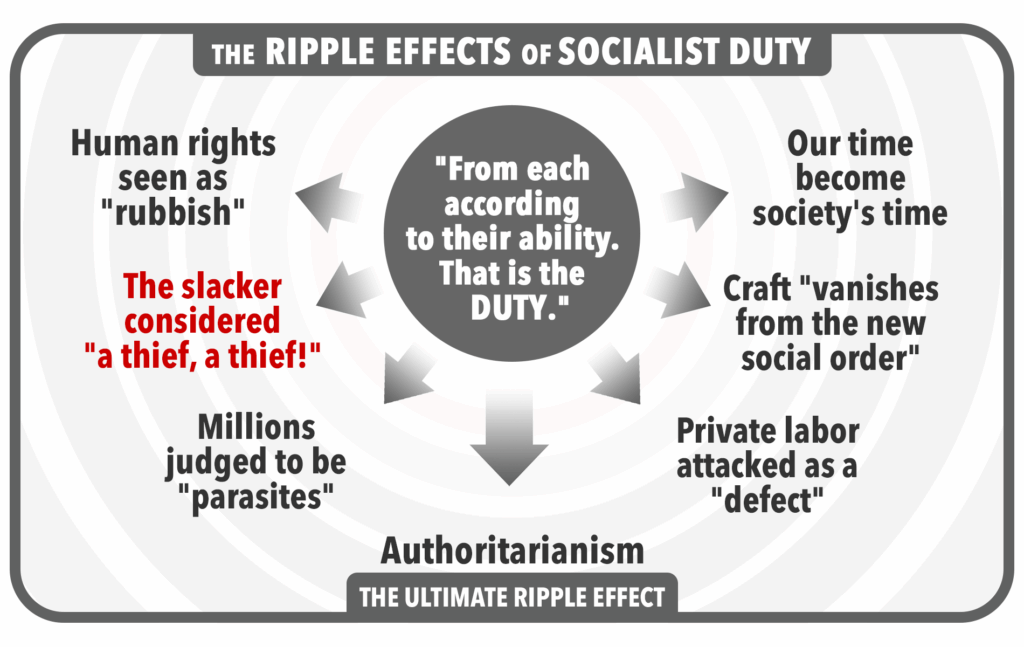
Socialism considering slackers to be "thieves" is one of the many ripple effects of socialist duty. It's a demonstration of how socialist duty turns the time in our lives into what socialists see as society's property to control.
Socialism's foundation on the duty of "from each according to their ability" is exceedingly dangerous—not just for those judged to be slackers, but for us all.
Who will decide if you're properly performing socialism's compulsory duty to society or if you're a "thief" or "parasite" in need of punishment?
One thing is certain: it won't be you.
Thanks for reading "Why Socialism Says Slacking Is 'Theft.'"