"WHY SOCIALISM SAYS CRAFTWORK IS 'IDIOCY'" ENDNOTES
[1]. Karl Marx, The Poverty of Philosophy (Moscow: Foreign Languages Publishing House, 1956), 144. Marx— ever the joker—named this book The Poverty of Philosophy as a parody of Proudhon's The Philosophy of Poverty, which was the primary focus of Marx's attention in this work.
[2]. Sean Sayers, "The Concept of Labor: Marx and His Critics," Science & Society 71, no. 4 (October 2007): 449.
[3]. Nikolai Bukharin, quoted in Morris Hillquit, From Marx to Lenin (New York: The Hanford Press, 1921), 39.
[4]. "Par la centralisation des services, on fera disparaître les petits ateliers où travailler péniblement trois ou quatre ouvriers ne produisant que la centième partie de ce qu'ils pourraient produire dans une grande usine sociale." Paul Argpriadès, Almanach de la question sociale (Paris: L'administration de la question sociale, 1891), 37.
[5]. "L'Etat … supprimera tous les petits ateliers, tout le travail a la main …." "Mais alors, Monsieur, tous les petits ateliers seront supprimés?—Parfaitement … en lieu des petits ateliers, on aura de vastes usines." Lucien Deslinières, Entretiens Socialistes (Paris: Choisy Le Roi, 1901), 22, 69.
[5a]. In his just published (2022) The Return of Nature, James Bellamy Foster [the number one salesperson of "ecosocialism"] cites Gronlund as an example of historical socialists who focused on what they considered the ecological failings of capitalism. Foster writes that Gronlund attacked private farming under capitalism, arguing that it results in a "rift in the reproduction of the soil."
Foster also reports that Gronlund's Co-operative Commonwealth "exercised an important influence on English-speaking socialists," including such noted socialists as Eugene Debs, Edward Bellamy, Bernard Shaw, and William Morris.[54]
But the number of Gronlund's ideas that can be twisted into seemingly eco-friendly ones are few and far between. Especially when compared to the bulk of his thinking— thinking that calls for a society in which all small enterprises are suppressed and production is carried out by a centralized government monopoly producing at the largest scale possible.
The sources for these quotes from Foster and additional details about Gronlund and his ideas (as well as details about socialist dictator Vladimir Lenin, who is also now being marketed as an early ecosocialist) are available here on our sibling site secretsauceofsocialism.org.
[6]. Laurence Gronlund, The Cooperative Commonwealth: An Exposition of Modern Socialism (Boston: Lee and Shepard, 1884), 109.
[7]. Vladimir Lenin, "Left-Wing" Communism: An Infantile Disorder (New York: International Publishers, 1940), 10.
[8]. G. A. Cohen, "Marx's Dialectic of Labor," Philosophy & Public Affairs 3, no. 3, (Spring 1974), 256. See also the points on p. 255, where Cohen lists two aspects of Marx's thinking that indicate Marx "must banish" craft from socialist society.
[9]. Karl Marx remains the defining thinker of today's socialism. A prime example of the many facts that demonstrate this reality: Rather than distancing today's democratic socialism from Marx, the founder of the Democratic Socialists of America, Michael Harrington, labels Marx a "democratic socialist."
For details on the multiple times Harrington knighted Marx a "democratic socialist," see our paper "Karl Marx, 'Democratic Socialist'" at ketofriendlysocialism.org. This site presents three papers demonstrating that "democratic" socialism is a misleading marketing slogan, not a new version of socialism.
[10]. Sayers, "Concept of Labor," 449.
[11]. Adler, "Marx, Machines, and Skill," 783. Similarly, Alan Bacon writes: "Marx welcomed the ending of the [craft] system" (Alan K. Bacon, "Morris's View of the History of Industrialism," Journal of William Morris Studies 5 [Summer 1982]: 8).
[12]. A good discussion of Marx's view that the social nature of work in large industry developed people ready for socialism is in Cohen, "Marx's Dialectic of Labor," 243–46.
[13]. Here's the complete paragraph in which Marx attacks craftwork and craftworkers as he takes a swipe at another philosopher, Pierre-Joseph Proudhon: "The automatic workshop wipes out specialists and craft-idiocy. M. Proudhon, not having understood even this one revolutionary side of the automatic workshop, takes a step backward and proposes to the worker that he make not only the 12th part of a pin, but successively all 12 parts of it. The worker would thus arrive at the knowledge and the consciousness of the pin." Karl Marx, The Poverty of Philosophy 1847 (Moscow: Foreign Languages Publishing House, 1956), 144, emphasis added.
Marx starts this complex passage by reporting what he considers good news: that the factory "wipes out specialists and craft idiocy." G. A. Cohen writes that "idiocy" as Marx uses the term implies "narrow parochialism," not "feeble intelligence" (G. A. Cohen "Marx's Dialectic of Labor," Philosophy & Public Affairs 3, no. 3 [Spring 1974]: 248). But when we consider the full paragraph, it certainly seems Marx intended both meanings to apply in his snarky attack on craftwork.
Marx discusses the production of pins, describing a twelve-step process to produce them. He contrasts the "automatic workshop" of the factory to production in a craftwork shop. In the automatic workshop that Marx prefers, each worker only performs one task, only makes one-twelfth of the pin. In the craft workshop, the craftworker performs all twelve steps in the production of the pin. Marx describes performing the entire process as "a step backward."
And what, to Marx's thinking, is the result of working as the craftsperson does, performing all steps in the production process? The craftworker ends up with "the knowledge and consciousness of the pin." Pins are certainly of "feeble intelligence" and, by comparing craftspeople to pins, Marx is saying craftspeople are too, that craftspeople end up pinheads—idiots.
[14]. Jane O'Grady, "GA Cohen, political philosopher who introduced a revolutionary interpretation of Marxist theory," The Guardian, August 10, 2009, https://www.theguardian.com/world/2009/aug/10/ga-cohen-obituary.
[15]. Cohen, "Marx's Dialectic of Labor," 235–61
[16]. Cohen, "Marx's Dialectic of Labor," 257.
[17]. Cohen, "Marx's Dialectic of Labor," 257.
[18] .Cohen, "Marx's Dialectic of Labor," 257. Cohen notes that those who want to see craftwork "as a means of material existence" won't be satisfied with this the only loophole in Marx's thinking he could find to permit craftwork in socialist society. His loophole only permits craft to be performed "alongside" the real production, not as true production intended to fulfill society's needs.
[19]. Stephen L. Carter, "Destroying a Quote's History in Order to Save It," Bloomberg Opinion, February 9, 2018, https://www.bloomberg.com/opinion/articles/2018-02-09/destroying-a-quote-s-history-in-order-to-save-it.
[20]. Cohen, "Marx's Dialectic of Labor," 256. See also the points on page 255 where Cohen lists two aspects of Marx's thinking that indicate Marx "must banish" craft from socialist society.
[21]. Above we saw Marx praise working in a group setting such as the factory as meaning the worker "strips off the fetters of his individuality, and develops the capabilities of his species." NYU professor and socialist Bertell Ollman similarly explains that Marx's desire for "industrial armies … for agriculture" wasn't only about boosting production. Ollman says Marx's desire was also motivated by "changing the personalities of those involved." One would assume that this personality change was not intended to make them desire their own small businesses—rather, it was about changing them into good socialist citizens. Bertell Ollman, "Marx's Vision of Communism," Dialectic Marxism, accessed August 21, 2019, https://www.nyu.edu/projects/ollman/docs/vision_of_communism.php.
[22]. In the following quote, Marx explains that the overall importance of bookkeeping in society increases as the scale of production increases and there are fewer individual producers. He also says that bookkeeping will be "more necessary" in socialist production (what he labels "communal production") than it is in capitalist society, thereby demonstrating his expectation that, in socialist society, production will be on a larger scale than is true in capitalist society:
"Book-keeping … becomes ever more necessary the more the [production] process takes place on a social scale and loses its purely individual character; it is thus more necessary in capitalist production than in the fragmented production of handicraftsmen and peasants, more necessary in communal production than in capitalist." Karl Marx, Capital, vol. 2, trans. David Fernbach (London: Penguin, 1978), 212.
[23]. Friedrich Engels writes: "The greatest saving of labour power lies in the fusing of the individual powers into social collective power and in the kind of organization which is based on this concentration of powers hitherto opposed to one another." Friedrich Engels, "Speeches in Elberfeld," in Marx Engels Collected Works, vol 4., Marx and Engels 1844–1845 (Chadwell Heath: Lawrence & Wishart, 2010), 248.
[24]. An example of socialism's biases against small-scale production predating Marx: Charles Fourier is one of socialism's most important early philosophers. Fourier attacked small-scale production and, in particular, individual production like craftwork, repeatedly in his works. As one example, writing in the early 1800s well in advance of Marx, Fourier presents a list of seven "Vices of Individual Action in Industry" and spends four pages detailing them. Craft is the very definition of individual action in industry. Charles Fourier, Œuvres complétés de Charles Fourier,vol. 5 (Paris, Editions Anthropos, 1966), 126–30.
An example of socialism's biases against small-scale production not being limited to Marxism: Beatrice and Sidney Webb were leaders of the British socialist organization the Fabian Society—a group that has long maintained its version of socialism is distinct from Marxism. The Webbs toured the Union of Soviet Socialist Republics (USSR) a decade after its founding and discovered a great deal they liked in this first socialist society. One of the things they appreciated was how the USSR had eliminated so many small producers. Here they praise the fact the USSR had used state power to do away with small bakeries:
"Perhaps the most outstanding single achievement of the consumers' cooperative organisation in the USSR is the abolition of the primitive and insanitary cellars and hovels in which was baked the bread that forms so large a part of the diet of all the inhabitants. These small hand bakeries, which were universal in all the cities of Europe a century ago, and still persist, to a greater or less extent, in all countries except the USSR, have been replaced in nearly all the cities of European Russia by large, new and completely mechanised plants." Sidney Webb and Beatrice Webb, Soviet Communism: A New Civilisation, 3rd ed. (London: Longmans, Green and Co., 1944), 246.
How is it that the USSR was able to eliminate all small bakeries whereas that did not happen in the rest of the world? The power of the socialist state.
[25]. Paul Blackledge, "Karl Kautsky and Marxist Historiography," Science & Society 70, no. 3 (July 2006): 338, 353.
[26]. Karl Kautsky, The Social Revolution, trans. A. M. Simons and May Woods Simons (Charles H. Kerr and Company, 1902), 168.
[27]. French Socialist Louis Blanc is typically credited with developing the expression "from each according to his ability, to each according to his need" in the 1840s (though another French socialist, Étienne Cabet, also started using it at roughly the same time).
Here's one example of Blanc's using this expression in 1848: "Chacun produise selon son aptitude et ses forces, que chacun consomme selon ses besoins." Louis Blanc, Nouveau discours de M. Louis Blanc sur l'organisation du travail devant l'assemblée générale des délègues des travailleurs (Paris: Commission du Gouvernement Pour Travailleurs, 1848), 10.
[28]. Any number of today's socialists make it clear that "from each according to their ability" remains the socialist standard of duty. DSA founder Michael Harrington writes, "The goal of socialism, clearly, is to overcome greed and act on the basis of 'to each according to his/her need, from each according to his/her ability.'" Harrington, "What Socialists Would Do in America—If They Could," 445.
Ron Baiman directly links democratic socialism to this standard of duty, defining "democratic socialist" by socialism's most famous axiom, which includes the duty of "from each according to their ability" as its opening clause: "democratic socialist ('from each according to ability, to each according to their need'), economics can be justified…" Ron P. Baiman, The Morality of Radical Economics (New York: Palgrave MacMillan, 2016), 276.
And in a third example, Robert Sewell writes, "Society will be based on the principle 'from each according to their ability, to each according to their need.'" Robert Sewell, "Why you should be a socialist," Socialist Appeal, September 4, 2015, https://www.socialist.net/why-you-should-be-a-socialist.htm.
[29]. These core socialist values are explored more fully in other Red Flags Press papers, including, "The Ripple Effects of Socialist Duty," which is available here.
[30]. Fidel Castro, "Castro Anniversary Speech in Santa Clara [July 26, 1968]," Castro Speech Database, accessed June 7, 2020, http://lanic.utexas.edu/project/castro/db/1968/19680726.html.
[31]. "Chaque individu dans sa sphère, travaille non pour lui, mais pour accomplir la tâche de l'humanité, dont il est member ; travaillant dans un but commun. … Tout homme naît pour travailler; tout travailleur est fonctionnaire public." Richard Lahautière, De la loi sociale (Paris: Chez Prevot, 1841), 64.
[32]. Two additional examples show socialists explaining that craft would not be permitted as a career in a first phase of socialist society following capitalism but would only be permitted should socialism achieve the utopian goal of a society in which all goods are produced in such stunning volumes that they are free:
A first and surprising example is found in the thinking of celebrated socialist William Morris, himself a great craftsperson. As detailed later in this paper (in the section "William Morris: A Bogus Proof that Socialism is Cool With Craft"), Morris is not an exception to socialism's anti-craft rule as he his often portrayed. Instead, Morris's thinking is actually a further demonstration of the rift between craft and socialism. Morris expected craft to play no role in a first phase of socialist society. And he also believed that, even if socialism achieved a second phase defined by production volumes so massive that all goods were free, craft would still only be permitted to return in certain approved fields.
Another socialist whose thinking mirrors G. A. Cohen's is American socialist leader James P Cannon. Cannon explains that the "artisans of the [socialist] future won't compete with machine industry—that would be anachronistically absurd—but will ply their crafts as a special form of recreation and artistic self-expression, and to make gifts for friends." In socialist society, craftwork would only be a "special form of recreation and artistic self-expression," that is, a hobby. Craftwork would not be permitted as actual work, work that fulfills one's socialist duty to labor for society. To let craftwork count as actual work, Cannon states, would be "anachronistically absurd." Craftwork is extremely inefficient relative to the production techniques available today. It's "anachronistic," that is "obsolete," and is seen by socialist theory as a waste of society's time. Thus, Cannon states that when anyone performs craftwork in socialist society it would be "outside his general contribution to the cooperative labour process." James P. Cannon, America's Road to Socialism (New York: Pioneer, 1953), 73–74.
[33]. A key element of socialist theory is the plan to ban all work deemed "socially useless," or what innumerable socialists label "parasitic" work—that is, work performed by those they deem "parasites." It's by suppressing "useless" work that socialist theory says socialism would fulfill its many sales promises. Those millions whom socialists believe perform socially useless work would be made to perform approved tasks instead. To learn more, see our sibling website parasiteobsessed.org.
[34]. August Bebel, Woman Under Socialism, trans. Daniel De Leon (New York: Schocken, 1971) 338–39.
[35]. Daniel DeLeon, Fifteen Questions about Socialism (New York, Socialist Labor Party, 1914), 39-40.
[36]. Lenin, "Left-Wing" Communism, 10.
[37]. Kautsky attacked the Russian Revolution in his 1918 work The Dictatorship of the Proletariat. Lenin counterattacked in his The Proletarian Revolution and the Renegade Kautsky, also published in 1918. See Albert S. Lindemann, "Socialist Impressions of Revolutionary Russia, 1920," Russian History 1, no. 1 (1974): 43.
[38]. Karl Kautsky, Dictatorship of the Proletariat, trans. H. J. Stenning (Manchester: The National Labour Press, 1919), 13.
[39]. Michael Harrington, Socialism, Past and Future (New York: Mentor, 1992), 267. Harrington also explains that, in socialist society, efficiency would not to be defined by the "private interest" but rather on the basis of social goals. This makes it clear that society would be the arbiter of which production methods would be approved as sufficiently productive—a test it's hard to imagine craft could ever pass.
It's certainly possible (and, given our love of craftwork, even likely) that those running socialist society would choose to permit some small number of craft artisans in each field. This "craft zoo" would permit those leading socialist society to proclaim their love of craft while still effectively eliminating inefficient craft as a career choice. "Of course we love craft! Of course you can be a craft furniture maker! Just apply for one of the positions of this type and we will contact you when one becomes available."
[40]. David M. Gordon, "Capitalist Efficiency and Socialist Efficiency," Monthly Review, Vol. 28, No. 3: July-August 1976, 28.
[41]. Leon Trotsky, Works of Leon Trotsky (Kindle Location 2350). The Perfect Library. Kindle Edition.
[42]. Charles E. Rothenberg, Voices of Revolt, X, Speeches and Writings of Charles E. Rothenberg, (New York: International Publishers, 1928), 25.
[43]. David McNally, Against the Market: Political Economy, Market Socialism and the Marxist Critique (New York: Verso, 1993), 206.
[44]. Ernest "Che" Guevara, "On Revolutionary Medicine [August 19, 1960]," trans. Beth Kurti, Obra Revolucionaria 24 (1960), https://www.marxists.org/archive/guevara/1960/08/19.htm.
[45]. In this quote from his work Grundrisse, Marx focuses on the importance of saving labor time—that is, working efficiently. He also states that this goal would not only remain "the first economic law" in socialist production (what he here calls "communal production"), but that it will be of greater importance ("a higher law") in socialist production than it is in capitalist production:
"On the basis of communal production, the determination of time remains, of course, essential. The less time the society requires to produce wheat, cattle etc., the more time it wins for other production, material or mental…. Economy of time, to this all economy ultimately reduces itself. Society likewise has to distribute its time in a purposeful way, in order to achieve a production adequate to its overall needs. … Thus, economy of time, along with the planned distribution of labour time among the various branches of production, remains the first economic law on the basis of communal production. It becomes law, there [under socialism], to an even higher degree [even than under capitalism]." Karl Marx, Grundrisse: Foundations of the Critique of Political Economy, trans. Martin Nicolaus (London: Penguin, 1973), 172–73.
[46]. Agnes Heller, The Theory of Need in Marx (London: Allison & Busby, 1974), 82.
Also, in Capital, Marx suggests that socialism means an "invariable" increase in productivity, whereas capitalism does not, making capitalism "senile" and foreshadowing its replacement by socialism. How is it that socialism would guarantee an invariable increase in productivity, making this "an economic law" as Agnes Heller describes it? It can only be that via centralized control of all production. Socialist society would eliminate inefficient production methods and force the greater and greater concentration of production into larger and more efficient producers. The very reason Marx describes capitalism as "senile" and in need of replacement is that the independent nature of production resulting from capitalism's foundation on property rights and "private labor" rights means capitalist society cannot force the choice of efficient production methods and the concentration of industry.
From Marx, Capital, 3:370–71: "This reduction in the total quantity of labour going into the commodity appears accordingly as the fundamental characteristic of a rise in labour productivity, irrespective of the social conditions under which production is carried on. In a [socialist] society where the producers govern their production by a plan drawn up in advance … the productivity of labour is in fact invariably measured by such a standard. But what is the situation in capitalist production? … For capital … the law of increased productivity of labour is not unconditionally valid. … [Capitalism's] historical mission is ruthlessly to expand the productivity of human labour, to drive it onwards in geometrical progression. It is untrue to its mission as soon as it starts to inhibit the development of productivity, as it does here. It thereby simply shows once more that it is becoming senile and has further and further outlived its epoch."
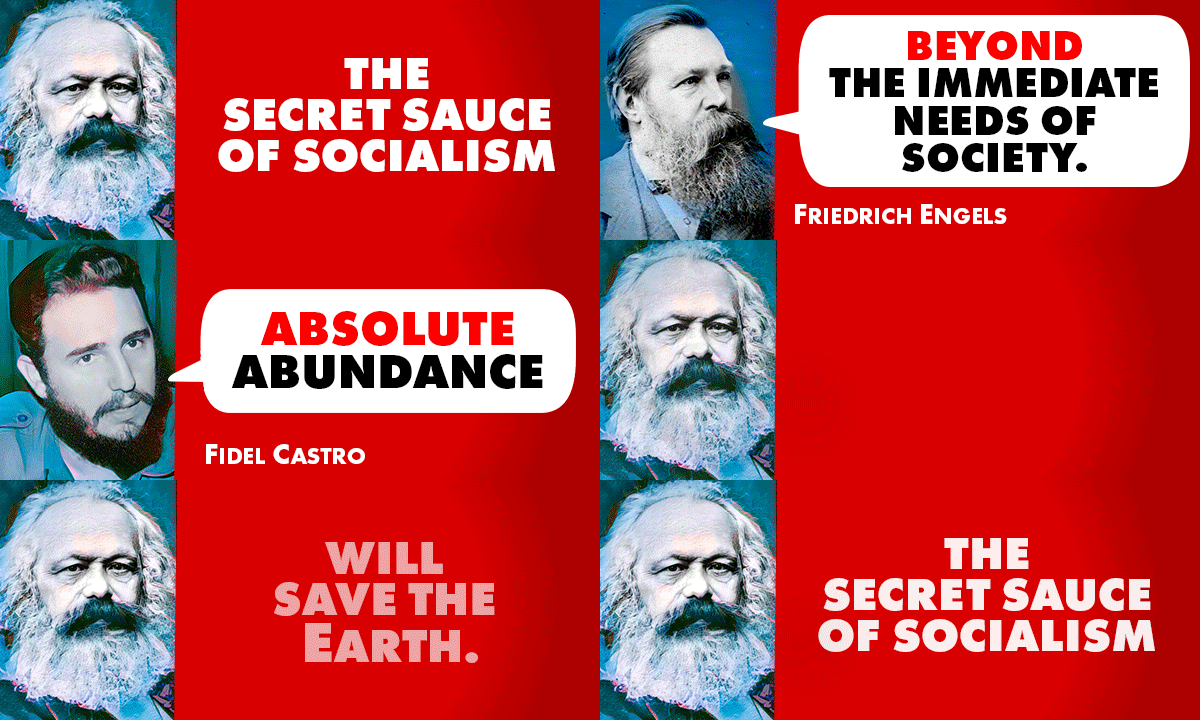
[47]. An upcoming Red Flags Press paper will explore the central role the socialist critique of capitalism as "anarchical" plays in socialist thought. This key aspect of socialist philosophy is also linked to the central flaw of socialist economic theory: the belief that when socialism replaces capitalist anarchy with a neatly organized system based on planning, the result would be dramatically enhanced productivity creating a world of superabundance. The actual results of socialist experiments have proven this theory to be a massive flub. See the soon-to-be-released Red Flags Press paper "The Secret Sauce of Socialism" for an overview.
Socialists have attacked the "anarchy" of capitalism on countless occasions. Here are three examples:
The opening sentence of Friedrich Engel's most famous individual work, Socialism: Utopian and Scientific, reads: "Modern Socialism is, in its essence, the direct product of the recognition … of the anarchy existing in production." Friedrich Engels, Socialism: Utopian and Scientific, trans. Edward Averling (London: George Allen and Unwit, Ltd., 1892), 1.
Noted British socialist J. Ramsey Macdonald writes: "There can be no steadiness of industry so long as there is anarchy in production." J. Ramsey MacDonald, Socialism and Society, 6th ed. (London: Independent Labor Party, 1908), 199.
Terry Eagleton writes: "It is capitalism which is out of control, driven as it is by the anarchy of market forces." Terry Eagleton, Why Marx Was Right (New Haven: Yale University Press, 2011), 187.
[48]. Prosper Enfantin et. al., The Doctrine of Saint-Simon: An Exposition, trans. Georg G. Iggers (New York: Shocken, 1972), 96.
[49]. Charles Fourier, La Fausse industrie morcelée, répugnante, mensongère, et l'antidote : l'industrie naturelle, combinée, attrayante, donnant quadruple produit (Paris: Bossange, 1835).
[50]. Fourier, Oeuvres complètes de Charles, 126.
[51]. Gronlund, Cooperative Commonwealth, 52.
[52]. Marx, Capital, 667.
[53]. Chris Williams, Ecology and Socialism (Chicago: Haymarket Books, 2010), 146, Kindle.
[54]. Robert Sewell, "Why You Should Be a Socialist," Socialist Appeal, September 14, 2015, https://www.socialist.net/why-you-should-be-a-socialist.htm.
[55]. In the title of his final work, Charles Fourier lists combinée (that is "combined") as the most important characteristic of the society he desired to see replace the morcelée (that is "fragmented") society of capitalism. Fourier, Fausse industrie morcelée, répugnante, mensongère, et l'antidote : l'industrie naturelle, combinée, attrayante, donnant quadruple produit.
[56]. Engels, Socialism, 81.
[57]. "The greatest saving of labour power lies in the fusing of the individual powers into social collective power and in the kind of organization which is based on this concentration of powers hitherto opposed to one another." Engels, "Speeches in Elberfeld," 248.
[58]. Karl Kautsky reports: "Where, however, a great industry exists to a considerable degree it is easy for a socialist society to concentrate production and to quickly rid itself of the little industry." Kautsky, Social Revolution, 144–45.
[59]. "This regime [socialism] will spare human labor, the waste of which is immoral. This savings will be achieved by several methods, including the following three: Competition will be suppressed. … Idleness will be suppressed. … Production will be centralized as much as possible" ("Ce régime épargnera le travail humain, dont le gaspillage est immoral. Cette épargne sera réalisée par plusieurs causés, dont les trois suivantes : La concurrence sera supprimée. … L'oisiveté sera supprimée. … La production sera centralisée autant qu'ilest possible"). Pierre Deloire [Charles Péguy], "De La Cite Socialiste," Le Revue Socialiste 25, no. 1 (1897): 187–88.
[60]. Agnes Heller, The Theory of Needs in Marx (London: Allison & Busby, 1974), 108. Vladimir Lenin, The State and Revolution, 2nd ed. (London: Laurence & Wishart, 1943), 118, emphasis added.
[61]. Figures from 2019 show an excess of 8,300 breweries, of which all but some 110 are a craft operation of one type or another. See www.brewersassociation.org/statistics-and-data/national-beer-stats/. Accessed September 7, 2020.
[62]. See www.brewersassociation.org/statistics-and-data/national-beer-stats/, esp. the graph entitled "Historical Brewery Count." The figure for 1978 is 89. Accessed September 7, 2020.
[63]. "Supply and Needs in Socialism," Socialist Standard, July 1984, http://www.worldsocialism.org/spgb/socialist- standard/1980s/1984/no-959-july-1984/supply-and-needs-socialism. Emphasis original.
[64]. Ernest "Che" Guevara, "On Economic Planning in Cuba," in Venceremos! The speeches and writings of Che Guevara, ed. John Gerassi (New York: Simon and Schuster, 1968), 149.
[65]. From the perspective of socialist theory, the superior aesthetics of craft-made items is a negative, not a positive. Craft goods are more desirable than mass-produced ones, creating competition and promoting the consumer mentality that socialism despites. As Che Guevara explains, a single design means no competition. The presence of multiple designs automatically "creates competition in the market." If one hundred craft artisans are producing purses, that's hundreds of purse designs competing on the market.
[66]. Kautsky, Dictatorship of the Proletariat, 13–14.
[67]. Kautsky, Social Revolution, 144.
[68]. Bebel, Woman Under Socialism, 289.
[69]. Castro describes the suppression of artisan businesses as meaning that 40,000 workers were "freed" for other work. Morphing job suppression into "freedom" is a long-running socialist practice, perhaps first employed by Frederick Engels. See the Red Flags Paper "The Socialist Obsession: The Central Role of 'Parasites' in Socialist Thought" for details and examples.
[70]. Fidel Castro, "Fidel Castro Addresses PURS Meeting (Havana CMQ Radio, February 23, 1963)," Latin America Network Information Center—Castro Speech Database, http://lanic.utexas.edu/project/castro/db/1963/19630223.html
[71]. Superabundant production of all needed goods and services, thereby permitting them to all be free for the taking; a society without pay for work, without buying or selling, and without money—these are assumptions that Morris uses as the starting point of News from Nowhere. They are also explicit goals of Marxian socialism (as will be detailed in the upcoming Red Flags Press paper "The Secret Sauce of Socialism").
Morris makes no effort to explain how it is that the staggering production volumes required to produce such a world were achieved or are maintained. The vast majority of production takes place off-stage and is simply assumed. This is, of course, Morris's prerogative because News from Nowhere is a novel, and as such, he can make any assumptions he wishes, just as J. K. Rowling assumes the existence of magic in the Harry Potter series.
But it's the fact that Morris's story is set in this perfected socialist society that permits Morris to include craftwork in a fashion that doesn't violate the precepts of socialist philosophy. By assuming the production levels of all goods are so great that everything is free, it creates a scenario in which the citizens of Nowhere are permitted to do essentially any work they wish, as what they do for work no longer actually matters. Morris's novel depicts the scenario G. A. Cohen describes as permitting the return of craft in a future socialist utopia: one in which the activities people perform only "resemble activity which once was labor."
[72]. For examples of the praise for both E. P. Thompson and his book William Morris: From Romantic to Revolutionary, see the PM Press website: https://www.pmpress.org/index.php?l=product_detail&p=256 (accessed May 23, 2021).
[73]. E. P. Thompson, William Morris: From Romantic to Revolutionary (Oakland: PM Press, 2011), 654. Emphasis added.
[74]. Paul Meier, William Morris, Marxist Dreamer, vol. 2 (Sussex: Harvester, 1978), 352; see also 351. Meier's contention is supported by Thompson, who writes that Morris considered the issue of craft in socialist society to be a "choice to be made after the transitional stage" (Thompson, William Morris, 654). This implies that the first stage of socialist society—the transition between capitalism and perfected socialism—would be barren of craftwork.
[75]. As Thompson writes, Morris felt that, if the first stage of socialist society achieved superabundance (thereby moving socialism out of the transitional phase into the perfected second phase), society at that point "might decide to return to handicraft in certain fields." "Might decide" and might not. And not all fields—"certain fields." Thompson, William Morris, 654.
Morris believed that to make the return of craft permissible within the strictures of socialist philosophy, all automated production in a given field would have to end and be entirely replaced by craft production. That way, there would never be competition between mass-produced goods and craft goods, and everyone in society would receive an item that had been produced in the same fashion. In this way, equity would be preserved.
Morris's method for permitting craft within the strictures of socialist thinking guarantees a grim future for craft, even if we assume the utopian world of superabundance. It's inconceivable that worldwide furniture production could be moved entirely from automated to craft production. As such, craftwork would never be permitted in this field. Thus, in the socialist future—even in one of limitless abundance—it would remain illegal to have your own craft furniture workshop that you supported by selling products of your creation.
[76]. Morris called repeatedly for socialist society to be in charge of determining what work is and isn't legitimate and for banning the right to pursue any job not approved by society. He didn't believe it was anyone's right to pursue work of their choosing unless and until society had approved that work as a legitimate use of what socialists see as society's time.
In "Art and Labour," Morris writes: "There must be no useless work done"; he calls for "all useless work abolished" (William Morris, "Art and Labour," in The Unpublished Lectures of William Morris, ed. Eugene D. Lemire [Detroit: Wayne State University Press, 1969], 115). In "Depression of the Trade," he writes: "If a man will not work usefully neither should he eat" (William Morris, "Depression of the Trade," in Lemire, Unpublished Lectures, 132). Society would determine what work qualifies as "useful" and what does not.
And, despite being an artist and novelist himself, Morris called for the suppression of numerous jobs in the arts come socialist society. Here Morris argues that "a new set of idlers" would result if socialist society permitted careers in sculpture, painting, and many other arts:
"Picture painting, sculpture, and the lesser or reproductive fine arts, such as engraving. Also imaginative literature, and the study of history and nature …. I feel sure that it would not do for men to be absorbed entirely in such arts. It would tend to disease, to anti-social habits which would burden the community with a new set of idlers." (William Morris, ed., Paul Meier, "An Unpublished Lecture of William Morris: 'How Shall We Live Then,'" International Review of Social History, Vol. X V I [1971], Part 2, 15-16.)
What does Morris say "would not do"? It would not do to let socialist citizens "be absorbed entirely" in such arts as painting, sculpture, or fiction writing ("imaginative literature"). To "be absorbed entirely" is a roundabout way of saying to work full time at a task, to make a career of it. It would not do to let people in socialist society have a career as a picture painter, a sculptor, a novel writer, etc.
[77]. Lenin, "Left-Wing" Communism, 10.
[78]. Harrington, Socialism, Past and Future, 267.
[79]. Enfantin, The Doctrine of Saint-Simon, 96.