
"Mercilessly put to death
the parasites."
—Alphonse Toussenel
The socialists quoted below (111 of them, actually) are but a small portion of the entire universe of socialist philosophers and leaders who attack alleged "parasites."
Some of these socialist thinkers are also cited in our paper "The Socialist Obsession." However, each quote below is new and additional, not a repetition of one appearing in the paper itself.
While only a single example of each socialist employing "parasite," "parasitism," or "parasitic" appears below, the vast majority of these individuals use these terms repeatedly in their speeches and writings.
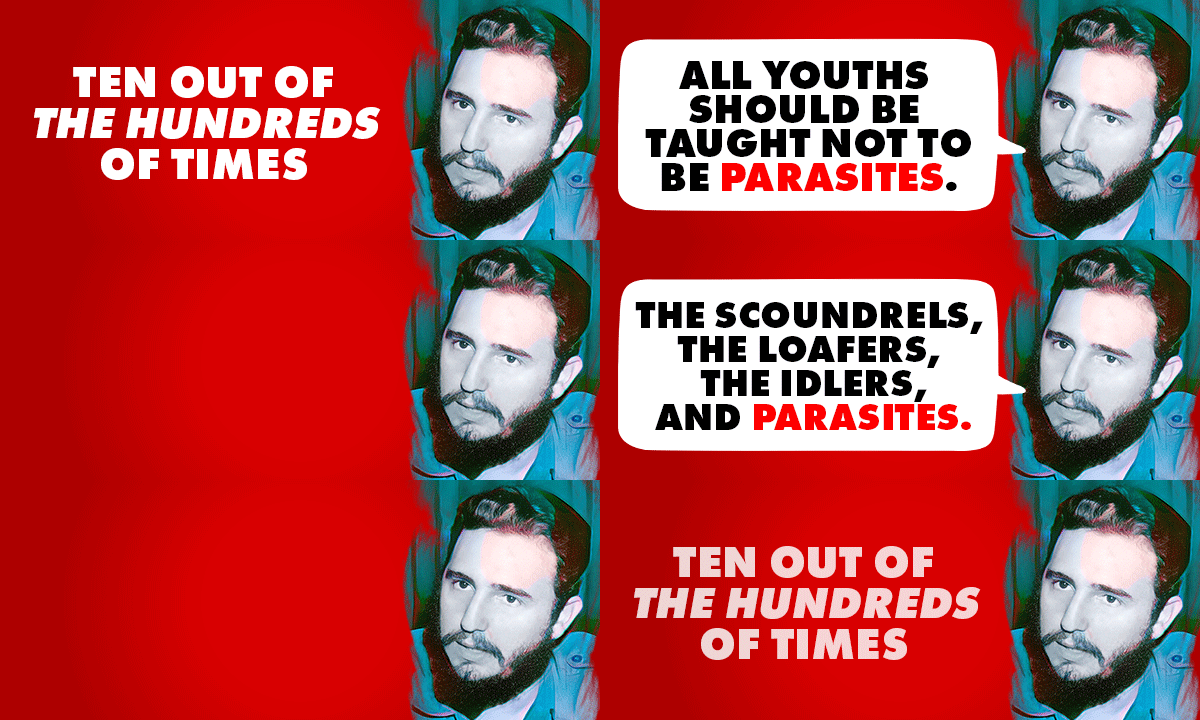
For example, Fidel Castro attacked slackers and others he considered parasites literally hundreds of times (ten examples from Fidel in the GIF above). And, on the page "Learning Democratic Socialism from Eugene Debs," we provide over two dozen examples of celebrated socialist Debs condemning supposed parasites.
We've emphasized "parasite" and related terms in the quotes below. All other emphasis is in the original.
1. Clement Attlee (1883-1967):
They are only parasites on parasites. The men and and women who produce the luxuries exposed in Bond Street are as parasitic as the footman in the big house. They are occupied in ministering to the unnecessary luxuries of the few. [Source]
2. Gracchus Babeuf (1760-1797):
Some crafts, it is true, whose productions only serve to relieve the ennui of a very small portion of parasites … should give place to others which would augment the well-being of the great mass of society." [Source]
3. Paul Baran (1909-1964):
The entire parasitic business of buying and selling and speculating in real estate. [Source]
4. E. Belfort Bax (1854-1926):
The disputes between individuals having their origin in the private ownership of property afforded the opportunity for a class of parasites to arise who could for their own purposes exploit these disputes. [Source]
5. August Bebel (1840-1913):
The increasing mass of the middlemen draws many evils in its wake. Although this class toils arduously and works under the load of heavy cares, the majority are parasites, they are unproductively active, and they live upon the labors of others, just the same as the capitalist class. [Source]
6. Allan L. Benson (1871-1940):
Under Socialism, the parasites will have to go to work. [Source]
7. Victor Berger (1860-1929):
The great capitalist triumphs, the small capitalist be-comes a clerk, a politician, a traveling agent, a saloon-keeper, a lawyer, or a parasite of one kind or another sometimes even a wage earner. [Source]
8. Eduard Bernstein (1850-1932):
the rank growth of all kinds of social parasitism and corruption. [Source]
9. Louis Blanc (1811-1882):
Their crowd was not long in being swelled, doubled, tripled, quadrupled, by the cessation of work, by the scarcity of grain, by lazy workers, by deserters, by parasites. [Source]
10. Auguste Blanqui (1805-1881):
Every day sheds more light on this alleged association of the parasite and their victim. The facts have their eloquence; they prove the duel, the duel to the death between income and salary. Who will succumb? Question of justice and common sense. Let's examine. No society without work! This means there are no idlers who do not need workers. But what need do workers have of the idle? [Source]
11. Amadeo Bordiga (1889-1970):
Even today the parasite and the egoist must pretend for others and for themselves. When wage labor is abolished it will be very difficult to create the illusion one is working. Everyone will be judged on what they actually do and not on the time spent. [Source]
12. Earl Browder (1891-1973):
Capitalism is, and can only be, the ownership and control of the national economy, and everything that goes with it, by a small class of parasitical monopolists. That is the root of crises, unemployment, and all the social ills of mankind; it is the root of militarism and war. [Source]
13. Étienne Cabet (1788-1856):
Back, parasite! No more parasites! [Source]
14. James Cannon (1890-1974):
The necessary amount of productive labour time which will be required of each individual in the new society cannot be calculated on the basis of the present stage of industrial development. … The elimination of waste caused by competition, parasitism, etc., will render any such calculation obsolete. [Source]
15. Fidel Castro (1926-2016):
It is necessary … to see the loafer as an enemy, a parasite, as an enemy who is taking away part of our wealth. And when we learn to see things that way, life will become impossible for them. [Source]
16. Auguste Chirac (1838-1910):
The productive and fruitful power of the earth was neglected because it requires work that parasites detest. [Source]
17. Paul Cockshott (1952- ):
At the same time the bourgeoisie devoted a trivial proportion of their profits to capital accumulation, consuming the rest in a parasitic fashion. [Source]
18. Victor Considerant (1808-1893):
The new order of things eliminates this unproductive and parasitic race of attorneys, lawyers, who know only how to confuse particular cases and throw disorder into public affairs which they constantly pretend to rule with their absurd ideological and quibbling subtleties. [Source]
19. Jeremy Corbyn (1949- ):
They are political parasites feeding on people's concerns and worsening conditions, blaming the most vulnerable for society's ills instead of offering a way for taking back real control of our lives from the elites who serve their own interests. [Source]
20. Lewis Corey (1892-1953):
Much of the middle class growth, however, represents cancerous elements of social-economic parasitism, multiplying the burdens upon productive labor. The more parasitic occupations (advertising, merchandising, speculation, the law) fattened upon an inflated prosperity. [Source]
21. Paul D'Amato (1956- ):
The ruling class today has become entirely parasitic, siphoning wealth but serving no useful social function. [Source]
22. J. Morrison Davidson (1843-1916):
Supernumeraries and Parasites —Of these in an individualistic community such as ours, the name is legion. It is probable that nine out of every ten persons now engaged as distributors would be set free for useful production under a Collectivist regime." [Source]
23. Daniel De Leon (1852-1914):
Nothing can contribute more towards calling attention to and proving the important Socialist tenet that the capitalist is an idler, a parasite, a being who contributes nothing towards production, but only sponges up the wealth of the producers, than to make in his behalf the preposterous claim that he 'expends ability'… [Source]
24. Eugene Debs (1855-1926):
The capitalist does no work himself; that is, no useful or necessary work. He spends his time watching other parasites in the capitalist game of "dog eat dog," or in idleness or dissipation. [Source]
Celebrated "democratic" socialist Debs attacks parasites again and again, exactly as authoritarian socialists do. See over two dozen examples of Debs attacking alleged "parasites" and calling for socialism to "abolish" them.
25. Lucien Deslinières (1857-1937):
By suppressing intermediaries and all social parasites, the socialist organization will restore to production a workforce which, for France, has been estimated at forty percent of the working population. [Source]
26. Théodor Dézamy (1808-1850):
Four hours of moderate and intelligent work, for every able-bodied man, would be enough to exploit and marvelously shape all its products, if the bulk of nations were not composed of so many parasites; all people of leisure or unproductive, even pernicious, workers. [Source]
27. Hal Draper (1914-1990):
These are upper-class elements: not detritus [trash] from the poor lower strata of society, but hangers-on of the rich and powerful. What they have in common with the poor lumpen-class is that they are functionally outside the social structure. To be sure, they also have in common a purely parasitic role, but this is not distinctive, for there are also functional elements in bourgeois society that are parasitic in a definable sense from Marx's standpoint. [Source]
28. Friedrich Engels (1820-1895):
Under the pretext that they save the producers the trouble and risk of exchange, extend the sale of their products to distant markets and are therefore the most useful class of the population, a class of parasites comes into being, 'genuine social ichneumons'… [an "ichneumon" is a parasitic family of wasps that lays its eggs in or on other insects.] [Source]
29. William Foster (1881-1961):
Gone are the hordes of high pressure salesmen insurance agents, lawyers, brokers, advertising men, real estate sharks, stock speculators, strike-breaking agencies, and the innumerable other ragtag and bobtail of capitalist society. Not only has the Soviet system saved the vast funds wasted on these useless armies of social parasites, but especially it is rid of their reactionary political influence. [Source]
30. Charles Fourier (1772-1837):
Parasitism or Superfluity of agents spoils the Body Social in two ways, by robbing it of an infinite number of arms employed in unproductive labor, and by the immorality and the disorders caused by the bitter struggle of these innumerable merchants. [Source]
31. Eugéne Fourniére (1857-1914):
Only the practice of economic solidarity, freed from capitalist parasitism, will be able to bring the moral world into line with the material world, and stop the deviations, too frequent today, from freedom to libertinism. [Source]
32. Hyman Frankel (1918-2010):
Based as it was at the beginning on competition, capitalism constantly socialized production. It created new wants and built an enormous and parasitical promotional industry. [Source]
33. Ted Grant (1913-2006):
If factories are to be set up with government money why should not the state and the people benefit, not the parasitic minority? [Source]
34. R. E. Greenblatt (?- ):
[Financial markets don't work on the basis] of social need, distorting the economy in the interests of an essentially parasitic class of speculators. [Source]
35. Deidre Griswold (1936- ):
What's more important? The "right" to become a rich parasite? Or the right to a job … [Source]
36. Laurence Gronlund (1846-1899):
The great capitalist triumphs, the small capitalist becomes a clerk, wage-laborer or parasite of some kind or other; the middle class disappears little by little. [Source]
37. Jules Guesde (1845-1922):
The socially necessary labour-time to be furnished by each capable member of the Socialist State will likewise be reduced … By the disappearance of the parasitical class, and not only of that alone but also of the sub-parasites who live on this class. In France there are more than two million persons of both sexes employed in domestic pursuits, without counting the numbers of prostitutes and parsons, police, magistrates, and soldiers. [Source]
38. Che Guevara (1928-1967):
the development of a parasitic bourgeoisie that adds nothing to the national wealth of their countries … [Source]
39. Takawira C. Gwarinda (?- ):
Hence socialist school organization is based on education with production (polytechnical education) which we shall examine in … Elitist education produces unproductive parasites whose survival depends on the oppression of other classes. [Source]
40. Keir Hardie (1856-1915):
With the land and machinery socially owned, with the parasites wiped out, with the entire nation organised so as to turn each individual service to the most profitable account, work would become a mere incident in man's life …. [Source]
41. Chris Harman (1942-2009):
Bankers, hedge funds and rich parasites could not extract from them the money they needed to pay back other bankers, hedge funds and rich parasites. [Source]
42. Michael Harrington (1928-1989):
I mentioned earlier the parasitic character of a great deal of the activity on Wall Street and in the financial industry as a whole. [Source]
43. Moses Hess (1812-1875):
The parasitic way of existence has played an important role in the development of human history and is by no means restricted to the Jews. [Source]
44. J. A. Hobson (1858-1940):
Often the parasites and hangers-on to upper-class sports and recreations, these form a large and growing class of our population, and their withdrawal from all industry that can be termed productive, coupled with the debased mode of consumption which they practice, count heavily in the aggregate of social waste. [Source]
45. Leo Huberman (1903-1968):
Who can deny that our economic system could operate—better than ever before—without parasites? [Source]
46. Henry Hyndman (1842-1921):
non-producing class and their parasites (including petty distributors who are economically useless). [Source]
47. Dolores Ibárruri (1895-1989):
The walls of hatred erected by the exploiters and parasites have been razed to the ground. [Source]
48. C. L. R. James (1901-1989):
The parasitism of the aristocracy and clergy, whose extortions burdened the peasant and were wasted in luxurious and unproductive consumption. That the cause of this is the "danger of communism" is the familiar alibi of all despots, parasites and privileged groups. [Source]
49. Jean Jaurés (1859-1914):
… it will increase their willpower to get rid of the parasitic classes that exhaust them and will raise their minds to organize with all the forces of science a more fruitful and less overwhelming work; they will raise their conscience to escape the jealousies and miserable mistrust which paralyze them and to substitute combination of efforts and peasant cooperation for isolated work. [Source]
50. Karl Kautsky (1854-1938):
The capitalist system of production squanders these forces; it steadily drives increasing numbers of workers into the ranks of the unemployed, the slum proletariat, the parasites and the unproductive middlemen. [Other examples from Kautsky attacking what he saw as parasites/parasitism appear in the full paper.] [Source]
51. John Keracher (1880-1958):
The only useful people today are those engaged in producing the wealth. It is they alone who must eliminate the parasites and usher in a new social order. The future of civilisation is in the hands of the producing class. [Source]
52. Paul Lafargue (1842-1911):
Natural history has shown that all parasites also have their parasites. Social history corroborates the fact. As the bourgeois are the social lice living on the working class, the servants of the bourgeoisie (statesmen, soldiers, magistrates, prostitutes, journalists, etc.) who share with them the loot stolen from the producers, are parasites on these social lice. [After a life filled with attacking parasites and inheritance, Lafargue and his wife Laura (one of Karl Marx's daughters) would use a portion of a large sum they inherited from Friedrich Engels to purchase a 30+ room mansion outside of Paris and staff it with three fulltime domestics. Lafargue himself? A parasite.] [Source]
53. Pieter Lawrence (1932-2007):
Beyond the hypocrisy of social parasites finding virtue in hard work so long as it does not refer to them, esteem and respectability in modern propertied society is still accorded to the individual in direct proportion to the amount of property that he or she owns. [Source]
54. Vladimir Lenin (1870-1924):
The solution lies only in socialized farming. … The way to escape the disadvantages of small-scale farming lies in communes, cartels or peasant associations. That is the way to improve agriculture, economise forces and combat the kulaks, parasites and exploiters. [Source]
55. George Lichtheim (1912-1973):
… modern industry operates more effectively if it is not loaded down by a body of parasites: the heirs of the original entrepreneurs. [Source]
56. Paul Louis (1872-1955):
Thus, any initiative will become more fruitful because it will no longer be hampered by another rival initiative; the parasites, the unproductive which abound today, thanks to disorder and confusion, will be compelled to an efficient task. [Source]
57. Rosa Luxemburg (1871-1919):
… the various parasites of present-day society ('king, professor, prostitute, mercenary'). Aside from the few who have jobs or professions, the women of the bourgeoisie do not take part in social production. They are nothing but co-consumers of the surplus value their men extort from the proletariat. They are parasites of the parasites of the social body. [Source]
58. Ramsay MacDonald (1866-1937):
Parasitism breeds parasitism. [Source]
59. Nicolás Maduro (1962- ):
Maduro launched what he described as "an economic offensive" against shopkeepers he called "capitalist parasites." [Source]
60. Errico Malatesta (1853-1932):
It can be said therefore, that the greatest harm wrought by the capitalist system is not so much the army of parasites that it feeds, as the obstacles it places in the way of the production of useful commodities. [Source]
61. Benoît Malon (1841-1893):
The economic world being, in a so-called capitalist system, based on the productivity of capital … it seems that everything is arranged to favor of parasitism and injustice. [Source]
62. Ernest Mandel (1923-1995):
eliminating the scarcities that are the root cause of the entrenchment of a parasitic bureaucracy … [Source]
63. Mao Zedong (1893-1976):
However rampant they may be for the moment, the parasites who depend on imperialism will soon find out that their bosses are not reliable. The whole situation will change when the tree falls and the monkeys scatter. [Source]
64. Herbert Marcuse (1898-1979):
Late industrial society has increased rather than reduced the need for parasitical and alienated functions … [Source]
65. Sam Marcy (1911-1998):
The police officer is a parasite who lives off what the worker produces. [Source]
66. Karl Marx (1818-1883):
A new variety of parasites in the shape of promoters, speculators and simply nominal directors the landowner – this idle, parasitic grain-profiteer – raises the price of the people's basic necessities and so forces the capitalist to raise wages without being able to increase productivity, thus impeding [the growth of] the nation's annual income, the accumulation of capital, and therefore the possibility of providing work for the people and wealth for the country, eventually cancelling it, thus producing a general decline – whilst he parasitically exploits every advantage of modern civilisation without doing the least thing for it … [Source]
67. Alan Maass (1962- ):
Blackstone doesn't launch new businesses or develop innovative products. Its chief activity is to be a traveling parasite. [Source]
68. Paul Mattick Jr. (1904-1981):
Mere numbers of workers opposed to the powerful capitalist state at times when history still favours capitalism do not represent the giant on whose back the capitalist parasites rest, but rather the bull who has to move in the directions his nose-stick forces. [Source]
69. Tatah Mentan (1948- )
As long as African political rulers and administrators are drawn from this class of parasites, no amount of preaching the virtues of good governance or tuition on public administration will fundamentally alter the quality of governance. [Source]
70. Istaván Mészáros (1930-2017):
Another grave problem that underscores the present and future historical unviability of capital is the calamitous shift toward the parasitic sectors of the economy. [Source]
71. Étienne–Gabriel Morelly (1717-1778):
Idle people, who belong to the tree [of life] only as parasitic plants, are not worth the most vitiated branch. [Source]
72. William Morris (1834-1896):
At present art is only enjoyed, or indeed thought of, by comparatively a few persons, broadly speaking, by the rich and the parasites that minister to them directly. [Source]
73. Benito Mussolini (1883-1945):
Before becoming "the father of Fascism," Benito Mussolini was a leader in the Italian Socialist Party and editor-in-chief of Avanti!, the party's national daily newspaper. In the hundreds of speeches he gave and the hundreds of articles he wrote as a socialist, Mussolini attacked supposed parasites any number of times. This prepared him to do likewise as the world's first fascist dictator. Learn more here. (Do not fear that this quote-less discussion of Mussolini means that "101 Damnations" is one short of 101 quotes. This page actually contains quotes from 111 socialists.)
74. Julius Nyerere (1922-1999):
When I say that in traditional African society everybody was a worker, I do not use the word 'worker' simply as opposed to 'employer' but also as opposed to 'loiterer' or 'idler' … Not only was the capitalist, or the landed exploiter, unknown to traditional African society, but we did not have that other form of modern parasite – the loiterer, or idler, who accepts the hospitality of society as his 'right' but gives nothing in return! … There is no such thing as socialism without work. [Source]
75. Moissaye J. Olgin (1878-1939):
We propose that production be made to serve the needs of those who work, rather than to serve the needs of a few parasites. [Source]
76. Sydney Olivier (1859-1943):
… in that section of our nation which speaks of itself as 'society,' being indeed a society separated by economic parasitism from the common mass, we find that the characteristic activity is the provision of agreeable and exciting methods of passing time. [Source]
77. Bertell Ollman (1935- ):
The new order brings to an end the parasitic situation existing under capitalism, where the few who don't work are supported by the many who do. [Source]
78. Sylvia Pankhurst (1882-1960):
We aim at the common service; we desire that all should serve the community, that no longer should there be diverse classes of persons; the hewers of wood and the drawers of water; the intellectuals, the leisured classes, who are merely parasites. The Individualist cries: 'Freedom.' We answer: 'Thou shalt not exploit.' 'Thou shalt not be a parasite.' [Source]
79. Anton Pannekoek (1873-1960):
The social revolution is nothing but this social reform. In realizing this program the proletariat revolutionizes the mode of production, for capitalism can only subsist on the misery of the proletariat. Once political power has been conquered by the proletariat and unemployment has been suppressed, it will be easy for union organizations to considerably raise salaries and gradually improve working conditions, up to the disappearance of profit. Exploitation will become so difficult that the capitalists will be forced to renounce it. The workers will take their place and will organize production by doing without parasites. The positive work of the revolution will begin. Proletarian social reform directly leads to the complete realization of socialism. [Source]
80. Brian Pearce (1915-2008):
Who are 'parasites'? A reader asks whether it is the view of the Socialist Labour League that everyone whose work does not directly produce a palpable object, such as a house or a heap of coal, is a parasite?… The category of 'socially-useful' work is a great deal wider than that of 'productive' work. Take book-keeping, for instance, a thoroughly 'unproductive' activity: in a well-known passage in volume ii of Capital Marx pointed out that it will be still more necessary under socialism than it is already under capitalism! [Source]
81. Constantin Pecqueur (1801-1887):
The State, that is society, everyone, which replaces the parasites and collects 9/10ths of the income for the benefit of all… [Source]
82. Juan Posadas (1912-1981):
In socialist society, society's capacity will be unlimited. The notion of life, existence, society, will be measured by the objective interests of life and progress. Existence and progress will be identified with one another. Notions of conservatism, parasitism, passivity, will no longer exist. [Source]
83. Pol Pot (1925-1998):
The April 17 People are parasitic plants. —["April 17 People" is the name the Khmer Rouge gave those tens of thousands they forced to leave Cambodia's cities upon taking over the country on April 17, 1974] [Source]
84. Pierre–Joseph Proudhon (1809-1865):
The idler, the slacker, who, without performing any social task, enjoys like others — and often more than others — the products of society, must be pursued as a thief and parasite. We owe it to ourselves to give him nothing; but since he must nevertheless live, to put him under surveillance, and compel him to work. [Source]
85. Charles Rappoport (1865-1941):
The supporters of capitalism ignore or do not know this basic and primary fact. They do not know and recognise anything save the individual. This bourgeois outlook sacrifices the interest of all, the collective interest of society to the self-interest of the individual; the interest of the producing majority to that of the parasitic minority. [Source]
86. Georges Renard (1847-1930):
In present-day society there's a multitude of useless, lazy, of parasites; at the top, people who can dispense with working, because they live off the work of others transformed into rents and profits; below, vagabonds and thieves grabbing a miserable existence at the expense of the possessors whom they can rob; among those who work, a results are lost as a result of organizational implied by the abandonment of production to private enterprises: the need for a swarm of intermediaries between the consumer and the producer; relentless competition. [Source]
87. Maximilien Rubel (1905-1996):
Although the disappearance of all intermediaries (parasites) would allow an increase in production, and by this means would guarantee the satisfaction of needs … [Source]
88. Charles Ruthenberg (1882-1927):
The wealth which the workers produce but do not receive is paid to an idle, parasitic class in the shape of interest and dividends. [Source]
89. Henri de Saint-Simon (1760-1825):
But there is around society, circling around its bosom, a crowd of parasites who having the same needs and the same desires as others, but who have not like them overcome the laziness natural to all and who, despite producing nothing still consume or want to consume like those who produce. [Source]
90. Robert Sewell (?- ):
Capitalists: wealth creators or parasites? [Source]
91. Max Shachtman (1904-1972):
The capitalist class has revealed how superfluous it is to society by openly becoming a parasitic class. It is a leech which systematically drains the life-blood of the economy. [Source]
92. Bernard Shaw (1856-1950):
There are too many people living as parasites on their fellows instead of by production. [Source]
93. A. M. Simons (1870-1950):
The conquest of nature was easy, the battle against social parasites well-nigh hopeless. [Source]
94. John Spargo (1876-1966):
… with the disappearance of the system of capitalist production and exchange, and the extensive advertising it involves, the servile and parasitic press would also disappear. [Source]
95. Joseph Stalin (1878-1953):
… in future society the hundreds of thousands of present-day parasites, and also the unemployed, will set to work and augment the ranks of the working people; and this will greatly stimulate the development of the productive forces. [Source]
96. John Strachey (1901-1963):
Those of the rich who elect to be idle have become demoralized and demoralizing parasites upon our communities, spoiling and soiling everything which they touch, degrading every value, their art turned to futility, their lives to waste, emptiness and decay. [Source]
97. R. H. Tawney (1860-1962):
It relieves them of the necessity of discriminating between different types of economic activity and different sources of wealth, between enterprise and avarice, energy and unscrupulous greed, property which is legitimate and property which is theft, the just enjoyment of the fruits of labour and the idle parasitism of birth or fortune … [Source]
98. Maurice Thorez (1900-1964):
… our Party wanted to unite all the workers, all the unfortunate against those who exploit and divide them. It wanted to unite the whole of the working people against the parasitic minority which oppresses and ruins the country. [Source]
99. Hillel Ticktin (1937- ):
The parasitic forms of finance capital will be abolished. The banks, insurance companies, stock exchange, and forms of adding up and collection of money will be abolished. [Source]
100. Sékou Touré (1922-1984):
The man who thinks and acts exclusively for himself is a social parasite. [Source]
101. Alphonse Toussenel (1803-1885):
A real democratic monarchy, where all work, queen as the people, and where the workers mercilessly put to death the parasites, to show us that the constitution of perfect order and attractive work does not involve idlers. [Source]
102. Gustave Tridon (1841-1871):
The first rank belongs to the useful citizen, the worker, the peasant. The idler and the parasite must be held in the contempt with which they have so long held their slaves. [Source]
103. Leon Trotsky (1879-1940):
We should have to decide the question of who is to be included in the category 'proletariat.' … Should we include the reserve masses of the urban proletariat – who on the one hand merge into the parasitical proletariat of beggars and thieves, and on the other fill the city streets as small traders playing a parasitical role in relation to the economic system as a whole? This question is not at all a simple one. [Source]
104. Anton Cu Unjieng (?- ):
If we got rid of those parasites and redirected all that time and resources towards meeting the needs of everyone generally, we could all work far less. [Source]
105. Charles H. Vail (1866-1924):
Beside the idle rich there are many other non-producers, such as servants, lackeys, and other satellites of the wealthy class. These parasites are paid by the rich out of the surplus which they have exploited from the useful producers. [Source]
106. Emile Vandervelde (1866-1938):
those legions of inferior parasites, valets, jockeys, hairdressers, croupiers, low-class actors, and prostitutes, who swarm like maggots on the capitalist dunghill … [Source]
107. Beatrice Webb (1858-1943):
Even more disastrous to the welfare of the community is the constantly recurring unemployment of millions of men, gradually producing a hard kernel of workless people, mostly young persons, who become, as years pass by, veritable parasites. [Source]
108. Sidney Webb (1859-1947):
No less necessary is it that the aggregate wealth production of the whole community should be greatly and continuously increased that, to this end, the primitive processes of agriculture, as of manufacturing industry, must be transformed by the universal application of mechanical, physical and chemical science; and that manual labour must be, as far as possible, superseded by power-driven machinery, without the toll else- where levied on production by "functionless owners" of either land or capital, or other "parasitic" consumers. [Source]
109. H.G. Wells (1866-1946):
I see no more difficulty in managing land, factories, and the like, publicly for the general good, than there is in managing roads and bridges, and the post office and the police. So far I see no impossibility whatever in Socialism. To abolish private property in these things would be to abolish all that swarm of parasites, whose greed for profit and dividend hampers and makes a thousand useful and delightful enterprises costly or hopeless. [Source]
110. Chris Williams (?- ):
Capitalism is essentially a parasitic relationship—bosses live off the lifeblood of workers and the raw material of nature. [Source]
111. James A. Yunker (?- ):
… the great majority do in fact have ordinary labor jobs, jobs which preclude them from being personally describable as "social parasites." [Source]