

"If abundance is not possible,
then neither is socialism,
and there's no reformulation
that can evade that fact."
— Michael Harrington, founder
Democratic Socialists of America
"In socialism
overproduction would be indispensable
to assure the satisfaction of social needs
and would therefore be
considered normal."
—Paul Mattick, Jr.,
socialist philosopher
Creating socialism
and fulfilling socialist sales promises
requires worldwide production volumes
far greater than today's.
CONTENTS
- INTRODUCTION
- THE RECIPE
- THE INGREDIENTS
- NO SAUCE? NO SOCIALISM
- "OPULENT ABUNDANCE": ACCEPT NO SUBSTITUTES
- WHERE ARE THE WARNING LABELS?
- CONSTANT OVERPRODUCTION WILL SAVE THE EARTH?
INTRODUCTION
There's a secret sauce required to cook up socialism—a special ingredient without which socialism is impossible.
That's what Michael Harrington, the founder of the Democratic Socialists of America (DSA), and other socialist philosophers tell us.
Why can't socialism be created without this ingredient?
Because so many key features of socialism require it, including what socialists say is the defining promise of their philosophy—a world based on this most famous of socialist axioms:
From each according to their abilities, to each according to their need.[1]
Even more critically, socialists assume this special ingredient would mitigate the dangers posed by socialism's foundation on the compulsory duty of "from each according to their ability."
This anti-liberal duty has warped so much of socialist philosophy (for example, causing socialism's fascist-like fixation with suppressing "parasites," a topic we explore in "The Socialist Obsession"). Socialists believe the secret sauce would end the nightmare of one socialist society after another turning into an authoritarian state.
What is this ingredient that's required to not only deliver on socialism's most important sales promises but also to minimize the risks of repression?
Socialists use two names for it.
The first is "abundance," which socialists often state more forcefully by using such terms as "superabundance,"[2] "limitless abundance,"[3] or as celebrated democratic socialist Eugene Debs puts it, capturing the spirit of what socialists expect and socialism requires, "opulent abundance."[4]
At its simplest, abundance is the opposite of scarcity. But as socialists use the term, abundance has a very specific meaning.
In the socialist lexicon, "abundance" means having so much of every needed thing that all on Earth can take whatever they wish for free forever, permitting socialist society to be based on the adage "to each according to their need."
Every needed thing. Free. Worldwide. Forever. That's a truly opulent abundance.
The second name for this ingredient expresses the method by which socialist abundance would be achieved. It's "overproduction," or as Karl Marx termed it, "constant over-production."[5]
"Abundance" and "constant over-production" are simply alternate names for the same key ingredient socialism requires.
As we'll see, the only way to create what socialists define as abundance is by overproducing. And because socialists promise abundance would last for eternity, overproduction must be constant.
Whatever you've heard about socialism, you likely have heard little, if anything, about its requirement for abundance and overproduction.
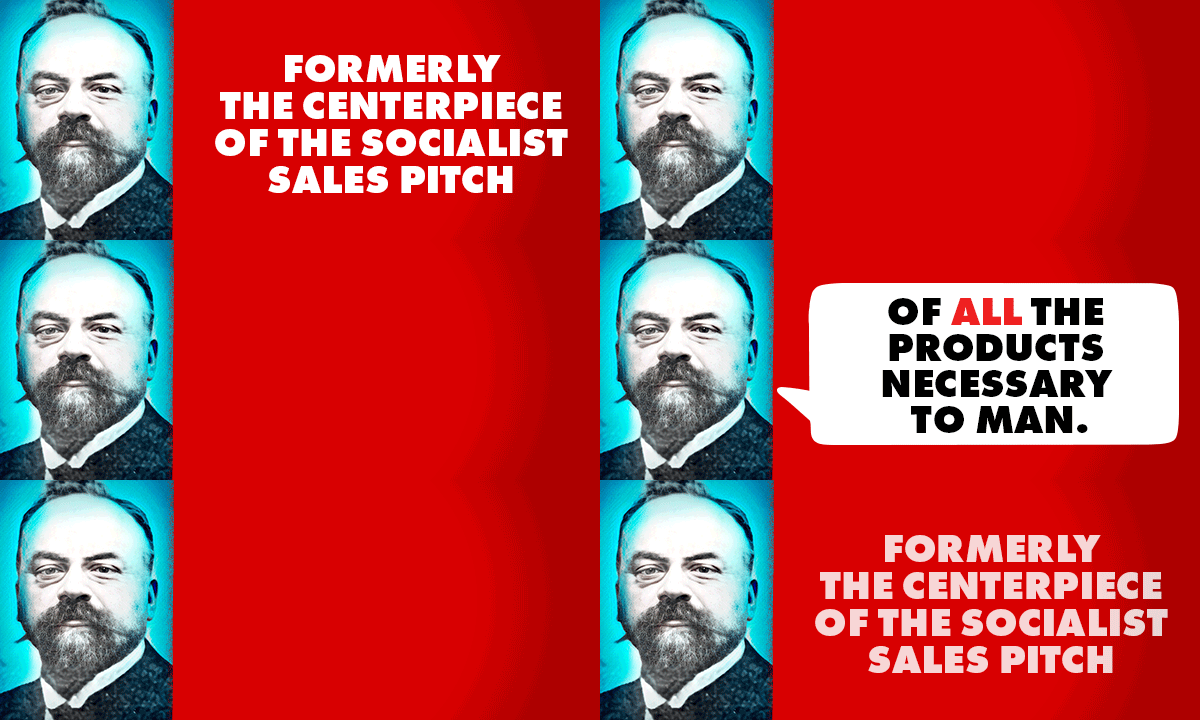
The claim socialism would create a world of abundance used to be the centerpiece of the socialist sales pitch. Today, however, socialists rarely mention the topic, even though abundance remains the essential ingredient in the recipe for socialism.
Abundance and constant overproduction—it's become socialism's secret sauce.
This paper aims to study this ingredient without which, according to socialists themselves, socialism is impossible. We'll explore the reasons the sauce is essential, why it went from center stage to secret, and how it makes socialism a utopian dream in its ambitions and a dystopian nightmare in its results.
THE RECIPE
"If abundance is not possible,
then neither is socialism"
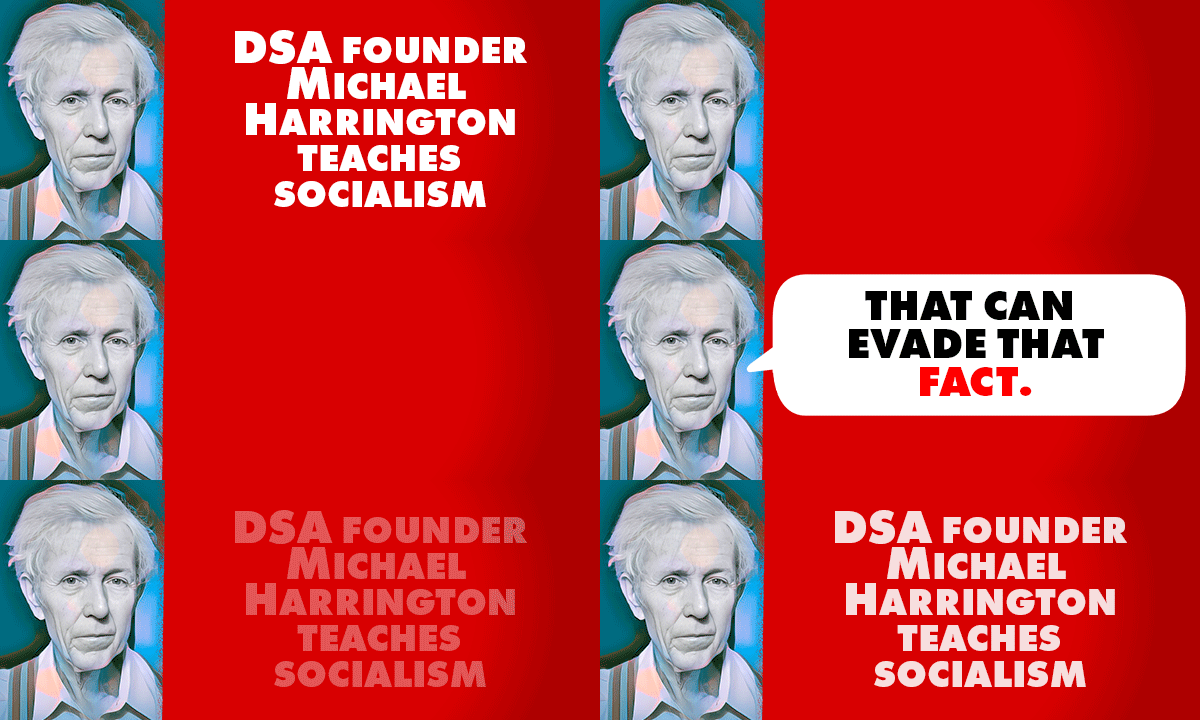
In his book Socialism, DSA founder Michael Harrington tells us:
If abundance is not possible, then neither is socialism.
He doubles down by immediately adding:
and there's no reformulation that can evade that fact.[6]
Harrington is clear that the recipe for socialism (democratic socialism included) requires abundance and that the formula can't be changed to escape this reality.
Paul D'Amato (who, like everyone quoted in this paper, is a socialist thinker) similarly writes that abundance is an ingredient without which socialism is utopian—that is, impossible:
Abundance is the first material premise that makes socialism more than a utopian dream.[7]
And Fidel Castro explains:
If we want to create socialism and create communism,[8] there is one most important thing—abundance. Such an abundance that men will have everything they need. … We will have to create abundance in practically unlimited quantities with our work and with technology.[9]
Hillel Ticktin makes the same point as Harrington, D'Amato, and Castro but does so from the perspective of scarcity, the opposite of abundance:
If scarcity is permanent, socialism is ruled out.[10]
Harrington describes socialism's requirement of abundance as a "fact." It's a fact about which socialist philosophers share a consensus, including, most importantly, Karl Marx. Marx's thinking has been the very definition of socialism for well over a century. He remains socialist superstar #1, with today's socialists proclaiming, "Marx lives!"
G. A. Cohen is considered by many to be the preeminent modern-day Marxist philosopher.[11] According to Cohen, Marx expected that socialist society would be one of
limitless conflicts-dissolving abundance.[12]
Marx imagined an abundance so extreme that it would dissolve all human conflict. That's even more opulent than Eugene Debs's "opulent abundance."
But Marx wasn't the first socialist philosopher to base socialism on the premise of a world of abundance. Paul Sweezy explains that
others before Marx had had a similar vision of the good society to come—a society of abundance in brotherhood in place of the society of scarcity.[13]

"This is why the superiority of socialism is brilliant"
Today, it's rare for socialists to speak about their philosophy's requirement for abundance and constant overproduction. But this wasn't always the case.
Earlier in socialist history, the "fact" that socialism was going to create a world of superabundance was touted as its essence and its genius.
In one such example, Lucien Deslinières crows:
This is why the superiority of socialism is brilliant; it will in a very limited space of time create a superabundance of all the products necessary to man; we will have to limit production, which will allow the surplus of labor to be allocated to beautification and to reduce the hours of work.[14]
For most of socialist history, such promises littered socialist books, articles, and speeches.
Examples, respectively from Fidel Castro, Karl Kautsky, Max Shachtman, Daniel DeLeon, James Cannon, and Leo Huberman illustrate the pervasiveness of these claims:
We will have such an abundance of everything…. There will be such an abundance of those things a man needs to live that there will be surpluses. [Castro also described socialist abundance as "superabundance," "complete abundance," "absolute abundance," and "limitless abundance."][15]
Everything wanted by man will be produced in great abundance.[16]
Socialism Means Abundance for All.[17]
Production—once emancipated from the trammels of being conducted for sale, and having become for use, will yield an abundance for all.[18]
In the socialist society, when there is plenty and abundance for all, what will be the point in keeping account of each one's share, any more than in the distribution of food at a well-supplied family table? … When you visualize society as a "groaning board" on which there is plenty for all, what purpose would be served in keeping accounts of what each one gets?[19]
With the discovery of atomic power and its ownership and planned development by a socialist society, the ultimate goal of satisfying the wants of all with a minimum of monotonous and burdensome labor need no longer be relegated to the distant future. Where formerly it was wise to estimate our ability to create a super-abundance in terms of centuries, now it is perhaps not over-optimistic to think in terms of years.[20]

From "brilliant" feature
to secret sauce
Why is abundance, the aspect of socialism that proves the "superiority of socialism is brilliant," now a secret ingredient? Two reasons.
First, because the actual results of socialism demonstrate that expecting it to create abundance is a utopian fantasy.
Contrary to what socialist theorists predicted and based their many promises on, socialism doesn't dramatically boost production. It does anything but.
Socialist thinkers flubbed their analysis of capitalism. They convinced themselves that replacing what socialists see as the "anarchy"[21] and "disorder"[22] of capitalism with "rational"[23] socialism would result in a dramatic increase in production. This is the very reason they assumed socialism would yield a world of abundance in the first place.
Here's an illustration of this thinking from celebrated socialist Mao Zedong:
Socialist revolution aims at liberating the productive forces. The change-over from individual to socialist, collective ownership in agriculture and handicrafts and from capitalist to socialist ownership in private industry and commerce is bound to bring about a tremendous liberation of the productive forces. Thus the social conditions are being created for a tremendous expansion of industrial and agricultural production.[24]
Experience with socialism has produced outcomes diametrically opposed to those socialist philosophers like Mao predicted.
The plans Mao outlined above were put to work in the People's Republic of China's so-called Great Leap Forward. The result? Mass starvation that took the lives of tens of millions.[25]
The second reason abundance has flipped from the centerpiece of the socialist sales spiel into its secret sauce? The climate crisis.
The effects of industrialization have been far from universally positive. The constant overproduction required to achieve socialist abundance is unsustainable in the extreme. It's dystopian in its costs.
Socialists now sell their philosophy as the answer to the climate crisis. But how would today's socialist slogan "System change, not climate change" go over if socialists were upfront about the fact that the "system change" they have in mind is one that requires the worldwide constant overproduction of everything?
Socialism's key ingredient of abundance pulls off quite a trick: it's both utopian and dystopian. No wonder it's now a secret.
Today's socialists no longer talk freely about how socialism cannot be created without abundance and thus overproduction. But that doesn't change reality.
If socialism is possible without this key ingredient, why did the founder of the Democratic Socialists of America insist it's not and that "there's no reformulation that can evade that fact."[26]
The Ingredients
Abundance:
a constant oversupply
of every needed thing
When we use the word "abundance" in casual conversation, it typically just means that a large quantity of an item is available. For example, "There was an abundance of candy on Halloween."
But in socialist philosophy, the term has a far more specific meaning—one we must understand in order to grasp what socialists imply when they say socialism is impossible without this ingredient.
We need to understand: (1) what makes a single product abundant by socialist standards, (2) what set of goods and services socialists say would be abundantly available in socialist society, and (3) for what period of time.
As Karl Marx explains, the fact that there's a large quantity of a product available (even millions or billions of a given item) does not mean it's "abundant" by socialist standards. By Marx's definition, a product only becomes "abundant" when the supply available is greater than demand—in other words when there's a supply in excess of demand, an oversupply.[27]
Moreover, Marx states that socialist abundance requires a cushion for unforeseen interruptions in production (like those that might be caused by a pandemic).[28] There must be a supply that exceeds current demand plus more to account for the unexpected. There must really be an over-oversupply.
And this over-oversupply must be worldwide because socialists reject the idea of "socialism in one country." As Paul Hudis explains in his recent Marx's Concept of the Alternative to Capitalism:
Marx never adhered to the notion that socialism was possible in one country.[29]
Max Shachtman similarly states:
Socialist society cannot be established within the framework of one country alone. … Socialism is world socialism, or it is not socialism at all.[30]
Thus, for a product to be abundant as socialists use the term, there must be a global oversupply.
If no one ate bread, a single loaf would be an abundant supply. But billions of people eat bread, and hundreds of kinds of bread. And the world's bread production isn't nearly enough to exceed all demand and permit everyone to take as much of any kind of bread they want for free.
This means bread is nowhere near "abundant" as socialism uses this term.
"Production must reach
undreamed of heights"
But it's not just bread.
In socialist theory, a world of abundance is one in which every single thing that humans need is abundantly available and thus free.
As Eugene Debs writes, socialism promises abundance would be for all human needs, even wants:
Now, we Socialists propose that society in its collective capacity shall produce, not for profit, but in abundance to satisfy all human wants.[31]
Beer has been nicknamed "liquid bread" because beer and bread are made from the same ingredients. As socialists use the term, abundance doesn't mean suppressing beer brewing so that bread production could be cranked up, creating an oversupply.
No, as socialists use the word, abundance implies the production of bread, beer, and every other good and service needed by the world's population would all be boosted through the roof.
Socialism, we're told, would create this world of overproduction (and even over-over production to accommodate natural disasters) for bread, beer, and every other needed thing. There would never be tradeoffs.
Finally, when socialists speak of abundance, it isn't for a month or a year. It's for eternity. It's constant abundance.
As Robert Owen—one of socialism's foundational thinkers—explains, socialism claims it will deliver
never failing abundance.[32]
Leo Huberman summarizes the implications of this promise:
Obviously, before it can be achieved, production must reach undreamed of heights.[33]

"There must be a
constant over-production"
The assumption of a world in which every needed product and service is available free for all forever is farfetched. But once we realize that this means a world in which everything is constantly overproduced, it begins to sound downright crazy.
Yet the only way to achieve socialism's requirement of abundance is by nonstop overproduction.
Why is "constant overproduction" another way of saying "abundance"?
For an item to be abundant by socialist standards, there must be a supply that exceeds demand—an oversupply. Apart from the handful of things, like air, that are naturally abundant, the only way to create this oversupply is by overproduction. Fidel Castro hits the nail on the head:
There is only one way to have everything we need and lack: by raising production, by producing all those goods in quantities which are more than enough to meet all our needs.[34]
And because socialism assumes constant abundance—never-ending abundance—the overproduction must be constant too.
Knowledgeable socialists recognize that these terms are ultimately two ways of expressing the same concept. For example, Sylvia Pankhurst makes the link between abundance and overproduction clear:
We do not preach a gospel of want and scarcity, but of abundance. … We call for a great production that will supply all, and more than all the people can consume.[35]
Marx and Engels (Friedrich Engels being Marx's colleague and socialist superstar number two) don't beat around the bush about this requirement. They call unequivocally for overproduction.
Engels says that in socialist society
overproduction beyond the immediate needs of society will mean the satisfaction of the needs of all, create new needs and at the same time the means to satisfy them.[36]
Engels guarantees what amounts to opulent overproduction. Socialist overproduction would be so massive that it spawns new needs and meets them with further overproduction.

And as discussed above, Marx states that socialist overproduction must do more than simply create an oversupply that slightly exceeds demand. It must provide additional overproduction—over-over production—that serves as a reserve to fill needs when production is interrupted by accidents and natural disasters.
Marx explains:
Considered from the standpoint of the whole society, there must be a constant over-production, i.e., production on a greater scale than is needed for the simple replacement and reproduction of the existing wealth—quite apart from any increase in population—for the society to have at its disposal the means of production needed to make good unusual destruction caused by accidents and natural forces.[37]
Even though today's socialists still make promises that without question require overproduction, it's rare for them to mention this underlying prerequisite of socialism.
But the term still slips through occasionally, as we can see in these examples, respectively from the works of modern socialist thinkers Paul Mattick, David McNally, and Paul D'Amato:
In socialism overproduction would be indispensable to assure the satisfaction of social needs and would therefore be considered normal.[38]
Planned overproduction is for Marx 'equivalent to control by society over the objective means of its own reproduction,' [thereby preventing that] condition that is most deleterious to human life—underproduction and scarcity.[39]
"Overproduction" does not mean overproduction in terms of what can be sold profitably on the market, but in terms of what society needs.[40]
Abundance and constant overproduction? These terms are ultimately two ways of describing the same essential ingredient required to create socialism.
No Sauce? No Socialism
Key socialist sales promises require "opulent abundance"
Why is socialism impossible without "abundance," which in socialist theory means a permanent worldwide oversupply of needed goods and services?
Because without it, there's no way to create a society that has the features Karl Marx and so many other socialists say are essential to socialism.
The prime example is found in the goal of creating a world based on socialism's most famous saying: "From each according to their ability, to each according to their needs."
It was Karl Marx who made this axiom socialism's defining objective.[41] And DSA founder Harrington says it still is today.[42]
Creating a world that operates based on "to each according to their needs" unquestionably requires abundance. Socialists say so themselves.
John Strachey, Hyman Frankel, and co-authors Paul Cockshott and Alan Cottrell, respectively, make the link explicit:
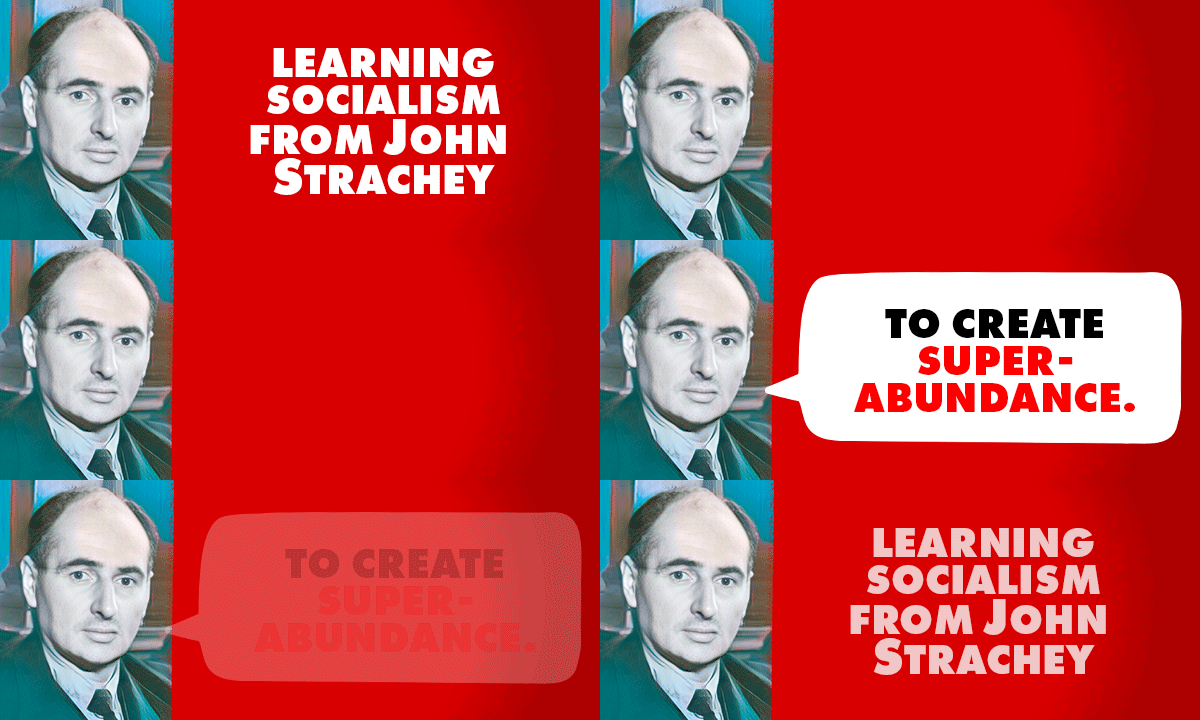
Before there can be any possibility of basing society upon the principle of "from each according to his ability, to each according to his needs" … we must have the technical ability to create super-abundance.[43]
When and only when, production increased to the level of "abundance" … "From each according to his ability, to each according to his need" would become the rule.[44]
"From each according to his ability, to each according to his need" is identified with a free distribution of goods based on material abundance.[45]
"To each according to their needs" doesn't mean a system where the socialist government tells you what you need. As John Crump, Tatah Mentan, and co-authors Binay Sarkar and Adam Buick respectively explain:
People will be free to take whatever they choose … without making payment.[46]
Individuals will have free access to what is produced according to self-defined needs.[47]
When the means of production had been sufficiently developed, socialism could go over to the principle: from each according to their ability, to each according to their needs. … Free access according to needs.[48]
There can be no question but that a world in which people can take whatever they choose according to self-defined needs and without making payment is a world that requires a preexisting superabundance of all needed goods and services.
Many other socialist goals also hinge on achieving abundance. For example, Karl Marx said the elimination of not only wage labor (being paid for our work) but also of all buying and selling are non-optional requirements for a socialist society.[49]
Only in a world where all goods are constantly overproduced and thus free for the taking would it be possible to have a (non-totalitarian) society in which we work for free and that operates without buying and selling.
Only opulent abundance
makes socialism safe
There's another critical reason socialism requires abundance: it reduces the threat of socialist authoritarianism.
If socialism could create this special ingredient, it would temper the risks posed by this philosophy's foundation on compulsory duty.
Socialism's duty of "from each according to their ability" puts our abilities—our time and talents—under the control of those running socialist society. This duty has played a key role in prior socialist experiments (experiments that were sold as being democratic socialism, just as socialism is today[50]) ending up as authoritarian nightmares.[51]
Marx, Engels, and other early socialists recognized their philosophy's risk of authoritarianism. However, they assumed socialism would not only create abundance but would do so quickly.
They anticipated that, once abundance arrived, socialism's duty of "from each according to their ability" would become meaningless in light of this cornucopia of free everything for all. Countless socialists even argue, as Engels did, that in this perfected society, government itself would "wither away,"[52] ending the risk of state oppression.
In his Karl Marx's Theory of History: A Defense, G. A. Cohen writes that, in the case of a socialist society that is "short of abundance," Marx essentially agreed with critics who attacked socialism as representing the threat "political tyranny."[53]
Unfortunately, Marx wasn't prescient enough to realize socialism would be permanently "short of abundance" and that, as such, the risk of socialist tyranny would be everlasting.
Before abundance became the secret sauce, socialists regularly argued that it was the solution to the risk of authoritarianism present in their philosophy. Here are examples in which twentieth-century American socialist leaders James Cannon and Max Shachtman make this claim.
Cannon writes:
The abundance which the planned economy will provide for all … is the surest safeguard against the usurping bureaucracy, infringing on the rights and liberties of the people as is the case today in the Soviet Union.[54]
Shachtman similarly claims that once socialism has created a society in which "there is abundance for all,"
what need is there for compulsion, for a machinery of force?[55]
But in the same passage, Shachtman explains how socialism would operate prior to the arrival of this utopia. He says that, before abundance, the socialist state would
sternly enforce the principle, "He who does not work shall not eat."[56]
How does socialism create a society of abundance that has no "machinery of force"? By using a machinery of force. This is the logic behind all of socialism: compulsion today for the false promise of a superabundant and thus super-free tomorrow.
A worldwide society that meets the socialist definition of abundance won't exist in our lifetimes, if ever. Even if we assume the possibility of a world of constant overproduction in a distant Star Trek-style future, that's of no value to us today.
The solution that earlier socialists claimed was the answer to the risks posed by their philosophy's foundation on compulsory duty isn't coming. We should be told of this fact rather than having both it and socialism's overall requirement of abundance hidden from view.
Unless and until opulent abundance arrives, socialism's duty of "from each according to their ability" will remain the irreparable[57] design defect of socialism. It's a defect that makes every socialist experiment an authoritarian accident waiting to happen.
"Opulent Abundance":
Accept No Substitutes
A limited abundance could not deliver what socialism promises
Socialists now do their utmost to avoid discussing their philosophy's requirement for abundance. But when the subject can't be evaded, many try to sell the notion that what Marx expected wasn't an opulent abundance but instead some limited version—a form of rationing called abundance.
The idea of a socialist society of superabundance and constant overproduction now seems absurd. Today's socialists take advantage of this reality to argue that Marx and company would never have expected this result.
We could employ the same tactic on behalf of the early astronomers who said the universe was centered around Earth: "The idea that the Earth is the center of the cosmos is ludicrous; there's no way this was what early astronomers believed."
But they did. They did believe the Earth was at the center of the universe. Despite being learned and intelligent individuals, these astronomers' erroneous assumptions led to a conclusion that we now realize is preposterous.
This is precisely what happened in the case of socialist theory—a theory that assumed socialism would "[in] a very limited space of time create a superabundance."[58] Marx and other socialists, despite their smarts, created a system based on the expectation and the requirement of an overflowing, limitless abundance. This reality can be demonstrated in multiple ways.
First, there's what Marx and Engels say directly. Marx envisions socialist overproduction being so massive and so easily achieved that it creates the opportunity for excess overproduction—over-over production—as insurance against unexpected disasters.[59] Engels promises overproduction so great that it can "create new needs and, at the same time, the means of satisfying them." [60]
As Engels's words demonstrate, he and Marx premised their socialism not on a limited or static set of needs but rather on rich and growing needs. These facts are noted by many modern-day socialists, including DSA founder Michael Harrington, who quotes Marx's statement that
the richness of human need is a precondition of socialism.[61]
Second, the idea that Marx meant some type of limited abundance is contradicted by the analyses of any number of socialism's most noted thinkers.
We've seen examples of this fact, including Eugene Debs promising socialism will mean an "abundance to satisfy all human wants"[62] and G. A. Cohen explaining that Marx's thinking is premised on a socialism of "limitless conflicts-dissolving abundance."[63]
An additional example comes from Michael Harrington, who writes that Marx based his ideas on the assumption that
there would be so much abundance that … resources would be available at a zero price.[64]
Third, a fake abundance could never deliver a society with the features that socialists have long promised would characterize a socialist one. No human conflict.[65] No crime.[66] No war.[67] A society of such overflowing wealth that there wouldn't even be a need for government.[68]
These promises are certainly outlandish. But they're not made by socialist eccentrics. They're claims that hundreds of mainline socialists have made and still do.[69] They're claims that only a limitless abundance could deliver—if, in fact, anything could.
Imagine a fake abundance that took advantage of the fact that beer and bread are made of the same ingredients and suppressed brewing in an effort to make bread abundant. Would this bring the end of human conflict? No, it would do exactly the opposite.
"Relative" abundance?
Still incredibly opulent
Even when socialists try to bring their definition of abundance down to earth, the requirements remain both utopian and dystopian. Here's an example from Hillel Ticktin.
In his article "What Will a Socialist Society Be Like?," Ticktin argues that socialism doesn't require "absolute abundance" but only "relative abundance."[70] However, what production volumes does this reduced standard require?
Ticktin says that, in a socialist society of "relative abundance," every person on Earth would have
a standard of living much higher than anyone has now.[71]
It's patently impossible to deliver a world based on Ticktin's only "relative abundance" without a gargantuan increase in worldwide production.
The number of people living in extreme poverty has fallen dramatically over the last forty years. But almost half of the world's 7.5 billion human inhabitants still subsist on under $2,000 a year.[72]
The increase in production volumes needed to give these billions "a standard of living much higher than anyone has now" would be staggering. Even Ticktin's "relative abundance" is incredibly opulent by the standards of what is produced today.
Socialism's founding thinkers created a theory premised on the assumption socialism could boost production to "undreamed of heights."[73] The fact that this was a colossal blunder on their part doesn't mean socialist philosophy gets a do-over, and it certainly doesn't justify today's socialists hiding this requirement from us.
Don't let those who try to disappear socialism's need for abundance and overproduction mislead you a second time. Socialism can't be cooked up without the incredible abundance socialists have long said is the essential ingredient.
Opulent abundance: accept no substitutes.
Where Are the
Warning Labels?
Socialism's most important sales promises hinge on the assumption that a world of opulent abundance is possible and desirable. But the odds socialism could create such a world are vanishingly slim. And the constant overproduction it would require is unsustainable in the extreme.
Socialists have an obligation to alert us when they make claims based on such wild assumptions. Without such warnings, how can we accurately evaluate the odds and desirability of socialist promises coming true?
Yet there are countless examples of socialists "forgetting" to provide the details they should.
In his 2015 article "Why You Should Be a Socialist," Rob Sewell writes that in socialist society,
eventually, as productivity expands and the last remnants of capitalism are eradicated, society will be based on the principle "from each according to their ability, to each according to their need."[74]
Sewell is a knowledgeable socialist who is certainly aware that socialist theory says abundance is required to deliver a world based on "to each according to their need." But his article doesn't include a single word about this fact. Sewell mentions that "productivity expands."
How many readers would guess this means production expands so radically that every good and service that over 7.5 billion humans need is overproduced and thus free for the taking?
Similarly, in his 2014 book Imagine: Living in a Socialist USA, Michael Steven Smith says that come socialism,
the rule will become "from each according to their ability, to each according to their need."[75]
Like Sewell and so many other socialists, Smith claims socialism will (not might) mean a world based on "to each according to their need." But nowhere does Smith explain that the result he guarantees requires abundance.
Instead, he ups the ante, making an additional claim that only a "limitless conflict-dissolving abundance" could deliver:
There will be no need for law as we know it.[76]
There are thousands of socialist claims like these, all based on the hidden premise that a socialist world would be a world of superabundance and overproduction. Yet it's extremely rare for those selling socialism to make this fact clear.
Surely every socialist promise that requires abundance should include an asterisked warning explaining this reality. Something along the lines of:
*Please note this sales promise assumes a socialist society in which every good and service needed by the world's population is constantly overproduced, thereby making all things abundant and free for the taking worldwide.
A warning of this type is the minimum requirement of ethical selling. Better yet, socialists should cease making all claims that are premised on the assumption socialism would mean a society of opulent abundance.
Socialists are selling vaporware. If a corporation were making such promises, we would be wholly justified in not only demanding that it stop but also that it publicly retracts its lies. Socialists should do the same.
Constant Overproduction
Will Save the Earth?
Today's socialists preach "system change, not climate change."[77] They say the climate crisis makes socialism necessary. These claims take socialist deceptive selling to new heights.
Knowledgeable socialists are well aware that socialism is predicated on a world of abundance and constant overproduction. The climate crisis makes this premise ludicrous—something only a climate change denier could think possible.
The ecological crisis unequivocally means that socialism cannot deliver on promises Karl Marx and an untold number of other socialists say must be fulfilled to call a society a socialist one.
It also means that any attempt to create socialism will be forever based on a dangerous form of duty with no hope of the limitless abundance socialists believed would mitigate the threat of compulsion.
Yet today's socialists publish lengthy books pontificating on "ecosocialism" that include not a single word about their philosophy's requirement of abundance.[78]
Even more dumbfounding and disingenuous: socialists argue that climate change demands socialism while still making promises that are based on the hidden premise that a socialist society would be one of overwhelming abundance and constant overproduction.
As one example, in "The Ethics of Ecosocialism," Michael Löwy writes:
In the final analysis, [ecosocialism] means the collective appropriation of the means of production and distribution of goods and services "to each according to their needs."[79]
By Löwy's definition, ecosocialism means a world based on "to each according to their needs," which socialist theory says is predicated on a world of abundance and constant overproduction.
Apparently, constant overproduction will save the Earth.
Socialists should stop making deceitful claims regarding the implications of the climate crisis.
The climate crisis doesn't make socialism a necessity; it makes socialist sales promises all the more impossible and socialist experiments forever dangerous. That's the clear implication of the principles of socialist philosophy and of what honest socialist thinkers have to say.
Democratic Socialists of America founder Michael Harrington doesn't mince words:
If abundance is not possible, then neither is socialism and there's no reformulation that can evade that fact.[80]
No reformulation can alter the fact socialism requires abundance, which in socialist theory means every needed thing free worldwide forever and necessitates constant oversupply and thus constant overproduction.
Unless this world of free everything for all is possible, any supposed "socialism" cannot actually be socialism. Unless this world of constant overproduction arrives, there's no fix for socialism's exceedingly dangerous foundation on the compulsory duty of "from each according to their ability."
There's only one thing socialism has ever succeeded in constantly overproducing: deceptive selling. The many socialist claims based on the premise of abundance should provide explicit warnings. Better yet, all such promises should cease.
Thank you for reading "The Secret Sauce of Socialism."