

This is one of 17 free papers available at Red Flags Press. Our small book, Socialism Says, also visually summarizes this paper along with nine others.
A hard copy of this paper is included in our Launch Bundle, which offers Socialism Says and three additional printed papers with free shipping for $9.99 (half off).
Today's socialists present tyrant Vladimir Lenin as a proto-ecosocialist. As we detail in the paper below, the same logic could be used to portray Hitler as an eco-Nazi.
"Lenin had strongly embraced
ecological values."
—John Bellamy Foster
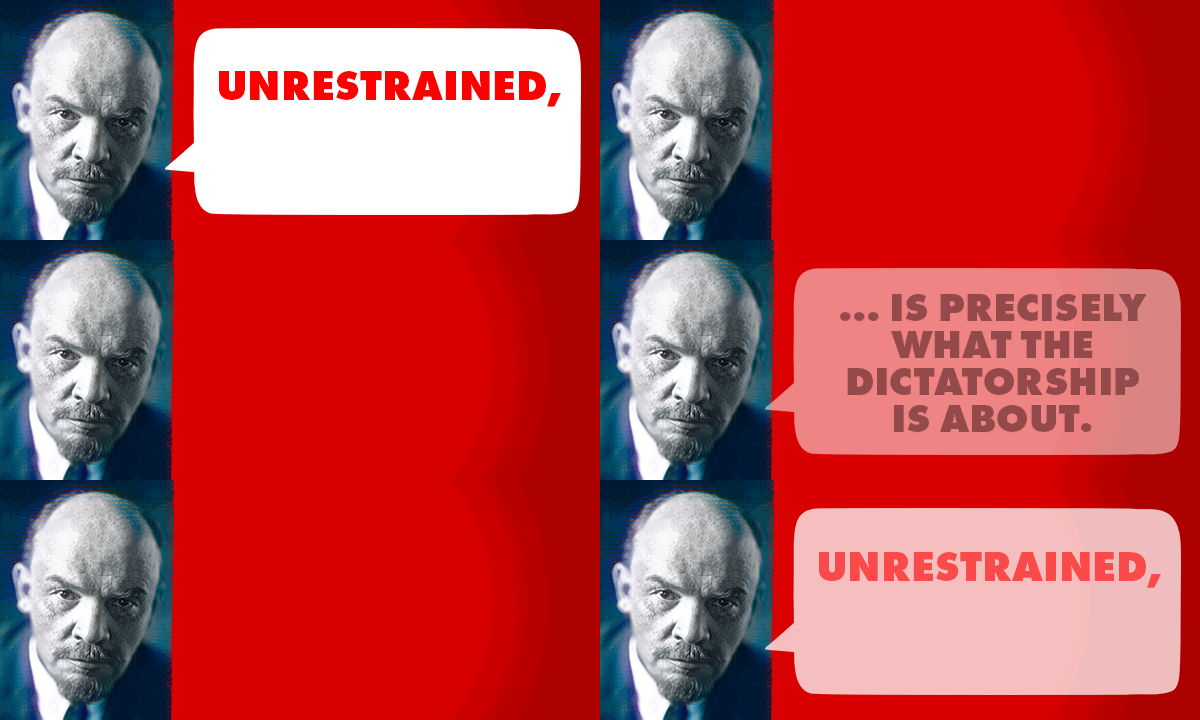
The dictatorship means
— take note of this once and for all —
unrestrained power
and the use of force, not of law."
— Vladimir Lenin
There's much to learn about ecosocialists from the praise they heap on a tyrant.
Vladimir Lenin was the first leader—the first dictator—of the Union of Soviet Socialist Republics (USSR). He created its secret police and concentration camps, delivering on his promise that the socialist government would be based on
unrestrained power and the use of force, not of law.[1]
Despite these and many similar facts about him, today's socialists don't distance themselves from Lenin. Instead, they present him as one of their own, a proto "ecosocialist" who
strongly embraced ecological values.[2]
Ecosocialists say socialism is the answer to the ecological crisis. Their marketing slogan is "System change, not climate change."[3] But ecosocialism isn't a new version of the socialist product. No, it's based explicitly on the principles that defined socialism when Lenin ruled the USSR a century ago.
In "An Ecosocialist Manifesto," Joel Kovel and "pioneer ecosocialist"[4] Michael Löwy write:
We see ecosocialism not as the denial but as the realization of the "first-epoch" socialisms of the twentieth century, in the context of the ecological crisis.[5]
Among the leaders and thinkers of the early socialist experiments that ecosocialism seeks to be "the realization of," Lenin was the most important.
Like Lenin, today's ecosocialists call for "overthrowing capitalism,"[6] for the elimination of private enterprise,[7] for the suppression of supposedly "useless" jobs[8] and "useless" products,[9] and for a society founded on the dangerous duty of "from each according to their ability."[10] Like Lenin, today's ecosocialists are anti-liberals. Noted ecosocialist Kohei Saito even argues that "Liberals are very dangerous."[11]
Ecosocialism is, in fact, closer to the "first-epoch" socialisms of the early twentieth century than it is to the so-called "market socialism" that socialists created in response to the collapse of the USSR.[12] It's a return to the original Marxist-Leninist recipe that calls for our society's market economy to be abolished, with a "planned" economy taking its place.[13]
If we explore what today's socialists say about Lenin's supposed ecological outlook and contrast it with his actual beliefs, we'll learn two important things about ecosocialism and those who espouse it.
First, ecosocialists are disingenuous when they present Lenin, Marx, and other historical socialists as ecologically minded. The goals of these earlier socialists were unsustainable in the extreme.
Second, ecosocialists demonstrate their own appetite for authoritarianism as they seek to make Lenin and ecology align.
Lenin "PROMOTED BOTH
CONSERVATION AND ECOLOGY"
Socialist author John Bellamy Foster is the number-one salesperson of "ecosocialism." Over the past two decades, he's written countless books and articles on the topic. His books include The Ecological Revolution, Ecology Against Capitalism, and The Return of Nature: Socialism and Ecology.
Many of these works cite Lenin as an illustration of what Foster argues is socialism's long-running green orientation. For example, in The Ecological Revolution, Foster writes that Lenin
promoted both conservation and ecology in the Soviet Union.[14]
He also notes that Lenin established the USSR's first nature reserve and concludes that
under Lenin's protection, the Soviet conservation movement prospered.[15]
In an essay entitled "Ecology and the Transition from Capitalism to Socialism," Foster argues that
Lenin stressed the importance of recycling soil nutrients and supported both conservation and pioneering experiments in community ecology.[16]
And in "Late Soviet Ecology," Foster declares:
Lenin had strongly embraced ecological values, partly under the influence of Marx and Engels, and was deeply concerned with conservation.[17]
Foster is not alone in proclaiming Lenin's allegedly green record. For example, in Ecology and Socialism, Chris Williams praises Lenin multiple times[18] and parrots Foster's claim that Lenin made the USSR an ecological "pioneer":
The Soviet Union under Lenin and through the 1920s was characterized by a stunning series of pioneering ecological policies, education, research, and theorizing.[19]
Another ecosocialist, Ben Stahnke, writes in an article titled "Lenin, Ecology, and Revolutionary Russia":
Lenin advanced both conservation and ecology more generally.[20]
However, this sort of praise for Lenin is deceptive, and it depends on a twofold strategy. First, ecosocialists shine a bright light on any of Lenin's actions or writings that smack of ecology or conservationism. At the same time, they keep us in the dark about the overarching and utterly anti-green theory to which Lenin, Marx, and other socialists subscribe: the expectation that socialism will create a world of constant overproduction leading to superabundance.
"AN ENORMOUS DEVELOPMENT OF THE PRODUCTIVE FORCES"
Socialists have long maintained that their philosophy would, as Lenin puts it,
inevitably result in an enormous development of the productive forces of human society.[21]
They claim that the outcome would be a society of such massive production volumes that all needed goods and services would be available for free worldwide, and not just for a year or a decade but forever.[22]
This world of "superabundance"[23] and "limitless abundance,"[24] as socialists have often termed it, is essential to fulfilling numerous socialist sales promises. Most importantly, it's required to deliver on what socialists say is their philosophy's defining promise: creating a society based on the axiom "to each according to their needs."[25] (Learn the full details in our paper, "The Secret Sauce of Socialism," which is also visually summarized in Ch. 10 of Socialism Says.)
Lenin unquestionably endorses this core aspect of socialist philosophy. For example, in his noted work The State and Revolution, he writes that socialism would produce a world where there is
no need for society to regulate the quantity of products to be distributed to each; each will take freely "according to his needs."[26]
How do you create a world in which all needed goods can be taken for free, and without society making any effort to regulate how much you take?
As Karl Marx explains, you must create a world in which there's an oversupply of every needed good—not simply more than enough to meet current requirements, but also an additional surplus to cope with unanticipated interruptions in production.[27]
Moreover, the socialist promise is that all needed goods would be free forever. Thus, the oversupply must last forever as well. There must be a constant oversupply. And how would socialist society create this constant oversupply? Except for a handful of things, like air, that are naturally superabundant, the only way to have an oversupply is by overproducing.
And the only way to have a constant oversupply is by, as Marx termed it, "constant over-production."[28] Socialist thinker Paul Mattick, Jr. provides the punchline:
In socialism overproduction would be indispensable to assure the satisfaction of social needs and would therefore be considered normal.[29]
A world in which the constant overproduction of tens of thousands of goods would be "considered normal" is a concept as far removed from ecologically sound as it's possible to imagine. It would require a radical—and unsustainable in the extreme—increase in worldwide production volumes. As British socialist and Marxist economist Edgar Hardcastle explains:
To set up conditions of free access will be the greatest problem socialist society will have to face. Karl Marx wrote long ago that the first task of a socialist society, will be to increase production, as much and as quickly as possible, and it is still true …. Now some people have fallen into the elementary error that under capitalism, enough is already produced for socialist society to operate. It's a dangerous illusion.[30]
In other words, as abundant as some goods and services may seem in our capitalist society, the volumes at which they're currently produced don't come anywhere close to what's required to make them available for free for the world's population of over eight billion.
The belief that socialism would dramatically boost production volumes creating a world of "free access" is the key assumption that underpins socialism's most important promises. Democratic Socialists of America founder Michael Harrington has even written that if this world of abundance cannot be created, then socialism itself is impossible.[31]
The significance of Lenin's few acts that can be construed as green pales by comparison to his support for socialism's completely anti-ecological plan for worldwide constant overproduction. And the same incongruity plagues attempts to characterize Marx and his other disciples as ecologically minded, since they also insist socialism would yield a society of such massive production that everything would be free worldwide forever.
"WE SHALL USE GOLD
FOR THE PURPOSE OF
BUILDING PUBLIC LAVATORIES"
Lenin didn't simply promise socialism would "inevitably result in an enormous development of the productive forces." He also preached and put into action standard socialist principles intended to produce this result.
One key element in the socialist plan to boost production is the elimination of small-scale enterprises and the concentration of industry and agriculture into the largest, most centralized factories and farms.[32] Lenin writes that the goal is to create a society in which
the whole of social production will function as a single office and single factory.[33]
He states:
I must once again emphasize that the only possible economic foundation of socialism is large-scale machine industry.[34]
Going hand in hand with Lenin's calls for the largest-scale industry possible were his negative views of small-scale production and demands for its suppression (which are standard views in socialist theory[35]). For example, regarding small farming, Lenin states that it results in "the fritting away and waste of human labour"[36] (illustrating how socialists see our time as society's time[37]) and that
the solution lies only in socialized farming.[38]
The socialist plan to boost production also calls for identifying the countless "idlers" and other "parasites" that socialist theory says exist in capitalist society and forcing them to work in approved occupations. (In socialist philosophy, "parasites" are not only individuals who shirk work but also those who work at jobs socialism doesn't approve of. Much as socialism says small farming is a "waste" of society's time, it says alleged parasites are "stealing" society's time.[39])
Among the many things Lenin has to say about "idlers" and "parasites" are these:
One out of every ten idlers will be shot on the spot.[40]
We have only one maxim, one slogan: All who work have the right to enjoy the benefits of life. Idlers and parasites who suck the blood of the working people must be deprived of these blessings.[41]
"He who does not work, neither shall he eat"—this is the practical commandment of socialism. This is how things should be organised practically.[42]
Suppressing small-scale production, suppressing "parasites," and acting on similar principles is what socialists say would lead to their promised society of abundance. Lenin describes a specific aspect of this fantastic world that's likely to come as a surprise:
When we are victorious on a world scale, I think we shall use gold for the purpose of building public lavatories.[43]
Public restrooms made of gold. Why?
Because to Lenin's thinking, when socialism succeeds in boosting production to such staggering levels that all goods are free, there would be no need for money of any form, gold included. Thus, we may as well take the gold bars from Fort Knox and make toilets out of them.
Lenin's gold lavatories are a humorous suggestion, but the underlying concept of a world in which money has become meaningless is a standard element of socialist philosophy—one endorsed by Marx and countless other socialist thinkers past and present.[44] It's another byproduct of the wildly unsustainable premise that underpins socialist thought: the expectation that socialism would create a world of constant overproduction and thus make every needed thing free for all.
What's hidden behind such exaggerated promises is the human and environmental cost. The truth is that by any measure, a world of such abundance and overproduction is not sustainable. You can't "strongly embrace ecological values" while seeking to create a world of constant overproduction. Portraying Lenin, Marx, and other noted socialists as environmentalists is dishonest. It requires hiding their belief that socialism would drive production volumes to absurdly unsustainable heights[45] and making arguments that are contradicted by what Marx, Lenin, and thousands of other socialists say.[46]
"WE SHALL CLEANSE RUSSIA"
It's misleading to present Lenin as eco-minded. But given his authoritarian actions and beliefs, it's astonishing that today's socialists are willing to associate themselves with him at all. What was this tyrant up to when he wasn't supposedly busy with "pioneering experiments in community ecology"?
Lenin directed the overthrow of Russia's first democratically elected government.[47] Why stage a coup rather than attempt to win power democratically? Because Lenin's party had received less than 25 percent of the vote.[48]
He suppressed Russia's independent press, forcing the closure of over three hundred newspapers.[49] With the aid of his wife, he banned thousands of books.[50] Over half the works in Russia's public libraries were purged.[51]
He ordered grain to be taken from small farmers by force, sending armed "requisition brigades" to thousands of villages.[52] He then exported almost a million tons of it[53] during a period when food shortages in Russia meant that his own citizens were starving, tens of thousands to death[54] (with "cannibalism common"[55]).
He incited the murder of religious leaders, calling explicitly for them to be shot. Over fourteen thousand priests, rabbis, imams, ministers, and lay staff were slain.[56]
He personally directed the suppression of Russia's intellectual class, including professors and artists.[57]
He founded the Soviet secret police, the Cheka, which later became the KGB. The Cheka is infamous for executing tens of thousands without trial. They maximized terror by coming for their victims in the middle of the night—a tactic conceived by Lenin himself.[58]
He created the USSR's system of "concentration camps" (this is Lenin's own term for them), which became known as the Soviet Gulag. These forced-labor camps for political prisoners operated outside of the traditional judicial and prison system. Within three years of the first Soviet concentration camp, there were over a hundred—all authorized by Lenin.[59]
And if what he did was not enough, listen to what Lenin said:
We shall cleanse Russia for a long time to come.[60]
Unrestrained, lawless power, based on force in the simplest sense of the word, is precisely what the dictatorship is about.[61]
The dictatorship means—take note of this once and for all—unrestrained power and the use of force, not of law.[62]
The dictatorship means nothing other than power totally unlimited by any laws, absolutely unrestrained by any regulations and based directly on the use of force.[63]
Large-scale machine industry—which is the material productive source and foundation of socialism—calls for absolute and strict unity of will … . How can strict unity of will be ensured? By thousands subordinating their will to the will of one. … Unquestioning submission [Lenin's emphasis] to a single will is absolutely necessary.[64]
The greater the number of reactionary clergy and reactionary bourgeois shot over this issue [the state's seizure of church valuables], the better.[65]
The rich and the rogues are two sides of the same coin, they are the two principal categories of parasites which capitalism fostered; they are the principal enemies of socialism. These enemies must be placed under the special surveillance of the entire people; they must be ruthlessly punished for the slightest violation of the laws and regulations of socialist society.[66]
You need to hang (hang without fail, so that the public sees) at least 100 notorious kulaks [relatively prosperous Russian farmers], the rich, and the bloodsuckers. … Publish their names. … Take away all of their grain. … Designate hostages.[67]
The rich and their hangers-on, and the rogues, the idlers and the rowdies …. No mercy for these enemies of the people, the enemies of socialism![68]
The summary executions and concentration camps that characterized the USSR weren't aberrations. They were a direct result of the principles on which this socialist society was founded.
If Lenin is eco anything, he's an eco-totalitarian. It's no small matter that today's ecosocialists consider him an intellectual forebearer.
Hitler And Göring,
EcO-NAZiS?
Ecosocialists say Lenin deserves kudos for establishing the USSR's first nature preserve. Who did likewise in Germany? The Nazis.
The Nazis implemented a conservation law that included provisions for nature preserves. This law "stood out internationally as one of the few important advances of conservationism in the 1930s." Hermann Göring—Nazi #2 behind Hitler—was the "crucial figure" behind this law that Hitler approved.
Using the standard socialists employ today, one could argue that Hitler and Göring were eco-Nazis and imply that they and their fascist philosophy weren't so bad.
Such an argument is obviously grotesque. Hitler and Göring were monsters and proponents of an evil doctrine that cost tens of millions their lives. Ditto Lenin.
The quotes and other details above come from Frank Uekötter's "Green Nazis? Reassessing the Environmental History of Nazi Germany" (German Studies Review 30/2 [2007], 267-287).
ANOTHER SUPPOSED
PROTO-ECOSOCIALIST:
LAURENCE GRONLUND
This [the socialist] conception of the State as an organism thus consigns the "rights of man" to obscurity and puts Duty in the foreground.[69]
Vladimir Lenin is only one of many noted historical socialists now disingenuously sold as early environmentalists. Let's briefly consider another: American socialist Laurence Gronlund.
Gronlund's most famous work is The Cooperative Commonwealth: An Exposition of Modern Socialism. Socialists say this book introduced Marx's ideas to America. (Actually, Gronlund failed to give Marx credit, leaving readers with the impression that, as one socialist put it, "Gronlund was the Christ of the new creed, rather than one of its apostles."[70])
In his recent (2022) The Return of Nature, James Bellamy Foster discusses Gronlund and The Cooperative Commonwealth. He writes that Gronlund's work was "an important influence on English-speaking socialists," including such noted socialists as Eugene Debs, Edward Bellamy, Bernard Shaw, and William Morris.[71]
Foster cites Gronlund as an example of historical socialists who focused on what they saw as the ecological failings of capitalism. He quotes The Cooperative Commonwealth, where Gronlund attacks private farming under capitalism and argues that it results in a
rift in the reproduction of the soil.[72]
But Gronlund's ideas that can be twisted into seemingly eco-friendly ones are few and far between, especially when compared to the bulk of his thinking. Like Lenin, Gronlund calls for a society in which small enterprises are suppressed and production is carried out by a government monopoly producing at the largest possible scale. Like Lenin, he is an authoritarian through and through.
Yet, as with his treatment of Lenin, Foster overlooks these alarming views while writing about the impact Gronlund's book had on other socialist thinkers and promoting Gronlund's supposed ecological orientation.
Here's a sample of other things Gronlund wrote in The Cooperative Commonwealth, none of which see the light of day in Foster's new book:
The State may do anything whatsoever which is shown to be expedient.[73]
Against the State, the organized Society, even Labor does not give us a particle of title to what our hands and brain produce.[74]
Every large factory that arises on the ruins of the shops of the small artisans we consider an advance in civilization.[75]
Is it Utopian to expect that all enterprises will become more and more centralized, until in the fullness of time they all end in one monopoly, that of Society?[76]
[The socialist] commonwealth—whose citizens will, consciously and avowedly, be public functionaries—will not know of a particle of distinction between the terms "State" and "Society"; the two ideas will become synonymous.[77]
Do not, however, suppose that there will be no subordination under the new order of things. Subordination is an absolute essential of Cooperation; indeed, Cooperation is Discipline.[78]
The anarchy of opinion of this transitory age is an enormous evil. Unity of belief is the normal condition of the human intellect; it is just as natural for healthy men to think and believe alike, as it is for healthy men to see alike.[79]
In a socialist society, we will all "think and believe alike." There will be no room or opportunity for dissent. In a socialist society, "even Labor does not give us a particle of title to what our hands and brain produce." Why? Because socialism's foundation on compulsory duty to society turns our time—and what we produce with it—into society's property, not our own.
As Foster notes, numerous celebrated socialists, such as democratic socialist icon Eugene Debs, were influenced by The Cooperative Commonwealth.[80] Rather than being turned off by its authoritarianism, they lapped it up. Famed British socialist William Morris (who today's socialists misleadingly portray as a socialist who loved liberty[81]) even recommended The Cooperative Commonwealth as a primer for those looking to learn the basics of socialism.[82]
Foster—the top banana among today's ecosocialists—doesn't reject Gronlund or alert readers to Gronlund's dangerous beliefs. Instead, he plugs Gronlund's alleged eco-mindedness.
"Power Totally Unlimited
by Any Laws"
Vladimir Lenin not only called for but also created a socialist society based on
power totally unlimited by any laws.[83]
And Laurence Gronlund couldn't wait for a socialist society in which
the State may do anything whatsoever which is shown to be expedient.[84]
As these quotes and the others above vividly illustrate, both Lenin and Gronlund weren't simply anti-liberals; they were authoritarians. So too were the other historical socialists now said to be ecosocialists, Karl Marx included.[85]
Why in the world haven't today's ecosocialists washed their hands of these historical figures? Portraying Lenin and company as ecosocialists means misrepresenting their actual thinking, not to mention condoning Lenin's appalling record as the leader of the USSR. Why go to these lengths?
First, because ecosocialism isn't some softer form of socialism; it's unadulterated Marxism. For ecosocialists, walking away from Marx and Lenin would be the equivalent of Christians turning their backs on Christ and Paul the apostle.
Second, while most will find the ideas Lenin and Gronlund express disturbing and dangerous, ecosocialists are far less likely to. The reality is that this illiberal and authoritarian thinking isn't an outlier in the realm of socialist thought; it's the norm.
Ecosocialism calls for the same compulsory duty that helped turn Lenin's socialist experiment into an authoritarian nightmare. And it unequivocally seeks a government with the power and the mandate to carry out a massive campaign of suppression like Lenin's: suppression of liberal rights, private enterprise, the market economy, supposedly "useless" jobs and products, and more.
What does the attempt to portray the likes of Lenin as eco-minded ultimately show? That ecosocialists are deadly serious when they say their goal is "the realization of the 'first-epoch' socialisms of the twentieth century."
Thank you for reading "Vladimir Lenin, Ecosocialist?"
Please be sure to check our small, illustrated book, Socialism Says. It presents a visual summary of 10 of our papers and is chock-full of damning quotes from celebrated socialists.