

"Russia Never Was Socialist"
—Editors of the Socialist Standard
"Socialism Hasn't Failed;
It Hasn't Been Tried—Yet!"
—Perry Sanders and Dianna Sitar
Uncorrectable defects
in the socialist product
force those selling it
to make silly arguments.
The Russian Revolution in 1917 led to the formation of the Union of Soviet Socialist Republics (the USSR). Socialists around the globe proclaimed the USSR not only the world's first socialist regime but also its first genuine democracy.
American socialist Eugene Debs is celebrated as a democratic socialist icon. In 1918, Debs expressed what would be the common opinion of socialists for decades to come[1] when he praised Bolshevik leaders Vladimir Lenin and Leon Trotsky, along with their allies, stating,
They have laid the foundation of the first real democracy that ever drew the breath of life in this world.[2]
The centennial of the Russian Revolution came in 2017. An editorial in the Socialist Standard marked the anniversary by summarizing the very different claim that socialists make today. Its title:
"1917 – 2017 Russia Never Was Socialist"[3]
Get that? Not "Russia represented a defective form of socialism, and we've since fixed the flaws." Not even "Russia started out socialist but veered off course." No, "Russia never was socialist."
Similarly, noted socialists Adam Buick and Hillel Ticktin, respectively, write of the USSR:
Countries such as Russia were not socialist.[4]
It was obviously not socialist in any sense.[5]
Rather than expressing disappointment that socialism in the USSR turned out to be a totalitarian horror that cost millions their lives, today's socialists attempt to erase it from the record books.
And the USSR is only one of the many disastrous socialist experiments that get the "not socialist" treatment. Essentially every socialist government has been praised at its inception as democratic socialism drawing "the breath of life." But when the authoritarianism of these states becomes indefensible, the go-to line is that they weren't socialist at all.
As the International Socialist Organization claims:
China and Cuba, like the former Soviet Union and Eastern Bloc, have nothing to do with socialism.[6]
Similarly, an article in the Socialist Standard argues that neither Cuba nor the USSR was socialist. What Cuban revolutionary Fidel Castro really did was create a
form of state capitalism like the one established by the Bolsheviks [in the USSR], and called it socialism.[7]
In other words, the leaders of these countries were con artists who "called it socialism" when they were actually creating a "form of state capitalism"—or so today's socialists want us to believe.
This is the reasoning behind today's catch-all excuse for socialism's awful record, often framed with the words, "Socialism has never been tried." Numerous socialist-authored papers make this claim, bearing titles like:
- "Socialism Has Never Been Tried"[8]
- "Socialism Hasn't Failed; It Hasn't Been Tried—Yet!"[9]
- "The Myth of Twentieth-Century Socialism"[10]
Russia, China, Cuba, and the dozens of other explicitly socialist governments[11] that arose in the last century? All apparently a "myth." That would come as quite a surprise to Che Guevara and others like him—bona fide socialist revolutionaries who committed their lives to what they believed was a genuine socialist movement.
All of this "socialism hasn't been tried" posturing is nothing more than a retroactive sales ploy. And there are three important things that we can learn from it.
First, it is, frankly, an attempt by modern-day socialists to avoid responsibility for the oppression and death their philosophy has caused—an attempt premised on an absurd fallacy: that only a successful socialist society can be counted as a real one.
Second, it highlights how socialists employ the tactics of unethical manufacturers, blaming user error instead of taking responsibility for a bad product.
Third, and most important, it reveals a concrete danger from today's socialism. Why do today's socialists contend "Socialism has never been tried" instead of arguing "Our socialism is a new version redesigned to eliminate the problems of the past"? It's because the defects in the socialist product have not been fixed.
In fact, they cannot be. The flaws that have turned one socialist society after another into authoritarian disasters are intrinsic to the product. These irreparable defects mean the constant cycle of socialists promising democracy yet delivering despotism will never be broken.
It's Only a SpaceX Rocket
If It Doesn't Blow Up
A SpaceX rocket blasts off on a mission to place a satellite in orbit. Company spokespeople applaud the launch as a great success.
But soon the rocket's ascent goes awry. A flaw in its design causes it to spiral off course and explode. How do the spokespeople respond now?
Imagine if SpaceX founder Elon Musk claimed that the failed rocket wasn't SpaceX one. His "logic"? SpaceX rockets perform as promised. Since this rocket exploded, it could not have been produced by SpaceX.
In other words: it's only a SpaceX rocket if it doesn't blow up.
This is an absurd argument, obviously. And claims that authoritarian socialist societies shouldn't count as socialist are equally absurd. They're tantamount to saying, "It's only socialism if it doesn't blow up."
Today's socialists effectively maintain that only successful socialism should count as socialism; socialism that fails should not. And since no socialist society has succeeded, they farcically assert, "Socialism has never been tried."
The primary method by which socialists attempt to dismiss the disasters of the socialist past takes advantage of the fact that socialists have long equated socialism and democracy. For over 150 years, socialists have maintained that socialism is essentially synonymous with democracy. (Learn the details in our paper "The 'Keto-Friendly' Political Philosophy.")
Socialists use this equation of socialism with democracy to argue that earlier socialist societies were not socialist, because they were not democratic. For example, the basis for Adam Buick's conclusion that "countries such as Russia were not socialist" is his belief that
socialism could only be democratic.[12]
Arguing that "socialism could only be democratic" is equivalent to arguing "SpaceX rockets can only be successful." A successful democracy, like a successful rocket launch, is a goal, not a given.
Nathan Robinson similarly writes:
Socialism is a term for economic democracy, so an undemocratic system doesn't deserve to claim the name.[13]
Our hypothetical Elon Musk might equally say, "'SpaceX rocket' is a term for a successful rocket, so a rocket that explodes doesn't deserve to claim the name."
Buick and Robinson are no doubt sincere in their belief that socialism should be democratic. So what? Eugene Debs and thousands of other socialists were equally sincere when they promised the USSR was the world's first democracy. It's not sincere beliefs that determine reality; it's real-world results.
When a society is built on socialist principles and is praised by socialists of the day as being true to their philosophy, that society is socialist whether or not it ends up a democracy.
Note also that Marx considered the initial society following capitalism to be socialist even though it was intended to be a transitional stage between capitalism and perfected socialism. Marx wrote that he expected socialism would eventually achieve what he described as a "higher phase."[14] The very choice of the term "higher phase" makes it clear that the lower phase is also socialism.
It's disingenuous to say that because twentieth-century socialist regimes failed to produce democratic outcomes or to achieve Marx's "higher phase," they weren't really trying or should not count as socialist. It's no different than claiming that SpaceX rockets that fail shouldn't count as SpaceX rockets.
Today's socialists make the same promise that earlier socialists made time and again: that the next socialist society will be democratic. What they don't promise is that changes have been made to the socialist product—changes that would solve the problems that caused the disasters of the socialist past. That's because no such changes have been made, nor can they be.
As such, there's no reason to expect anything but another broken promise and another authoritarian result. Hoping socialism will be democratic isn't going to make it so—especially given socialism's requirement for compulsion and suppression, the flaws inherent in its design.
Blame the Driver
Socialism being sold as "democratic" is analogous to a carmaker marketing a model as "safe." In both cases, it's not the claims of the salespeople but the performance of the product that determines whether these descriptions are accurate.
When a defective car model crashes, manufacturers don't have the option of pretending they didn't make it. Instead, a tactic that dishonest car companies employ is to try to shift blame onto the driver.
Today's socialists take the same approach, with the prime example being the case of Soviet dictator Joseph Stalin. Socialists now argue that it's not socialism but rather Stalin that is responsible for the horrific outcomes in the USSR. Were it not for Stalin—so the argument goes—the socialist revolutions in the USSR and elsewhere would have turned out fine.
There's even a handy way of putting it: all that bad stuff, they say, was "Stalinism," not socialism. For example, an article on the Marxist Student Federation website argues that
it is Stalinism which ultimately failed not socialism.[15]
And Anthony Arnove claims in the International Socialist Review that
Stalinism was actually the negation of socialism.[16]
Socialists go so far as to say that Stalinism is not only responsible for what happened in the USSR but also for other authoritarian socialist regimes. Daniel Taylor writes in his article "How Stalinism Distorted Marxism" that
Stalinist "revolutions" also took place around the world: more countries adopted state-led economies, aiming for rapid industrialisation by centralising all power in the state bureaucracy.[17]
The revolutions in Cuba, China, and elsewhere? In Taylor's telling, they weren't socialist revolutions but rather "Stalinist" ones.
Today's socialists even use the blame-Stalin tactic in connection with their efforts to portray other early leaders of the USSR, such as Vladimir Lenin and Leon Trotsky, as reasonable people who were democratically minded.
For example, in his recent book Socialism … Seriously, Danny Katch spins a fantasy version of the history of the USSR in which Lenin and Trotsky were worried about the Russian Revolution losing its supposed "democratic culture." Katch contends that socialism in the USSR was on the road to success when Stalin crashed the car:
Stalin maneuvered his way into a dictatorship and launched a historic reign of terror, featuring slave labor camps and mass executions.[18]
Katch and others would like us to believe Stalin's evil represented a dramatic change in trajectory from the course set by Lenin, Trotsky, and others. However, that's anything but the case.
Stalin's "historic reign of terror, featuring slave labor camps and mass executions" was a terrible but unsurprising result of the authoritarianism that socialism makes inevitable. And it was a logical if horrific outcome of the repressive regime Lenin had already created with Trotsky's help.
Katch fails to mention that it wasn't Stalin but rather Lenin who established the USSR's system of "concentration camps" (as Lenin called them), and also its secret police. Lenin even originated the idea of the secret police coming for their victims in the middle of the night.[19] And he without question sanctioned an untold number of executions without trial.[20]
Given his own dictatorial rule, the notion that Lenin was concerned with democracy is laughable. As these examples of Lenin's thinking make clear, he made no secret of the authoritarianism that socialism requires:
The dictatorship means nothing other than power totally unlimited by any laws, absolutely unrestrained by any regulations and based directly on the use of force.[21]
One out of every ten idlers will be shot on the spot.[22]
The rich and their hangers-on, and the rogues, the idlers and the rowdies …. No mercy for these enemies of the people, the enemies of socialism![23]
And what about Leon Trotsky? His analysis of Marx's thought led him to conclude that
It is beyond question that to step from bourgeois anarchy to Socialist economy without a revolutionary dictatorship, and without compulsory forms of economic organization, is impossible.[24]
And he similarly wrote that creating socialism demands
the most ruthless form of state which embraces the life of the citizens authoritatively in every direction.[25]
As we'll see, these are features of socialism writ large, not bugs in Russia's implementation. "The most ruthless form of state" is what Trotsky says socialism requires. "The most ruthless form of state" is what Lenin and Trotsky created.
But when Lenin died, Stalin beat out Trotsky in the bid to be Lenin's successor and used "the most ruthless form of state" not only against the general population but even against Trotsky and his followers (who, in classic socialist fashion, were charged with being fascist sympathizers[26]).
It's no surprise that once socialism's "most ruthless form of state" exists, it cannot be controlled. It's no surprise that a "historic reign of terror" can easily result.
SOCIALISM'S IRREPARABLE
DESIGN DEFECTS
When a SpaceX rocket explodes, the company's engineers don't pretend that it wasn't theirs. They try to determine what went wrong and fix the problems.
When a car's design results in crashes, ethical manufacturers don't blame the driver; they issue a recall and attempt to correct the issue. And if problems persist? Again, the response is to find the flaws and fix them.
But this has not been the socialist strategy. And there's a reason that's the case.
Why do socialists argue that "socialism has never been tried" and try to pin the blame on Stalin? Why not explain how socialism has been redesigned to solve the problems of the past?
The answer is found in the fact that there is no fixing the faulty aspects of socialism. There's no way to replace the bad parts or fix the bugs. The problems are baked into its very structure.
There are three significant flaws in socialism's design, and they can't be eliminated. They are non-optional features. According to socialist philosophy, they are unequivocally required to create a socialist society. And they guarantee that any future socialist experiment will be an authoritarian accident waiting to happen, no different than the socialist disasters of the past.
DEFECT 1: A FOUNDATION ON COMPULSORY DUTY
From its beginnings as a philosophy, socialism has demanded that our time and talents be given to society, putting them under social control.[27] This foundational duty is reflected in the famous socialist axiom "from each according to their ability."
French socialist Louis Blanc developed the specific phrasing of this expression more than 170 years ago. Marx embraced it, and it remains socialism's central requirement today.
Blanc explains its meaning (the italics and capitalization are his):
The more one can, the more one must. … Hence the axiom: from each according to his ability. That is the DUTY.[28]
Socialist duty turns our time into what socialism treats as society's time. It gives those running socialist societies the power to use our lives for their purposes. It gives them the right to judge us and punish us if we don't perform our duties to their satisfaction. As prior socialist societies have repeatedly demonstrated, it's a despot's dream.
In our present liberal society, our time and talents are our personal property to use as we wish. We're not born owing them to King or Queen, to fascists calling themselves "the community," or to socialists calling themselves "society." Because liberalism treats our time and talents as our private property, it's our right to use them in essentially any way we wish, including ways others consider wasteful and wrong.
Socialism's duty of "from each according to their ability" flips the script. How we use our time and talents must now be approved by those running society, because socialist duty makes time and talents society's property to control. As Fidel Castro explains:
Socialism cannot exist unless every citizen is given optimum employment, unless every citizen is used in an optimum, rational way.[29]
Consider how socialist duty and the goal of making sure every citizen "is used" transforms reactions to slacking in socialist society. In our liberal society, it's our right to be slackers if we wish. Others may disapprove, but as our time is our individual property, it's ours to use as we see fit.
In contrast, under socialism, which treats our time as society's time, slackers are branded "thieves" and "parasites" and "dealt with as such."[30] Socialist greats not only call for idlers to be "shot on the spot" as we've seen Vladimir Lenin do above, but they also argue, as Fidel Castro, does that "laziness must become a crime."[31]
The implications of socialist duty transforming our time into society's time even extend to the efficiency of labor. For example, in our liberal society, it's our right to open a craft workshop even though craftwork involves extremely inefficient production methods.
In contrast, under socialism, the inefficiency of small-scale production like craftwork is seen as a "waste"[32] of society's time. This is what leads socialists to express views like those of celebrated socialist thinker Nikola Bukharin (praised by today's socialists as a proto-ecosocialist[33]):
All small and futile enterprises must die out. All work must be concentrated in the largest possible factories, works, farms.[34]
Today's socialism remains founded on the same dangerous duty of "from each according to their ability."[35] This is the duty that was required of citizens in Stalin's USSR, Mao's People's Republic of China, Castro's Cuba, and on down the line. Socialism could not function if this duty to give our time and talents to society didn't override our liberal right to use our lives as we choose.
Come socialism, who will decide if you're properly performing its duty of "from each according to their ability" or if you're a "social parasite" in need of punishment?
One thing is certain: It won't be you.
DEFECT 2: A SOCIETY OF SUPPRESSION
Socialists say transforming our present society into a socialist one necessitates "drastic measures"[35] and the "suppression,"[36] "elimination,"[38] "abolition,"[39] "wiping out,"[40] and so on, of many aspects of our current liberal society.
The socialist plan calls for the suppression of:
- "idlers" and other "social parasites,"[41]
- "socially useless" work,[42]
- "socially useless" products,[43]
- our "private labor" rights,[44]
- private property rights and private enterprise,[45]
- and small, independent producers like craft workshops.[46]
Even "democratic socialists" and "ecosocialists" are in favor of such suppression (including, as we'll shortly see, the most important democratic socialist and ecosocialist of all time). They call for socialism to eliminate these aspects of liberal society.
Again, socialist philosophy states that these forms of suppression are essential to creating socialism. Take, for example, the plan to make "socially useless" work illegal.
According to socialist theory, dozens of jobs in our present society are "socially useless" ones, and all who work at these supposedly meaningless tasks must be forced to perform jobs approved as useful instead. This is said to be key to creating a society based on the axiom "to each according to their need."[47] It's also cited as the critical path to fulfilling socialism's claim that it would dramatically reduce work hours.[48]
The suppression of allegedly "useless" work isn't just socialist theory; this is exactly what's happened in earlier socialist societies. (Despite claims that "socialism has never been tried," these societies really did what socialist theory called for.) For example, Fidel Castro celebrated the "rationalization"—that is, the elimination by state power—of craft workshops in Cuba:
Artisan-type enterprises are disappearing as a result of the rationalization—as a matter of fact, when those firms were rationalized, 40,000 workers were made available for other industries. … Note the 40,000 workers freed for those industries![49]
Socialism's goals make it biased towards greater suppression rather than less. Each additional type of work that's made illegal means more socialist citizens will be "freed" to perform jobs those running socialist society claim are related to achieving socialist objectives. Each additional product that's made illegal means one less thing that socialism must constantly overproduce to deliver "to each according to their need."
The government of a socialist society must take up the vast powers required to carry out this mission of suppression. It must have the wherewithal to crush resistance to its draconian policies. It's no surprise, then, that Vladimir Lenin—whom today's socialists still praise[50]—called for a society based on "unlimited power and the use of force, not of law."
The mass suppression socialism entails is authoritarian in its own right. But the danger is far greater than that. Once a government founded on suppression is in place, there's no telling how its powers will end up being used, and little if anything to keep authoritarianism from becoming totalitarianism—and even mass murder.
DEFECT 3: "MARX LIVES!"
Socialism is, in reality, Marxism. Contrary to what the terms "democratic socialism" and "ecosocialism" would lead one to believe, these aren't new versions of the socialist product. No, they remain Marx's communism.
This is vividly illustrated by the fact that today's socialists say Karl Marx should be considered a literal "democratic socialist" and a literal "ecosocialist."
Who says Marx should be considered a "democratic socialist? None other than the founder of the Democratic Socialists of America, Michael Harrington.[51] (This is despite the central role Marx's thinking has played in authoritarian socialist nations, and it's despite the fact Marx called human rights "nonsense."[52]
And who says Marx should be considered an "ecosocialist"? Celebrated ecosocialist Kohei Saito for one.[53] (This is despite Marx's desire for socialism to result in a world of "constant over-production."[54])
Given the overwhelming importance of his thinking to socialist philosophy, there can be no more important democratic socialist or ecosocialist than Marx. He denies any possibility of mixing liberalism and socialism.[55] He calls not only for the eradication of every business, large and small[56] but also for the elimination of all self-employment,[57] and even all buying and selling.[58] As noted socialist thinker Agnes Heller puts it, his philosophy seeks to abolish all independent aspects of society, instead creating one in which
"the whole of social production functions as a single factory."[59]
Despite these and numerous other anti-liberal aspects of Marx's philosophy, there's no question that for today's socialists, "Marx lives!" This two-word sentence concludes Kohei Saito's recent Karl Marx's Ecosocialism (winner of the 2018 Deutscher Prize, a socialist book award). Saito is right: Marx's thinking remains the socialist gospel. Each year, socialists publish a torrent of new works arguing that Marx's ideas should be the basis of a radically altered society.
Today's socialists attempt to hide the real Marx—for example, his plan for child labor to be a key part of "school" in socialist society,[60] and the reality that his socialism effectively bans craftwork from socialist society.[61]. But as one comes to understand Marx's thinking, it's easy to see why things always spin out of control in societies built on his philosophy.
The fact that socialism is really Marxism reinforces the risks posed by socialism's other irreparable defects. There's no way to deliver on the goals Marx established for socialism without basing society on a compulsory duty that gives those running socialist society dangerous control over our lives. There's no way to create the society Marx demands without a government tasked with and empowered to undertake the wholesale suppression of our rights and numerous other important aspects of our present liberal society.
It's unfortunate but true: "Marx lives!"
ANY Future Socialist Experiment
Will Also End Up A "Myth"
If the design flaws in the socialist product could be repaired, they would have been long ago. Instead of arguing that "socialism has never been tried," today's socialists would be explaining how they had solved the problems that caused prior socialist nightmares.
But socialism's requirement for compulsion and suppression are defects that cannot be corrected. And this means that future socialist societies will inevitably result in authoritarianism, just like those of the past.
When the next socialist experiment launches, it will repeat the cycle we've seen so many times before: Socialists will begin by celebrating it as democratic socialism come to life. But soon they'll be claiming that it was never socialism at all.
Thank you for reading "It's Only Socialism If It Doesn't Blow Up."
THE FIX THAT ISN'T COMING
Karl Marx recognized the threat of authoritarianism baked into socialist philosophy. But he mistakenly expected this risk to be neutered by socialism radically outproducing capitalism to create a world of limitless abundance based on what he termed the "constant over-production" of needed goods.
Marx's anticipated fix to socialism's design flaws will never come. Socialism has not only failed to boost production as predicted, but a world in which tens of thousands of items are constantly overproduced is absurdly unsustainable.
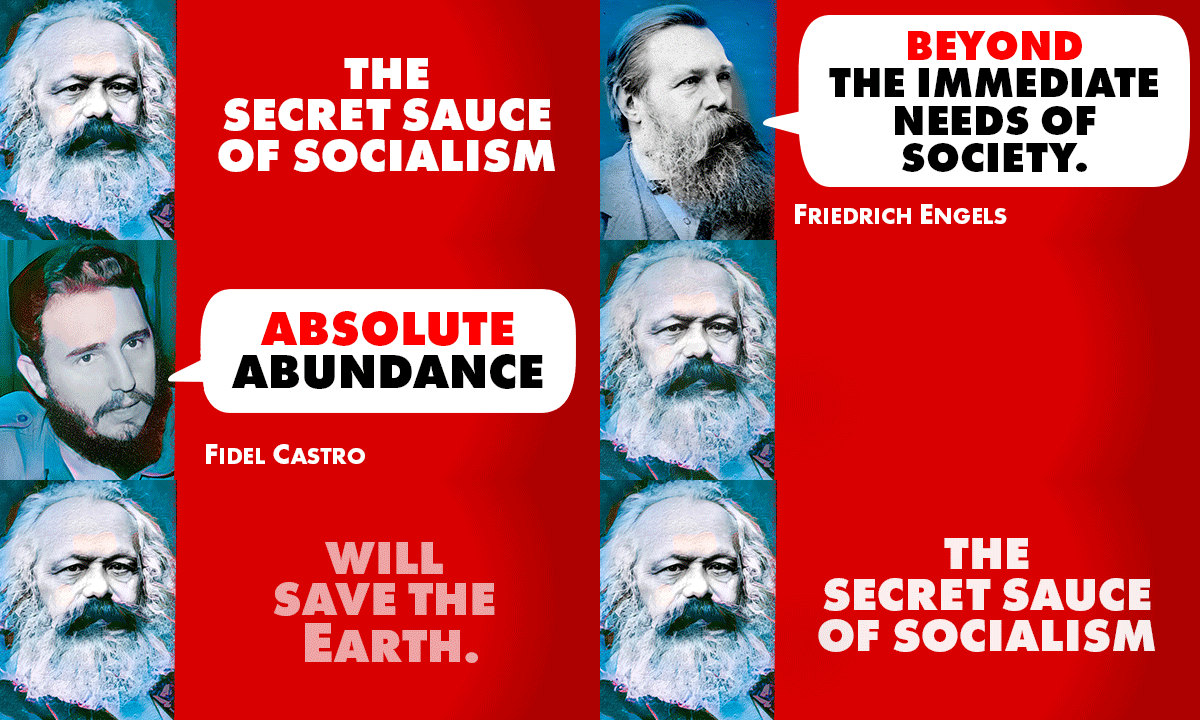
To learn more, see our paper "The Secret Sauce of Socialism."