"A 'DEFECT' OF LIBERALISM" ENDNOTES
[1]. Michael Lebowitz, The Socialist Imperative: From Gotha to Now (New York: Monthly Review, 2015), 67.
[2]. Lebowitz, Socialist Imperative, 67. Emphasis in original.
[3]. Lebowitz, Socialist Imperative, 154–55. As is the socialist norm, Lebowitz sees "socialism" and "democracy" as synonyms. See also Lebowitz, The Socialist Alternative: Real Human Development (New York: Monthly Review Press, 2010), 132, where Lebowitz outlines the "battle of democracy," which could just as well be called "the battle of socialism."
[4]. For a detailed exploration of socialism's foundation on mandatory duty, see the Red Flags Press paper "The Ripple Effects of Socialist Duty."
[5]. While liberal philosophy is based on the premise that our time and talents are our private property that others cannot take without our consent, liberal democracies like those in the U.S., Canada, France, and elsewhere have not always been true to these liberal principles. The primary recent exception is found in the case of the military draft such as was used in the U.S. during the Vietnam War. This is a clear and sad exception to the principles of liberalism—an exception that, thankfully, has long since come to an end with the all-volunteer military replacing the draft.
[6]. Adolph Hitler spoke of "the community" as frequently as socialist thinkers speak of "society." In his notorious work Mein Kampf, Hitler refers to "the community" dozens of times. One example could appear in a piece of socialist writing without a single change: "The evaluation of the man must be based on the manner in which he fulfills the task entrusted him by the community." Adolph Hitler, Mein Kampf, trans. Ralph Manheim (Boston: Houghton Mifflin, 1943), 434.
[7]. That today's socialism remains defined by Marx and his thinking is demonstrated by the fact Michael Harrington, the founder of the Democratic Socialists of America (DSA), declares Marx to be a democratic socialist, and also by the fact that the DSA identifies as a Marxist organization. For details and sources for these facts, see the Red Flags Press paper "The Keto-Friendly Political Philosophy."
[8]. Karl Marx, Capital: A Critique of Political Economy, trans. en Fowkes (vol. 1) and David Fernbach (vols. 2–3), 3 vols. (London: Penguin Classics, 1976–1981), 1:188n.
[9]. Ernest Mandel, Power and Money: A Marxist Theory of Bureaucracy (New York: Verso, 1992), 18. Emphasis added.
[10]. See Ernest Mandel's introduction to Marx, Capital, 39. See also Peter Hudis, Marx's Concept of the Alternative to Capitalism (Boston: Brill, 2012), 111, 160; Adam Buick, "The Myth of the Transitional Society," Critique 5 (1975): 59–70.
[11]. Karl Marx, Grundrisse: Foundations of the Critique of Political Economy, trans. Martin Nicolaus (Harmondsworth: Penguin Books, 1973), 172.
[12]. Even though Marx does not specify "directly" in when he states "the labour of the individual is posited from the outset as social labor," he's writing about the same concept he elsewhere describes as "directly social labor." Present-day socialists note this fact themselves. For example, when Peter Hudis quotes this passage in his work Marx's Concept of the Alternative to Capitalism, he presents it as "the labour of the individual is posited from the outset as [directly] social labor." Peter Hudis, Marx's Concept of the Alternative to Capitalism (Boston: Brill, 2012), 111.
[13]. Friedrich Engels, Anti-Dühring (New York: International Publishers, 1947), 345.
[14]. Samezō Kuruma, quoted in Tadayuki Tsushima, "Understanding 'Labor Certificates' on the Basis of the Theory of Value," in Myths of the Kremilin, trans. Michael Schauerte (Marxists.org, 2006; orig. 1956), https://www.marxists.org/subject/japan/tsushima/labor-certificates.htm.
[15]. Paul Cockshott, "Abstract Labour and Socialism," Paul Cockshott's Blog, June 14, 2018, https://paulcockshott.wordpress.com/2018/06/14/abstract-labour-and-socialism/.
[16]. Kohei Saito, Karl Marx's Ecosocialism: Capitalism, Nature, and the Unfinished Critique of Political Economy (New York: Monthly Review Press, 2017), conclusion, Kindle.
[17]. When socialist great Charles Fourier attacks the "parasites" he believes inhabit society, he says the new society will return them to duty: "It [socialism] will return to duty and return to productive work those legions of parasites, called merchants, which create a domain of piracy within each empire" ("Elle fera rentrer dans le devoir et retourner au travail productif ces légions de parasites appelés marchands, qui se créent un domaine de piraterie au sein de chaque empire"). Charles Fourier, Crime du commerce (Paris: Aux Bureaux de la Phalange, 1845), 19.
Liberal society's lack of mandatory duty is what Fourier and socialism generally see as permitting the existence of "parasites"; socialist duty is the path to their suppression. Similarly, in The Doctrine of Saint-Simon, one of the foundational works of socialism, Prosper Enfantin and his Saint-Simonian coauthors call for us to "return with love to OBEDIENCE" (their choice of all cap to for emphasis). Socialist true believers will no doubt "return with love" to obedience. The rest of us will be made to return to duty whether we like it or not.
The Saint-Simonians see a return to duty as the means to achieve social goals: "We will return with joy to this high virtue, so misunderstood, we can even say so despised today, to this virtue so easy and so sweet, between beings who have a common goal which they all desire to achieve … we will return with love to OBEDIENCE" ("Nous reviendrons avec joie à cette haute vertu, si méconnue, nous pouvons même dire si méprisée aujourd'hui, à cette vertu si facile et si douce, entre des êtres qui ont un but commun qu'ils désirent tous atteindre … nous reviendrons avec amour à L'OBEISSANCE"). Prosper Enfantin, et. al., Doctrine de Saint-Simon, Exposition Premier Année, 3rd ed. (Paris: Au Bureau de l'Organisateur, 1831), 330.
[18]. Louis Blanc is typically credited with developing the expression "from each according to his ability, to each according to his need" in the 1840s (though another French socialist, Étienne Cabet, also started using it at roughly the same time). Blanc wrote in 1848: "Chacun produise selon son aptitude et ses forces, que chacun consomme selon ses besoins." Louis Blanc, Nouveau discours de M. Louis Blanc sur l'organisation du travail devant l'assemblée générale des délègues des travailleurs (Paris: Commission du Gouvernement Pour Travailleurs, 1848), 10.
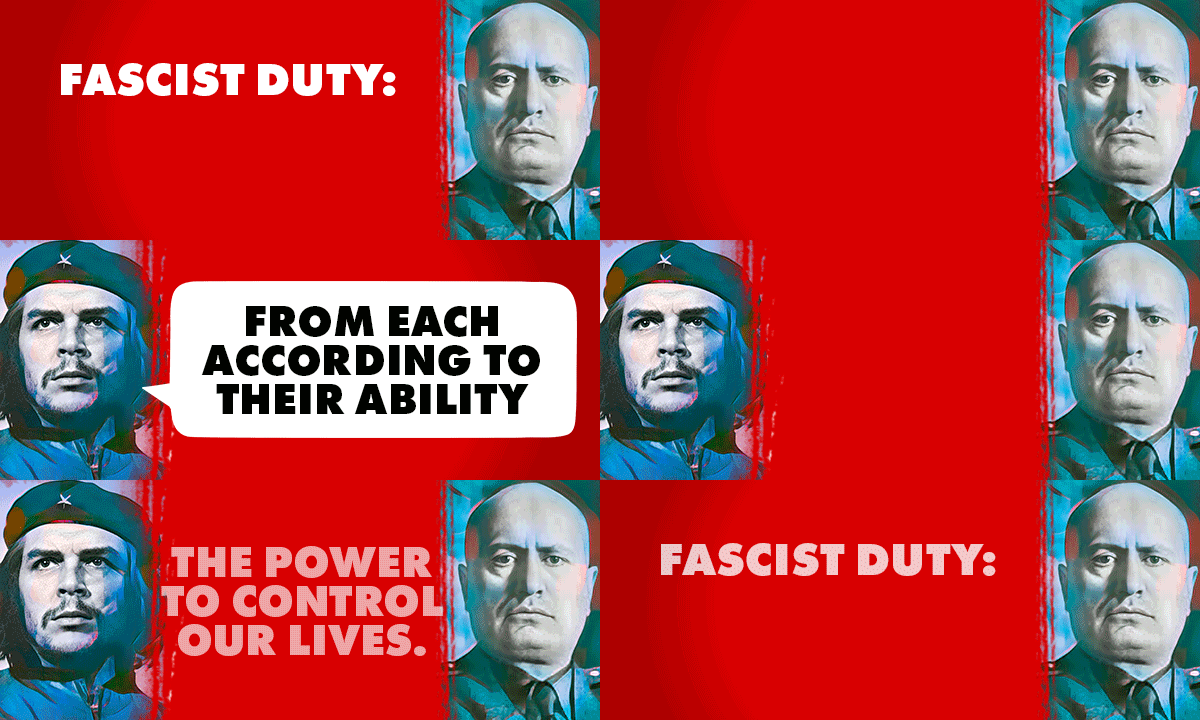
[19]. The axiom "from each according to their ability" without question remains the socialist standard, appearing time and again today, as three examples illustrate.
First, the Democratic Socialists of America's 2017 annual convention used signage with sayings of Karl Marx, including "from each according to their ability, to each according to their needs." David Weigel, "The Socialist Movement is Turning Younger and Turning into a Left-Wing Force," Chicago Tribune, August 6, 2017, https://www.chicagotribune.com/nation-world/ct-socialist-movement-bernie-sanders-20170806-story.html.
Second, the Socialist Students Society of Cardiff University proclaims in its organizational overview: "As socialists we believe that a different kind of society is possible in which the principle of 'from each according to their ability, to each according to their need' (Karl Marx) is realized." "Socialist Students Society," Cardiff University Students Union, accessed February 15, 2021, https://www.cardiffstudents.com/activities/society/socialiststudents/.
Third, Binay Sakar, in his article "Road-Map to Socialism—Democracy Is the Road to Socialism," cites "from each according to their ability, to each according to their needs" as the goal of democratic socialism. Binay Sakar, "Road-Map to Socialism—Democracy Is the Road to Socialism," July 6, 2019, https://countercurrents.org/2019/07/road-map-to-socialism-democracy-is-the-road-to-socialism/.
[20]. See the Red Flags Press paper "The Socialist Obsession: The Central Role of 'Parasites' In Socialist Thought."
[21]. Friedrich Engels, "Speeches in Elberfeld," in Marx/Engels Collected Works, vol 4. (Chadwell Heath: Lawrence & Wishart, 2010), 252.
[22]. Samezō Kuruma quoted in Tsushima, "Understanding 'Labor Certificates.'"
[23]. Marx, Capital, 2:434.
[24]. Marx, Capital, 2:434.
[25]. Agnes Heller, The Theory of Needs in Marx (London: Allison & Busby, 1974), 108.
[26]. Vladimir Lenin, The State and Revolution, 2nd ed. (London: Laurence & Wishart, 1943), 118.
[27]. Agnes Heller, The Theory of Needs in Marx (London: Allison & Busby, 1974), 108.
[28]. Michael Harrington, The Twilight of Capitalism (New York: Simon and Schuster, 1976), v.
[29]. Engels, "Speeches in Elberfeld," 252.
[30]. Michael Harrington, Socialism, Past and Future (New York: Mentor, 1992), 47.
[31]. Like so many socialists, Mandel saw socialism as the only true form of democracy and without question considered himself a democratic socialist. For example, see Ernest Mandel, "Marxism and Democracy," Fourth International 10, no. 4 (April 1949): 104–9, https://www.ernestmandel.org/en/works/txt/1948/marxism_and_democracy.htm.
[32]. That Cockshott considers himself a democratic socialist is demonstrated by the discussion in chapter 13, "On Democracy," in Paul Cockshott and Allin Cottrell, Towards a New Socialism (Nottingham: Spokesman, 1993).
[33]. Michael Lebowitz, The Socialist Imperative, 154–55. Like so many socialists, Lebowitz sees socialism and democracy as essentially equivalent (one of the facts that demonstrates "democratic socialism" is a marketing slogan, not a new version of socialism; see the Red Flags Press paper "Democratic Socialism? Déjà Vu All Over Again). For additional evidence that Lebowitz's sees himself as a democratic socialist, see Lebowitz's The Socialist Alternative: Real Human Development (New York: Monthly Review Press, 2010), 132. Here Lebowitz outlines the "battle of democracy," which is essentially the same as "the battle of socialism"—to socialist thinking, it is only when socialism arrives that democracy arrives. Again, we should focus on the fact that Lebowitz sees socialism as synonymous with democracy at the same time he calls for the suppression of private labor rights—that is, our right to individually control how the time in our lives is used.