


"The only method of producing
fully developed human beings."
—Karl Marx
"A means for
increasing social production."
—Karl Marx
Socialists unethically hide
Marx's anti-liberal goals and beliefs
as part of their effort to
rebrand socialism.
Karl Marx is the most important socialist philosopher of all time. His thinking has defined socialism for the past 150 years.
And today's democratic socialism is no exception. Michael Harrington, the founder of the Democratic Socialists of America, declares Marx a
champion of human freedom and democratic socialist.[1]
Today's socialism remains Marxism, but socialists want to distance Marx from the oppressive history of the nations and parties that have carried his banner. They assert with Harrington that Marx was for freedom and democracy.
For example, in Marx's Concept of Man, celebrated socialist Erich Fromm writes that
Marx's philosophy was … aimed at the full realization of individualism.[2]
And Terry Eagleton, in his recent book Why Marx Was Right, writes that the "whole aim" of Marx's philosophy is
the free flourishing of individuals.[3]
Such claims simply aren't true. They only succeed by hiding Marx's many anti-liberal goals and beliefs.[4]
A prime example of this anti-liberal thinking is found in Marx's plan for "the education of the future,"[5] an idea he considers so good that he describes it as
the only method of producing fully developed human beings.[6]
What is Marx's strategy for "producing fully developed human beings"?
It's compulsory child labor. Compulsory child factory labor.
"EVERY CHILD WHATEVER,
FROM THE AGE OF NINE YEARS"
Marx advocates for child labor as a core component of education multiple times, including in three of his most important works.
He characterizes this idea not only as "the only method of producing fully developed human beings" but also as
a progressive, sound and legitimate tendency.[7]
Consider this example from his most famous individually authored work, Capital:
The germ of the education of the future is present in the factory system; this education will, in the case of every child over a given age, combine productive labour with instruction and gymnastics, not only as one of the methods of adding to the efficiency of production, but as the only method of producing fully developed human beings.[8]
The only difference between traditional education and the "education of the future" is the addition of a requirement for "every child over a given age" to perform "productive labor."
Marx further identifies factory labor in education as a socialist goal in The Communist Manifesto, his best-known work, one he co-authored with Friedrich Engels. They call for
Abolition of children's factory labour in its present form. Combination of education with industrial production.[9]
In other words, Marx was against banning child labor outright (as actually happened under the liberal/capitalist system he loathed). Instead, he wanted a new type of child labor under the label of education.
Some thirty years after first writing to advocate child labor as supposed education, Marx pitched his Education of the Future idea in another of his most noted works, The Critique of the Gotha Program.[10] He writes:
A general prohibition of child labour is incompatible with the existence of large-scale industry and hence an empty, pious aspiration. Its realisation—if it were possible—would be reactionary, since, with a strict regulation of the working time according to the different age groups and other safety measures for the protection of children, an early combination of productive labour with education is one of the most potent means for the transformation of present-day society.[11]
Despite having three decades to reevaluate his thinking, Marx still refused to call for the elimination of child factory labor.
Instead, Marx explicitly dismissed the idea of banning child labor. He called a world without it "reactionary"—that is, a step backward.
Friedrich Engels, too, remained in favor of child labor as "education" some thirty years after he and Marx first wrote of the idea. In The Anti-Dühring, Engels references "the education of the future" and explains his and Marx's desire for
the combination of work and instruction in socialist society.[12]
Another instance of Marx promoting child labor, with additional details on his recipe for the Education of the Future, is found in papers he drafted for the International Workingmen's Association (IWA). As part of this material, he writes:
We consider the tendency of modem industry to make children and juvenile persons of both sexes co-operate in the great work of social production, as a progressive, sound and legitimate tendency, although under capital it was distorted into an abomination. In a rational state of society every child whatever, from the age of nine years, ought to become a productive laborer.[13]
Again, Marx doesn't seek the end of child labor but rather to make it an everlasting element of socialist society. Child labor is "an abomination" under capitalism, he says, but it's going to be peachy keen come socialism.
In the material he drafted for the IWA, Marx also defines how many hours of the school day should be devoted to performing labor[14] instead of attending class:
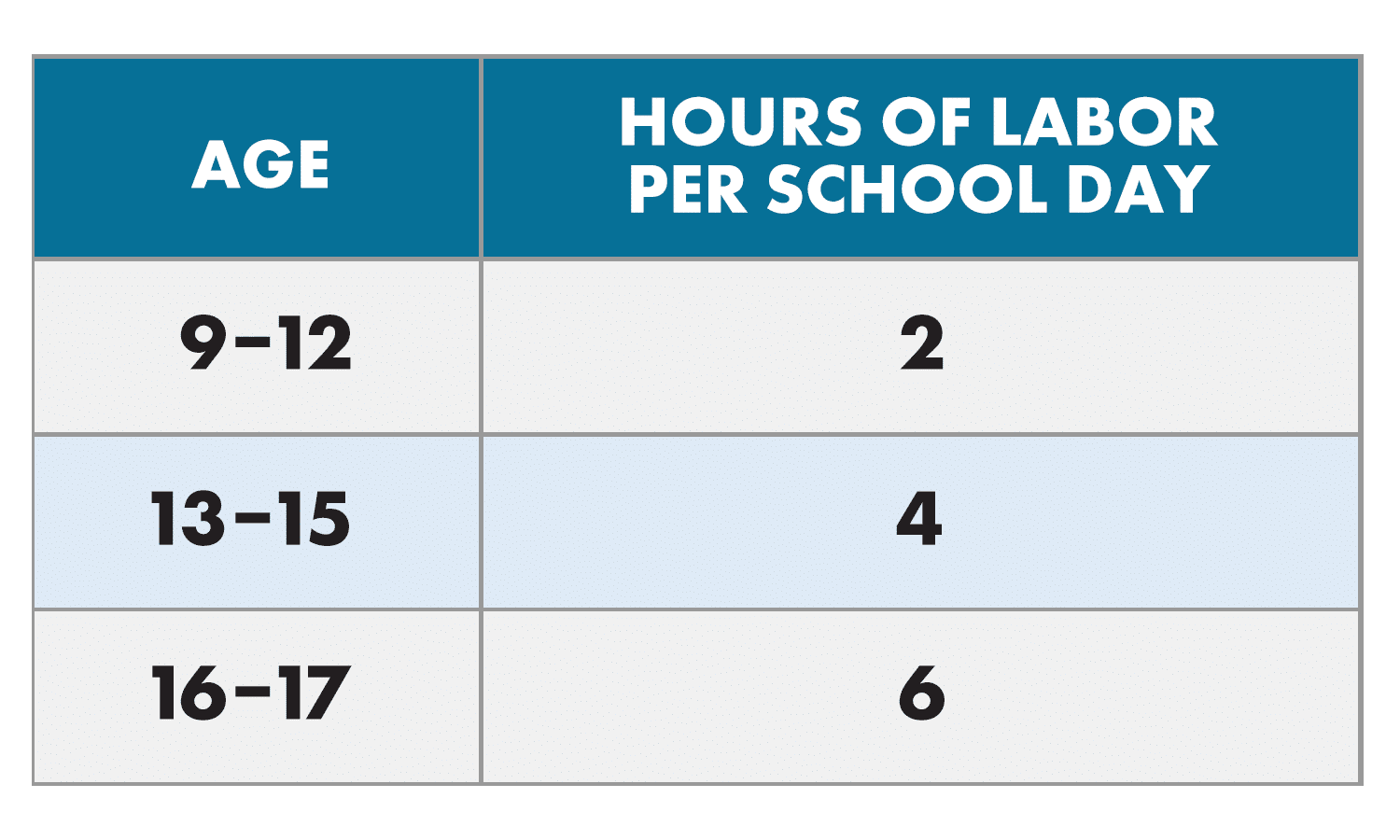
Those thirteen and older would spend four or more hours a day laboring for society. That doesn't leave much time for instruction and gymnastics, does it?
STRIPPING OFF THE
FETTERS OF INDIVIDUALITY
What type of work does Marx want children to perform? The same kind he desires for adults: factory labor.
Marx's preference for factory labor isn't just about maximizing production. He also believes that working in large-scale industry produces humans well suited to be socialists. He writes that
the partially developed individual … must be replaced by the totally developed individual, for whom the different social functions are different modes of activity he takes up in turn.[15]
How is the partially developed individual turned into a fully developed one? By working in large-scale industry. To Marx's thinking,
large-scale industry, by its very nature, necessitates variation of labour, fluidity of functions, and mobility of the worker in all directions.[16]
He believes that when someone works
systematically with others, he strips off the fetters of his individuality and develops the capabilities of his species.[17]
Working in the social setting of large industry yields what Marx sees as a one-two punch.
One: it "strips off the fetters," or chains, of the worker's individuality.
Two: it "develops the capabilities of his species."
In other words, it strips away the personal autonomy and identity of each person with the goal of improving the productivity of the collective and creating people trained to pursue social objectives.
Marx doesn't simply favor work in large industry; he's also against people working independently.
In contrast with factory labor, working individually doesn't "strip off the fetters" of individuality. It develops individuality. And we can't have that.
This animosity for working individually is illustrated by Marx's contempt for craftwork. In The Poverty of Philosophy, Marx notes with pleasure that
the automatic workshop [the factory] wipes out specialists and craft-idiocy.[18]
In the same passage, Marx makes the snarky assertion that craft-style production turns craftspeople into pinheads, idiots.[19]
As one socialist has written,
Marx completely rejects the craft ideal. … It's a limited, individual activity.[20]
Marx's love of large industry and his disdain for craft production are reflected in his plans for the Education of the Future. He's explicit that children are to carry out their compulsory labor for socialist society in "the factory system,"[21] performing "industrial production."[22]
(To learn the details about socialism's strong biases against craftwork, see our paper "Why Socialism Says Craftwork Is 'Idiocy.'" This paper is summarized in Chapter 6 of Socialism Says.)
"WORK IN ORDER TO
BE ABLE TO EAT"
Marx's child labor plan has nothing to do with developing our individuality—quite the contrary! But that's what makes it a winner for a socialist society.
First off, compulsory child labor would give socialist society the ultimate method of producing citizens drilled in the principle of "from each according to their ability," socialism's 170-year-old duty to work for society.[23]
In the materials he authored for the IWA, Marx states that being compelled "to become a productive labourer" would teach children a key lesson: that one must "work in order to be able to eat."
In a rational state of society, every child whatever, from the age of nine years, ought to become a productive labourer in the same way that no able-bodied adult person ought to be exempted from the general law of nature, viz.: to work in order to be able to eat, and work not only with the brain but with the hands too.[24]
In what Marx considers "a rational state of society," every child would be required to start working for society at age nine.
Obviously, children of nine, ten, eleven, and so on, would not be involved in workplace decision-making. They'd be taking orders.
And when someone felt a child failed to execute orders properly? Then the child would have another educational opportunity: being schooled in workplace discipline.
By the time kids turned eighteen, they'd have spent a decade learning about socialism's compulsory duty to give our time and talents to society by being compelled to give their time and talents to society. The Education of the Future is preparing them for the reality they will experience as adults in socialist society.
Marx also writes about a second benefit socialist society would receive from the Education of the Future. In Capital, the first justification he lists for child labor is that it's
one of the methods of adding to the efficiency of production.[25]
Another translation of the same passage of Capital puts this first benefit socialist society receives from child labor even more bluntly. It's
a means for increasing social production.[26]
How nice for socialism! Boosted production and improved efficiency via the compulsory labor of children as young as nine.
Socialists—with Marx leading the charge—have long attacked capitalism as meaning the "exploitation" of workers.
But, in Marx's socialism, making children perform compulsory labor as "a means of increasing social production" somehow doesn't count as exploitation.
"MARX DID NOT WRITE
DIRECTLY ON EDUCATION"
As socialist authors explain,[27] Marx expected the advent of socialism during his lifetime or soon thereafter. Had he been right, the odds are high his dream of compulsory child labor as education would also have come true.
Today's socialism remains firmly founded on the duty of "from each according to their ability."[28] But because our liberal society did away with child labor long ago, it's not realistic for socialists to promote Marx's call for this duty to commence at age nine.
It's not surprising that today's socialists have abandoned Marx's plan for the Education of the Future. But that doesn't give them the right to do what they have done: disappear this favorite idea of Marx's so they can sell him as a "champion of human freedom."
Marx's plan for a large chunk of the school day to be spent performing factory labor affords critical insights into his overall thinking—the thinking that's been the essence of socialism for well over a century.
And Marx's repeated writings on this topic are exceptionally noteworthy because they are rare violations of his famous-in-socialist-circles pronouncement that he would not "write recipes" for the operation of socialist society.[29]
Nevertheless, you can consume any number of socialist-authored works about Marx and his philosophy without reading anything whatsoever about his calls for child factory labor as education.
Is there any mention of the Education of the Future in Terry Eagleton's Why Marx Was Right, the work in which Eagleton claims that the aim of Marx's thinking is "the free flourishing of individuals"?
No. There's not one word.
Is there any mention of the Education of the Future in Erich Fromm's Marx's Concept of Man, the work in which Fromm argues that "Marx's philosophy was … aimed at the full realization of individualism"?
No, there isn't. In fact, as part of his effort to make Marx out to be a humanist, Fromm writes that Marx
speaks of the importance of producing "fully developed human beings."[30]
The phrase "fully developed human beings" has been plucked out of Marx's explanation of the Education of the Future in Capital, quoted earlier in this essay.[31]
But Fromm doesn't explain that the context of the phrase is Marx's argument for child labor as education. Instead, he uses Marx's words out of context for his own misleading purposes.
Marx's calls for child labor as a key component of socialist education are even missing from works specifically about Marx and education.
Consider a book with that exact title, Marx and Education,[32] and one titled Marxism and Education.[33] These books—authored by socialists Dr. Jean Anyon and Mandan Sarup, respectively—contain detailed overviews of Marx's philosophy[34], many quotes from him, and even more commentary about his thinking.
Yet nowhere in either of them is there a single quote—or even a single word—about "the education of the future."
Hiding what Marx says about child labor as education yields books full of dishonest material.[35] Sarup goes so far as to claim that
Marx did not write directly on education.[36]
Similarly, in an online essay on Marx and education, author Barry Burke praises Marx and writes about the "profound" influence Marx has had on educators.[37] But Burke's opening sentence reads:
Karl Marx never wrote anything directly on education.[38]
It's all but impossible to believe that these authors—who researched and then wrote about Marx and education—could have missed every one of Marx's repeated calls for child labor as a critical aspect of socialist education.[39]
These authors are either astonishingly ignorant of this favorite idea of their "champion of human freedom" or they want you to be.
"Free Flourishing"
Individuals or
"Conscious Cogs"?
Today's socialists sell Marx and Marxism as desiring "the full realization of individualism."[40] But earlier socialists offered a fundamentally different—and far more accurate—vision of the goals of Marx and socialism generally.
Ernest Bax was a founder and leader of two prominent British socialist organizations: the Social Democratic Federation and (with Marx's daughter Eleanor) the Socialist League.[41] He's credited with introducing many of Marx's ideas to the English-speaking world.[42]
Bax writes about the "new ethic of socialism." He explains that it
exhibits for the first time in the world's history the conscious sacrifice of the individual to the social whole.[43]
Bax isn't criticizing socialism because it means "the conscious sacrifice of the individual." No, he's praising this premise at the heart of socialism—one reflected in and enforced by socialism's compulsory duty of "from each according to their ability."
Socialist icon Che Guevara similarly explains that socialism would mean that
man once again regains the old sense of happiness in work, the happiness of fulfilling a duty, of feeling himself important within the social mechanism. He becomes happy to feel himself a cog in the wheel, a cog which has its own characteristics and is necessary although not indispensable to the production process, a conscious cog.[44]
Socialism isn't about "the free flourishing of individuals," as Terry Eagleton claims.
No, what socialism offers us is "the happiness of fulfilling a duty." Socialism will make us "happy to feel [like] … a conscious cog."
Marx considered his formula for the Education of the Future "the only method of producing fully developed human beings."
Under his plan, every socialist citizen would be the product of a school system that devoted as much time to "productive labour" as it did to classroom instruction. Every socialist citizen would spend a decade of their childhood working in an industrial environment that Marx favored because it "strips off the fetters of [our] individuality."
What type of humans would this system produce? Not free flourishing individuals but conscious cogs.
Socialism has long been based on the requirement of "fulfilling a duty," the duty of "from each according to their ability." It remains so today.[45]
Socialism's foundation on this compulsory duty makes it a system that inevitably leads to the development of "conscious cogs."[46] The history of socialist experiments has demonstrated this reality time and again.
It's dishonest for socialists to sell Marx as a "champion of human freedom" or his philosophy as seeking the "full realization of individualism."
And it's all the more unethical for socialists to peddle this fiction by hiding what they know about Marx's Education of the Future thinking and his many other[47] anti-liberal goals and beliefs.
Thank you for reading "Karl Marx's 'Education of the Future.'"