

"Individualism ought to be
the efficient use
of the whole individual
for the absolute benefit
of the collectivity."
— Che Guevara
Socialism's foundation on compulsory duty has shaped—contaminated—so much of socialist philosophy
Here are two critical things to know about socialism: it's founded on compulsory duty, and this duty has shaped the entire philosophy.
For over 170 years, socialism's requirement of duty has been defined by the famous axiom "from each according to their ability."[1]
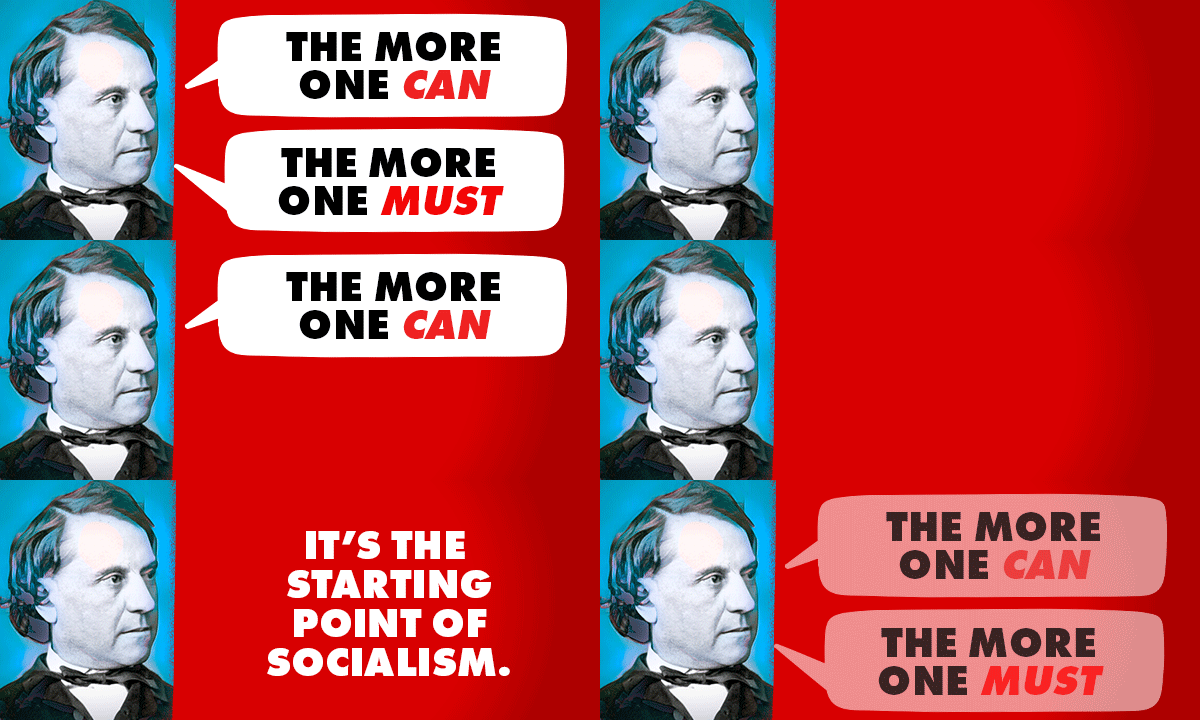
French socialist Louis Blanc coined this phrase that remains the socialist standard today.[2] He emphasizes its essence in italics and all caps, explaining:
The more one can, the more one must. … Hence the axiom: From each according to his ability. That is the DUTY.[3]
Socialism says all should be born owing their abilities—their time and talents—to society.
This requirement of duty both reflects and enforces the socialist worldview that sees us as "cells"[4] in the body of society, as "cogs"[5] who exist to perform our "humble function in the great social machine."[6]
In contrast, the liberal philosophy that underpins democracies like the United States, Canada, France, and Japan rejects compulsory obligations to give our time and talents to others.
Liberalism rejects such duties, be they to a king or queen, to fascists calling themselves "the community,"[7] or to socialists calling themselves "society."
The founding principle of liberalism is that we each own our lives free and clear. It says others should not—without our express consent—have the power to control our time or talents or to interfere with our right to define our own lives.[8]
Socialism repudiates this fundamental liberal belief. It starts by demanding that all "return to duty" and to "obedience."[9] It imposes a type of duty that directly contradicts liberal principles.
Socialists recognize the distinction, admitting that duty of the type socialism demands is "strikingly absent" from liberal philosophy and also from the constitutions of liberal democracies.[10]
Socialist duty is dangerous. It is not only illiberal but anti-liberal. It morphs our time into what socialism treats as society's time. It gives those running socialist society the very power that liberalism is designed to prevent: the power to take control of our lives.
This duty is non-optional for socialism. A socialist society cannot be created or maintained without those running society having this power over our lives.[11]
The twentieth century's experiments with socialism were humanitarian disasters, despite the high hopes and promises of socialists at the time.[12]
What went wrong? Duty.
Socialism's duty of "from each according to their ability" overrides individual rights, making it all too easy for authoritarians to seize control.
The belief that we owe our abilities to society leads those running socialist societies to treat people not as individuals but as resources to be "used" and used "efficiently,"[13] as the iconic socialist Che Guevara puts it.
"From each according to their ability" is socialism's philosophical Chernobyl. Socialist duty has broken containment, irradiated the whole of the philosophy, and warped its reasoning. It makes socialism a philosophy that
- denigrates human rights;
- considers slackers to be "thieves";
- is obsessed with identifying and eradicating "parasites";
- seeks to eliminate our "private labor" rights;
- is strongly biased against craftwork; and
- treats the time in our lives as society's time.
Let's explore these six ways the duty of "from each according to their ability" has contaminated socialist philosophy. After we do, we'll also briefly review:
- how duty is baked into socialism—democratic socialism included;
- why it's dishonest to compare socialist duty to income taxes;
- socialism's "perfect freedom" sales trick; and
- the implications of Che Guevara's new definition for "individualism."

OUR "SO-CALLED" RIGHTS
To socialism, duty to society always beats individual rights.
That this is the case is simply a given. If socialism permitted our rights to override the duty of "from each according to their ability," it would no longer be a true duty.
Socialist philosophers don't mince words when it comes to socialism prioritizing duties over rights. They explain that socialism favors duty because it compels us to work on social goals, whereas rights are a problem because they permit us "to resist."
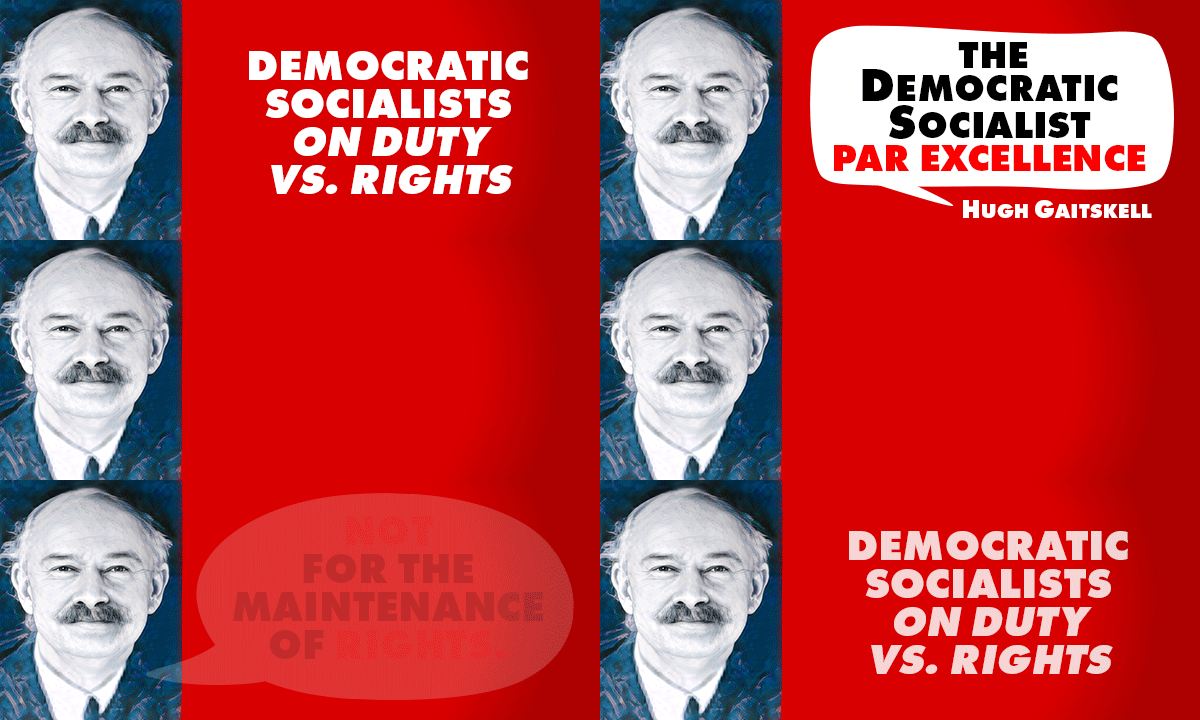
In two of the innumerable examples of socialist philosophers praising duty and disparaging rights, celebrated socialists (both considered democratic socialists[14]) R. H. Tawney and J. Ramsey MacDonald, respectively, report:
Society should be organized primarily for the performance of duties, not for the maintenance of rights. … Duties, unlike rights, are relative to some end or purpose, for the sake of which they are imposed. [Rights] are a principle of division; they enable men to resist. [Duties] are a principle of union; they lead men to cooperate.[15]
The State does not concern itself primarily with man as a possessor of rights, but with man as the doer of duties. A right is the opportunity of fulfilling a duty, and it should be recognized only in so far as it is necessary to the performance of duty.[16]
Another noted socialist, Bernard Shaw, writes:
We, as Socialists, have nothing to do with liberty. Our message … is one of discipline, of service, of ruthless refusal to acknowledge any natural right.[17]
Shaw's "ruthless refusal to acknowledge any natural right"" is not of his own invention. It's a common socialist sentiment, as demonstrated by the thinking of none other than Karl Marx, socialism's far-and-away most important philosopher.
Marx flat out rejects the concept of human rights. He calls rights
"ideological nonsense"[18]
and
"verbal rubbish."[19]
He refers to them as "so-called rights" and "supposed rights."[20]
Marx's thinking has defined socialism for the last 150 years and still does today. Michael Harrington, the founder of the Democratic Socialists of America, even says Marx should be considered a democratic socialist.[21]
Not only does this show Marx remains the socialist messiah, but it also illustrates the dubious meaning of "democratic" in the term "democratic socialism."[22] One can be a democratic socialist despite considering rights "rubbish" and "nonsense."
The first critical byproduct of socialism's foundation on duty? Socialism will forever place duty above rights.
To learn more about the ways belief in duty leads socialist thinkers to demean rights, visit socalledrights.org

"THEY ARE SLACKERS,
THAT IS TO SAY THIEVES"
To socialism, the slacker is a "thief" and shirking work is a "crime."
Henri de Saint-Simon, Gracchus Babeuf, and Fidel Castro provide three examples of the dozens of prominent socialists who attack slackers and slacking. They tell us, respectively:
They are slackers, that is to say thieves.[23]
No one can without committing a crime shirk labor.[24]
This person is a thief, a thief! … The slacker! He is not going to become our exploiter![25]
You may feel that choosing to be lazy is a waste of one's life. But even if that's the case, it's something altogether different to say this choice should be considered a crime against society.
Seeing slackers as thieves is, however, a given result of socialism's foundation on "from each according to their ability." This duty morphs our time and talents into what socialism treats as society's property to control.
Slackers, by definition, do not put their full abilities to work. They are thus seen as stealing the time and talents socialism claims we are born owing to society. The dozens of celebrated socialists who attack slackers and slacking aren't expressing personal opinions; they're stating a given outcome of socialism's foundation on duty to society.
That socialist duty transforms slacking into theft highlights the danger this duty poses to our liberal right to define our own lives. One noted socialist thinker after another condemning slackers should serve as a warning, not just to those who wish to be lazy, but to us all.
The second critical byproduct of socialism's foundation on duty? Those who don't give their full abilities to society are counted as criminals.
To review dozens of examples of socialist thinkers attacking slackers and learn more about why they do, visit slackingistheft.org.
SOCIALISM'S PARASITE OBSESSION
Beatrice and Sidney Webb were leaders of the famed British socialist organization The Fabian Society. They describe the duty of socialism as
a duty not to be a parasite.[26]
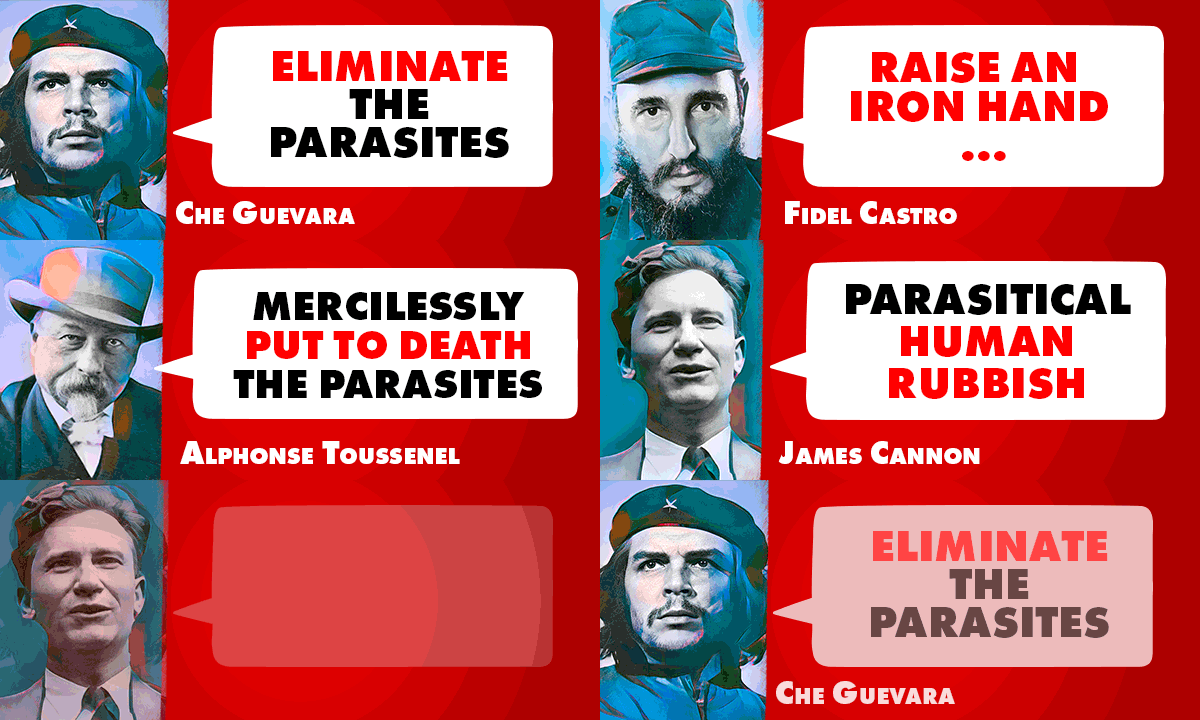
The Webbs are but two of the hundreds of socialist thinkers who attack alleged "parasites" and call for their suppression.
Socialists don't just berate "parasites" in casual conversation; this term appears again and again in socialist philosophical writings. It's an expression employed by nine generations of socialist thinkers, and it is still used today.
Who are "parasites" to socialism? They're the millions of us who perform work that socialist theory labels "socially useless" and thus "parasitic."
Socialist Lucien Deslinières explains:
These useless ones are not just idlers as you might think. They are workers and sometimes even work a great deal, but their work produces nothing. … Now these useless workers, socialism will suppress them; it will make them useful. Instead of being parasites they will become producers.[27]
Socialism's foundation on duty makes it a philosophy in love with passing judgment and with branding people as "parasites."
But the parasite concept plays a far more significant role in socialist thought than simple name-calling. Those whom socialists deem to be parasites are seen as a vast pool of wasted labor that can ("thanks" to socialism's foundation on duty) be put to work on tasks of socialists' choosing.
Socialist theory is explicit that its many sales promises are to be fulfilled by forcing those judged to be parasites to work on approved tasks. As Fidel Castro elucidates, socialist goals are achieved by purging socialist society of supposed parasites:
We will have such an abundance of everything. … We can have it with our work, with the effort of our working people, with a country of workers without parasites of any type.[28]
Only one other philosophy has a parasite fixation analogous to that of socialism: fascism.
Like socialism, fascism rejects liberalism's lack of compulsory duty and demands that we be made to return to duty.[29]
Like socialists, fascists pass judgment on all: are you or are you not correctly performing your duty to the community?
Like Fidel Castro, fascists promise "a country of workers without parasites of any type."[30]
Fascists and socialists, despite being historical rivals, both see parasites everywhere they turn. These similarities aren't surprising because "the father of Fascism,"[31] Benito Mussolini, learned to love duty and loathe parasites when he was a socialist leader.[32]
The third critical byproduct of socialism's foundation on duty? Socialism's multi-century fixation with parasites and its plan to suppress them.
To learn more about socialism's fascist-like fixation with "parasites" and their elimination (and to see hundreds of examples of socialists attacking supposed "parasites"), visit parasiteobsessed.org.
THE "DEFECT OF PRIVATE OWNERSHIP OF LABOR POWER"
In our liberal society, our work is what Karl Marx calls "private labor."[33] It's "private labor" in that our work is under our individual control in the same way that our private property is under our individual control.
Our private labor rights mean we each have the ultimate say over which jobs we're willing to perform. They also mean we're free to pursue any job we wish and do so without those running society being able to limit our choices to those they prefer.
Socialism objects to this liberal principle. For example, in his recent book, The Socialist Imperative, democratic socialist Michael Lebowitz attacks what he labels the
defect of private ownership of labor-power.[34]
Lebowitz also describes our private control of our work as an "infection"[35] that socialism must cure.
Socialism calls for the "abolition of 'private labor.'"[36] The plan is for our private labor rights to be replaced by what Marx calls "directly social labor,"[37] which is our work under society's control.
In a liberal society such as our current one—a society that rejects compulsory duty of the type socialism demands—there's simply no way for socialists to implement their plan to give society direct control of our work.
The imposition of socialist duty changes all that. It sets the stage for the suppression of our private labor rights.
A fourth critical byproduct of socialism's foundation on duty? What we do for work is to be under society's direct control.
To learn more about socialism's plan to abolish our private labor rights, see the paper "A 'Defect' of Liberalism," available here on redflagspress.org.

CRAFT "IDIOCY"
Here's an aspect of socialist theory about which many are unaware: socialism is strongly biased against small enterprises and craftwork, preferring large-scale production and maximally efficient work.
That's why socialist great Vladimir Lenin says:
Unfortunately, small production is still very, very widespread in the world, and small production engenders capitalism and the bourgeoisie continuously, daily, hourly, spontaneously, and on a mass scale.[38]
And Lenin is only one of the socialist thinkers who state that small-scale production creates capitalism non-stop, a result that's obviously diametrically opposed to the goal of socialism.[39]
The socialist bias against small enterprises is also vividly illustrated by Karl Marx's outright rejection of craftwork. Marx calls craftwork "idiocy" and makes the snarky claim that performing it turns craft artisans into pinheads.[40]
Socialist thinkers admit that
Marx completely rejects the craft ideal.[41]
There are four distinct reasons that craft workshops and other small enterprises clash with socialist theory and socialist goals.
But each of these conflicts is itself rooted in the ultimate disagreement between liberalism and socialism: the debate over who should control our time and talents, we individuals or society? Thus, even socialism's bias against craftwork results from its foundation on the duty to give our abilities to society.
The fifth critical byproduct of socialist duty? Socialism's objections to craftwork and other small-scale production, including small farms.
To learn more about socialism's biases against craftwork and small enterprises, visit craftidiocy.org.
OUR TIME AS SOCIETY'S TIME
The sixth ripple effect of socialism's foundation on the duty of "from each according to their ability"?
It's that this duty morphs the time in our lives into what socialism treats as society's property, as society's time.
Actually, the link between socialist duty and the socialist view that our time is society's property is an instance of the proverbial chicken and egg problem.
Which comes first? Does socialism's belief in compulsory duty cause socialists to treat our time as society's time? Or does the socialist belief that our time should be treated as society's property result in the duty of "from each according to their ability"?
These two key dimensions of socialist thought unquestionably reinforce each other. But ultimately, it's socialism's formal requirement of duty that compels us to submit to the commands of those running socialist society. The constitutions of socialist nations even include socialism's "from each according to their ability" standard of duty as an explicit obligation of citizens.[42]
We've already seen instances of how socialism treats our time as society's property, as society's time. For example, it's the society's time principle that leads socialists to see slackers as "thieves" (slackers, by being lazy, "steal" time that is society's property).
But thinking of our time as society's property plays a far broader role in socialist philosophy than has been detailed to this point.
Let's consider an additional example of how the society's time principle is a hidden premise behind so much of socialism—one illustrated by quotes from Laurence Gronlund, Michael Lebowitz, and Karl Marx.
Gronlund writes:
Against the State, the organized Society, even Labor does not give us a particle of title to what our hands and brain produce.[43]
Why doesn't our work give us even "a particle of title" (not even a tiny bit of ownership) in what we produce?
This thinking is a natural extension of the socialist belief that our time and talents are society's property. Because socialism starts from the assumption that society owns our abilities, what we produce using them is considered society's property as well.
Gronlund's words certainly don't appear in the socialist sales pitch. But, if anything, that makes his thinking more important to hear. He accurately summarizes the mainline socialist viewpoint, as demonstrated by comparing Gronlund's analysis to that of Karl Marx and Michael Lebowitz.
Again, Marx's beliefs have defined socialism for the past 150 years, and they still do today. Lebowitz quotes Marx while explaining that the goal of socialism is to create a society in which
the product of our activity is "a communal, general product from the outset."[44]
If what you produce is "a communal, general product from the outset," then what you produce is—from the outset—never yours.
Lebowitz and Marx tell us precisely what Gronlund has: that, as socialism sees it, our work does not give us even a smidge of ownership in what our hands and brains produce. Socialist duty turns our time into society's time. As a result, socialism considers what we produce to belong to society from the get-go.
What follows logically from the socialist belief that our time is society's time and that what we produce with society's time belongs to society from the outset?
Given these premises, would it make sense for us to be permitted to work at any job we wish? Would it make sense for us to be permitted to produce whatever we feel like?
Of course not. From the socialist perspective, letting us do whatever we want and make whatever we want would be absurd, likely resulting in a grave misuse of society's time.
No, socialist society determines how best to use its time. Socialist society decides what work is a valid use of society's time. It decides what we should be permitted to produce using society's time.
These beliefs permeate socialist philosophy. As Fidel Castro says:
You cannot talk of socialism if you do not accept the premise of the rational, optimum use of human resources.[45]
To socialism, our lives are a societal resource—a resource to be used as those running socialist society consider best. Socialist duty spurs and enforces this type of thinking.
The sixth ripple effect of socialism's foundation on duty? It causes socialists to see our time and talents as society's property to control.
This logic is anti-liberal and incredibly dangerous. It inevitably leads to authoritarianism.
Additional examples of socialist theory and theorists treating our time as society's time appear in many Red Flags Press papers, for example, in "Why Socialism Says Craftwork Is 'Idiocy,'" available at craftidiocy.org.
SOCIALIST DUTY: BAKED IN
Today's socialism remains firmly founded on the duty that produces each of the ripple effects outlined above. It still requires "from each according to their ability," just as socialism has for the past 170 years.
This is a standard explicitly endorsed by Michael Harrington, the founder of the Democratic Socialists of America (DSA)[46] and by other present-day democratic socialists.[47] It's an axiom that's appeared on signage at the DSA annual convention.[48]
That today's socialism remains based on the duty of "from each according to their ability" is one of the many factors demonstrating "democratic" socialism is a marketing slogan, not a new version of socialism.
The reality is that, for well over a century, socialists have believed that socialism is democracy.[49] To socialists, "democratic socialism" is a needless redundancy equivalent to "socialist socialism." For this entire period and still today, socialists have considered their philosophy to equal democracy despite its foundation on an anti-liberal and dangerous duty.
Compulsory duty is baked into the socialist cake. Decorating the cake by piping "DEMOCRATIC" across the top doesn't change the ingredients inside.
To learn the details that demonstrate "democratic socialism" is a misleading marketing slogan, not a new version of socialism, visit ketofriendlysocialism.org.
Another proof that compulsory duty is baked into the socialist cake? The existence of an alternate version of socialism's most famous saying: "From each according to their ability, to each according to their needs."
The purpose of the little-known second version? To make sure we're under the compulsory duty of "from each according to their ability," even when socialism fails to deliver on its promise of "to each according to their need."
To learn more, see our paper "Doubling Down on Duty," available here on redflagspress.org
"Like Taxes"—A Sales Trick
Don't fall for claims that the requirement to pay taxes in our current liberal society is analogous to socialism's duty of "from each according to their ability." Such arguments are disingenuous at best.
In liberal society, our time is our own to use as we wish to define our lives. Income taxes apply after we choose what to do with our time.
We decide how to use our lives. And then we are taxed on the income that results from our choices.
In stark contrast, socialist duty gives society control of our time before we make our choices. Socialist duty morphs our time into what is effectively society's time and socialist thinkers and socialist rulers have long treated it as such.
The duty to pay taxes doesn't give those running society the power to suppress alleged "parasites." Socialist duty does. And socialist nations have.
The duty to pay taxes doesn't give those running society the power to outlaw jobs that socialists consider "socially useless." Socialist duty does. And socialist nations have.
The duty to pay taxes doesn't give those running society the power to set caps on the number of people permitted to pursue careers in the arts and other fields. Socialist duty does. And socialist nations have.
The duty to pay taxes doesn't permit society to make it illegal for us to use our lives to start our own business. Socialist duty does. And, again, socialist nations have.
Fidel Castro tells us:
Socialism cannot exist … unless every citizen is used in an optimum, rational way.[50]
Socialism's existence requires us to be used—used in what socialists consider an "optimum, rational" way. Taxes do not give those running society this incredibly dangerous power.
When operating in a liberal society and thus contained by liberalism's rejection of compulsory duty to society, socialists certainly favor higher taxes. But that by no means suggests taxes bear any meaningful relationship to the nature of socialist duty.
To the socialist mindset and in socialist theory, taxes are the equivalent of taking aspirin when brain surgery is required—a palliative, not the cure.
The socialist cure is to leave liberalism behind and to create a society based on the duty of "from each according to their ability"—a society that controls our time and talents so that parasites can be suppressed, "useless" jobs made illegal, and so that our lives can be "used" in what socialists consider "an optimum, rational way."
Without these steps, socialist theory says what Fidel Castro does: that "socialism cannot exist."
Again, taxes take place after we use our lives as we wish. Conversely, socialist duty gives those running society the power to control our lives before we use our brief time on Earth as we choose.
Fascism is another philosophy that rejects liberalism and calls for the imposition of compulsory duty—compulsory duty to "the community."
If someone argued that fascist duty was like paying taxes, we'd consider such a claim is ludicrous. Comparing socialist duty to the duty to pay taxes is every bit as absurd.
BUT DOESN'T SOCIALISM PROMISE "PERFECT FREEDOM"?
Instead of explaining what socialism requires of us, today's socialists pitch its many promises. They even make claims that would lead one to believe that socialism has nothing to do with compulsion.
One common promise is that socialism would mean a society of "perfect freedom,"[51] a society in which government itself even "withers away."[52] For example, celebrated socialist Leon Trotsky writes:
Under socialism there will not exist the apparatus of compulsion itself, namely, the state.[53]
But unless the assumptions behind all such promises of socialist freedom are fully explained, they are, in reality, sales tricks of the most fraudulent sort.
There are three critical points that socialists often fail to explain when they claim socialism would mean a world of "perfect freedom."
First, socialist theory says these promises do not pertain to the initial socialist society that would follow capitalism. Instead, they would only be realized in what Marx called a "higher phase"[54] of socialism.
Second, socialist theory says the possibility of creating this higher phase of socialism hinges on the first phase boosting worldwide production to astronomical levels—levels so great that all needed goods would be available in quantities exceeding demand, permitting them to be free.[55] The hypothesis is that the cornucopia of free everything would end all human conflict, thereby eliminating the requirement for government.[56]
And the third premise behind promises of a higher phase of socialism that features perfect freedom? Socialist theory is explicit that the key to creating this fantasyland second phase is a first phase that takes full advantage of socialism's foundation on compulsory duty.
It turns out that socialist promises of a super-free tomorrow depend on their plans for compulsion today. The greater the compulsion today, the greater the odds of "perfect freedom" tomorrow.
And if the whip of duty is not vigorously cracked in the first phase of socialist society? Then there isn't the slightest chance of achieving the second.
Leon Trotsky promises that "there will not exist the apparatus of compulsion itself, namely, the state." When he continues his explanation, Trotsky provides the rest of the story:
Nonetheless the road to socialism lies through a period of the highest possible intensification of the principal of the state. … Just as a lamp before going out, shoots up a brilliant flame, so the State, before disappearing, assumes … the most ruthless form of state which embraces the life of the citizens authoritatively in every direction.[57]
How is the higher phase of socialism without government oppression created? By a first phase based on "the most ruthless form of state."
Once we understand the details behind socialist promises of perfect freedom, it turns out that they, of all things, reinforce the central role compulsory duty plays in socialist thought.
To learn more about the hidden premises behind socialist promises of a world of "perfect freedom," visit secretsauceofsocialism.org.
"THE EFFICIENT USE
OF THE WHOLE INDIVIDUAL"
Che Guevara provides a socialist definition for "individualism":
Individualism ought to be the efficient use of the whole individual for the absolute benefit of the collectivity.[58]
This new individualism is what results from a philosophy founded on the duty of "from each according to their ability." It's a definition that stands the true meaning of individualism on its head. One that provides another example of how socialism's belief in the morality of duty has rippled out to contaminate all of socialist thought.
The "whole" of you is to be "used"—and used "efficiently" at that. Your time and talents are to be used not as you desire but for the "absolute benefit of the collectivity."
Who will decide how best to use you? Who will decide if you're being used efficiently? Who will decide when the whole of you has been consumed?
One thing is certain: it won't be you.
Why have history's socialist experiments—experiments sold as representing democratic socialism[59]—become human rights disasters despite socialists' promises and expectations?
Because when each must give according to their ability, someone must have the power to determine how that ability is used.
Inevitably, socialist duty means absolute authority over individuals, and inevitably that authority falls into the hands of authoritarians.
Belief in the morality of duty has convinced history's socialist leaders that they were doing Marx's work—if not God's work—as they created systems designed to ensure "individualism" via "the efficient use of the whole individual for the absolute benefit of the collectivity."
Nothing about socialist duty has changed in almost two centuries. Nor can it. Socialism is founded on belief in the morality of duty. Moreover, socialism has been designed so that it requires this power over our lives to function.
Today's socialism, like yesterday's, is based on the duty of "from each according to their ability." And today's socialists, like yesterday's, sell their philosophy as democratic despite its foundation on this duty that makes every socialist experiment an authoritarian accident waiting to happen.
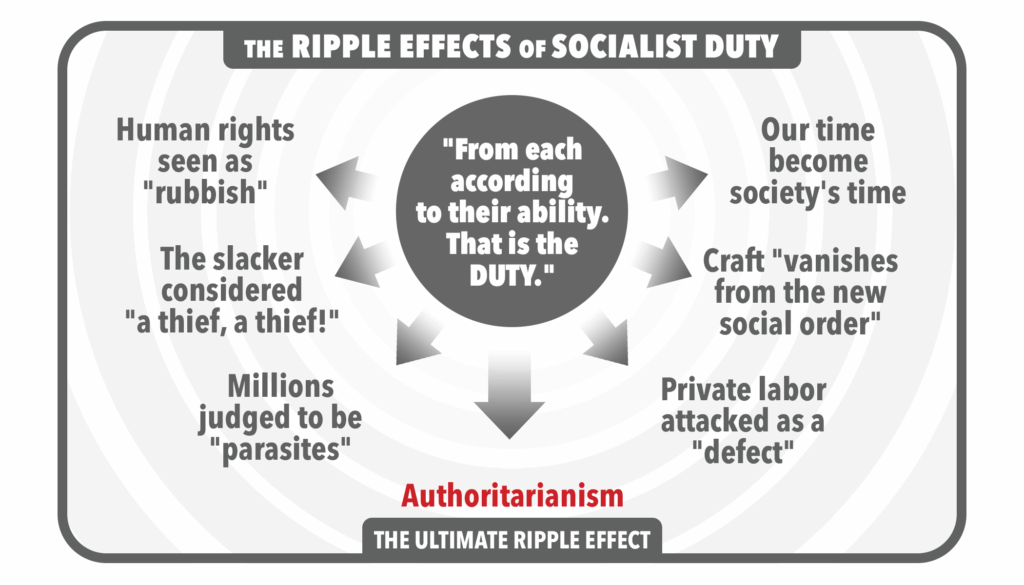
Compulsory duty of the type socialism demands leads inexorably to authoritarianism. Authoritarianism is the ultimate ripple effect of socialist duty.
Thank you for reading "The Ripple Effects of Socialist Duty."